
Follow the Festivals

Meskel

Meskel

Addis Ababa, Ethiopia

2027-09-27 - 2027-09-28

The Story

Festival Overview

Before the branches are gathered, something less visible is expected to begin.

A disagreement is addressed. Relatives prepare to return home. Neighbors who have allowed a grievance to remain between them are asked to put it down.

Then the Demera is built.

Meskel is an Ethiopian Orthodox Tewahedo Christian feast commemorating the finding of the True Cross. It is celebrated across Ethiopia, while the country’s largest public ceremony takes place at Meskel Square in Addis Ababa.

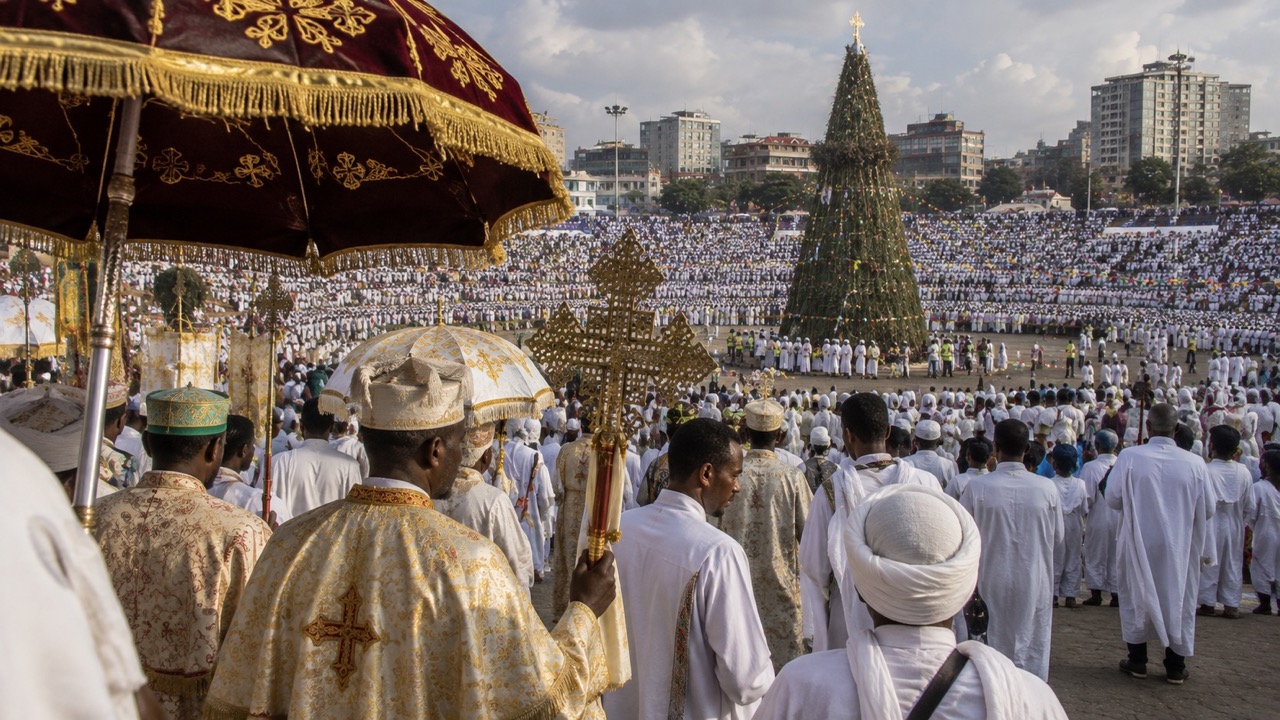
At the center stands the Demera, a tall conical bonfire assembled from wooden poles and branches, covered with grass and decorated with yellow Meskel daisies. Clergy in ceremonial vestments process around it. Choirs chant and move in measured rhythms. Worshippers dressed in white gather across the square until the unlit structure becomes the center of an entire city’s attention.

The Patriarch of the Ethiopian Orthodox Tewahedo Church lights the bonfire. Flames climb through the branches, smoke rises above Addis Ababa and thousands of faces turn toward the same sacred image.

The fire is the most visible moment.

The reconciliation that made the gathering possible began elsewhere.

Why This Festival Is Special

Meskel places private repair before public celebration.

The expectation that personal quarrels and social disagreements should be resolved gives the bonfire a meaning that spectacle alone cannot supply. People are not asked merely to stand together in the square. They are asked to address what might prevent them from doing so honestly.

The yellow flowers surrounding the Demera deepen that renewal. Meskel daisies appear after the rains and around the beginning of the Ethiopian year, placing the feast within a season when the landscape itself is changing.

Addis Ababa gathers those symbols at an immense scale. Separate parishes arrive with their own clergy, choirs and worshippers. Distinct processions enter one square without losing the communities from which they came.

The fire does not erase those differences.

It gives them one center.

By the time the Demera is lit, reconciliation has moved from conversations in homes and neighborhoods into a public image visible across the capital.

Festival Experience

What to Expect

Meskel unfolds across an evening and the feast day that follows.

The great Demera ceremony in Addis Ababa takes place on the eve of the principal religious observance. Worshippers, parish groups, clergy, choirs and other participants gather at Meskel Square through the afternoon.

Processions, prayer, chanting and ceremonial movement build gradually around the bonfire. The structure may be visible long before it is lit, but visitors should not mistake the waiting for inactivity. The square is being transformed from an urban public space into a place of worship.

The lighting occurs near the culmination of the ceremony. The crowd’s attention narrows, flames rise and the smoke becomes part of a tradition connected with the discovery of the True Cross.

The following day belongs more fully to church services, family gatherings and meals. Visitors who witness only the bonfire will see the public center of Meskel without experiencing the quieter relationships through which the feast continues.

Meskel Square becomes extremely crowded. Security controls, designated entrances, restricted zones and road closures shape access. Arrive early and remain in the viewing area assigned to the public.

This is a religious observance conducted in public.

Visibility does not turn it into a performance staged for visitors.

Festival Highlights

  • – The gathering of parish communities changes Meskel Square before the central ceremony begins. White cotton garments, ceremonial robes, crosses and banners move into position as separate groups bring their own voices toward one sacred center.
  • – The unlit Demera deserves attention. Wooden poles, branches, green grass and yellow flowers have been shaped into a structure whose meaning depends upon what will happen later. Arriving early allows visitors to see preparation before flame conceals it.
  • – The clergy’s chanting and rhythmic movement create the ceremony’s spiritual architecture. Listen through a complete sequence rather than waiting only for the fire. Repetition carries prayer across a space too large for ordinary speech.
  • – The Meskel daisies connect the square with Ethiopia’s season of renewal. Their yellow color appears around the end of the rains and the beginning of the Ethiopian year, surrounding the bonfire with something grown rather than constructed.
  • – The lighting of the Demera brings the square into collective stillness and sound at once. Flames rise, prayer continues and smoke moves above the crowd. Remain within the public area and allow the ritual to unfold without pursuing a closer photograph.
  • – Local bonfires reveal another scale of Meskel. Churches and communities across Addis Ababa build their own Demera, allowing the observance to belong to neighborhoods rather than one monumental ceremony alone. Attend only where public access is clear.
  • – The feast day returns attention to worship, family and food. Churches receive congregations, homes receive relatives and the celebration becomes less visible to an outsider precisely as it becomes more personal.

Getting There & Around

Where It Happens

Meskel is celebrated across Ethiopia through churches, communities and local Demera ceremonies.

The largest gathering takes place at Meskel Square in central Addis Ababa. The immense public space bears the festival’s name and functions at other times as a transport corridor, exercise ground and location for major civic events.

During Meskel, traffic gives way to procession. The square’s broad terraces and open center accommodate clergy, choirs, worshippers, officials and spectators around the central bonfire.

Access is controlled. Ceremonial areas belong to clergy and organized participants, while members of the public enter through designated approaches and remain within assigned sections.

Churches throughout Addis Ababa hold their own services and community observances. These are not overflow attractions from the central event. They are places of worship with their own congregations and boundaries.

A local ceremony may offer greater intimacy, but only when visitors are clearly welcome.

Meskel Square gives the feast national visibility.

The churches give it continuity.

Getting Around

Road closures around Meskel Square begin before the principal ceremony and can affect a much wider area than the square itself.

Walking is generally the most reliable way to complete the final approach. Choose shoes suited to long periods standing, uneven pavement and the possibility of rain.

Taxis and app-based rides should drop passengers beyond the controlled zone. Arrange the return pickup well away from the departing crowd, where a driver can approach without crossing closed roads.

Public transportation may be diverted, crowded or temporarily interrupted near the ceremony. Verify current operations rather than relying on an ordinary weekday route.

The elevation and sloping streets make short walks more demanding than the map suggests. Move slowly, drink water and do not allow the crowd’s pace to determine the body’s effort.

Agree upon a meeting location with companions outside Meskel Square. Mobile networks can become strained, and people separated by controlled areas may be unable to cross toward each other.

Leave gradually after the bonfire. Thousands of people moving at once can make the nearest exit slower than a route chosen with patience.

Visitor Guide

Festival Food & Drink

Meskel returns people to the same table.

Injera spreads beneath stews, vegetables, lentils and meat, allowing several people to eat from one shared surface. Individual dishes remain distinct, but the meal asks every hand to approach the same center.

That form suits a feast associated with reconciliation. Hospitality is not demonstrated through abundance alone. It appears in the invitation to sit close, share what has been prepared and continue a relationship beyond the public ceremony.

Doro wat often carries the weight of celebration. Chicken and eggs cook slowly in a sauce deepened by onions, berbere and spiced butter. The time required to prepare it makes the dish part of the household’s work before guests arrive.

Vegetarian and fasting dishes reveal an equally important part of Ethiopian food culture. Lentils, split peas, greens, potatoes, cabbage and chickpeas can fill an injera platter with color, texture and spice without functioning as secondary food.

Coffee slows the conclusion of the meal. Beans may be roasted, ground and brewed while conversation continues around the ceremony. The cup belongs to a longer act of receiving someone.

#### Must Try

– **Injera** — A fermented flatbread, traditionally made with teff, that serves as both the foundation and shared surface of the meal.

– **Doro wat** — Chicken and boiled eggs cooked in a deeply seasoned sauce made with berbere, onions and spiced butter.

– **Shiro** — A smooth stew prepared from ground chickpeas or broad beans and seasoned with aromatics and spices.

– **Misir wat** — Red lentils cooked with berbere into a rich, warming stew. **Tibs** — Pieces of meat sautéed with onion, peppers, herbs and spices, sometimes served sizzling.

– **Kitfo** — Finely minced beef seasoned with mitmita and spiced butter, served raw or cooked according to preference. **Beyaynetu** — A selection of vegetable, pulse and stew preparations arranged together on injera. **Ethiopian coffee** — Beans roasted, ground and brewed through a social ritual that gives the drink time to gather people around it.

The bonfire asks an entire square to face one center.

The meal brings that shape home.

Budget & Costs

The public Demera ceremony at Meskel Square is generally free to witness from authorized areas.

Accommodation creates the largest festival expense, particularly around central Addis Ababa. Proximity may increase price without guaranteeing easy access through security zones and road closures.

Local transportation, meals and ordinary city expenses can remain moderate, but festival congestion may increase travel time and vehicle demand.

A knowledgeable Ethiopian guide can help visitors understand the liturgy, access boundaries and wider history of Meskel. Choose someone who treats the feast as a living religious practice rather than a photography opportunity.

Church visits and local celebrations should not be approached through informal payments promising privileged access. Donations belong within the practices established by the church or community.

A complete experience does not require premium positioning.

The most valuable preparation is knowing what the square has gathered to do.

Tips for First-Time Visitors

Learn the distinction between Meskel and Demera. Meskel is the feast commemorating the finding of the True Cross; Demera refers to the bonfire ceremony held on its eve.

Arrive early enough to experience the gathering rather than only the ignition. Procession, chant, flowers and the unlit structure carry much of the meaning.

Dress for a religious observance. Shoulders and knees should be covered, while layers help with Addis Ababa’s changing afternoon and evening temperatures.

Ask permission before taking close photographs. Avoid turning prayer, emotional reunions or individual worshippers into anonymous festival imagery.

Do not step into clergy processions or organized parish formations. A temporary opening in the crowd is not an invitation to occupy ceremonial space.

Remain behind barriers and follow instructions when the Demera is lit. Do not approach the fire, collect material or enter the central area unless officials explicitly permit it.

Attend the following day with restraint. Church services should be approached as worship rather than a continuation of public entertainment.

Meskel does not conceal its sacred center.

Visitors still have to know where to stand.

Safety

Crowd density, fire, altitude and controlled access are the principal festival-specific considerations.

Arrive in Addis Ababa early enough to understand how the elevation affects breathing and walking. Rest, hydrate and seek medical assistance if symptoms become severe or worsen rather than improving.

Remain behind official barriers around the Demera. Wind can carry heat, smoke and sparks beyond the visible edge of the fire.

Identify exits before the ceremony reaches its greatest crowd. Leave when movement remains orderly rather than waiting until every surrounding section empties at once.

Carry minimal belongings and keep valuables secured against the body. Security checks may restrict bags and other items.

Afternoon rain and cooler evening temperatures are possible around the end of Ethiopia’s rainy season. Bring a modest waterproof layer that can be packed compactly without obstructing others.

Follow current government guidance, local authorities and church officials. Meskel Square is both a sacred gathering place and one of Addis Ababa’s most important civic spaces.

Do not pursue a better view through a restricted area.

A sacred fire should never require unsafe proximity.

Cultural Significance

Meskel commemorates the Christian tradition that Saint Helena—known in Ethiopia as Queen Eleni—discovered the True Cross in the fourth century.

Within the tradition, smoke helped reveal where the Cross had been buried. The Demera carries that relationship among prayer, smoke, direction and discovery into the present.

The feast holds a particularly important place within the Ethiopian Orthodox Tewahedo Church. Its chants, processions, ceremonial clothing, crosses and bonfires are sustained by religious communities rather than assembled as historical reenactment.

Meskel also carries social meaning. Family members return home, communities prepare together and personal disagreements are expected to be resolved before the celebration.

That expectation makes reconciliation part of safeguarding the tradition. The festival survives not only because people remember how to construct the bonfire or perform the chants, but because they continue practicing the relationships the feast asks them to renew.

UNESCO inscribed the commemoration feast of the finding of the True Cross on the Representative List of the Intangible Cultural Heritage of Humanity in 2013.

The recognition belongs to a living practice.

Its authority remains with the communities who continue it.

Plan Your Journey

When to Go

Meskel is celebrated in late September according to the Ethiopian calendar.

The great Demera ceremony takes place on the eve of the feast, while worship and family observances continue the following day. Confirm the official schedule because entry times, road closures and ceremonial arrangements can change.

Arrive in Addis Ababa at least two days beforehand. The city stands at an elevation above 2,300 metres, and travelers arriving from much lower altitudes may need time before long walks and crowded standing areas feel comfortable.

The days before Meskel reveal preparation. Yellow flowers appear in markets and along streets. Churches and parish communities organize their participation. The structure in Meskel Square begins acquiring the shape that will hold everyone’s attention.

Remain through the feast day if possible. The public fire is not the ending. Church attendance, homecoming and meals allow the celebration to return to smaller circles.

The strongest visit sees both scales.

Where to Stay

Kazanchis offers a central base near Meskel Square, several major hotels and parts of the city’s diplomatic and institutional district. The apparent proximity can be useful, but road closures may still lengthen the final walk.

Kirkos includes areas surrounding the square and provides the closest accommodation options. Expect noise, security controls and difficult vehicle access during the ceremony.

Bole offers the broadest range of hotels, restaurants and convenient access to Addis Ababa Bole International Airport. It sits farther from Meskel Square, but the relative distance can provide quieter recovery after the gathering.

Piazza and Arada place visitors within an older part of Addis Ababa, with markets, churches and historical character. Traffic toward the central ceremony requires additional time.

Choose a hotel after asking how guests enter during Meskel road closures. A property near the square may become inaccessible by vehicle hours before the ceremony begins.

Reliable transport, clear pedestrian access and staff familiar with the festival matter more than an unobstructed view from the room.

Meskel belongs in the square.

The hotel should provide somewhere to recover from it.

Bottom Line & Key Days

Bottom Line

The Demera is built where an entire city can watch it burn.

Branches are gathered. Yellow flowers cover the structure. Parish communities enter Meskel Square carrying crosses, chants and the work of preparation completed elsewhere.

When the fire is lit, smoke rises above thousands of people standing together.

By morning, the great flame is gone.

Families continue toward churches and homes. Injera is spread across tables. Stews arrive around its edges, and several hands reach toward the same center.

Two people who had stopped speaking sit down beside one another.

Key Days

Preparation begins before the public ceremony as churches organize participants, families arrange homecomings and communities gather the branches, grass and flowers used for local bonfires.

Demera day brings parish processions, clergy, choirs and worshippers into Meskel Square. The unlit structure remains central through the afternoon before prayer and ceremony culminate in the lighting.

The evening belongs to flame, smoke, chanting and the gradual departure of the crowd. Local bonfires may continue the observance within neighborhoods and church communities.

The feast day turns toward church services, blessings, family gatherings and shared meals. It is quieter from a visitor’s perspective but closer to the relationships Meskel renews.

The days afterward return Meskel Square to traffic and ordinary civic life.

Churches and families carry the feast beyond what the public can continue seeing.

Ready to Experience Meskel?

You've explored what makes this festival special. Now it's time to plan your trip. Compare flights, book your hotel, arrange transportation, and take care of your travel essentials—all in one place.

✈ Find Flights

Loading booking widget...

Booking is completed on Expedia in a new tab.

🏨 Find Hotels

Search places to stay

Powered by Booking.com

Booking is completed on Booking.com in a new tab.

Rail & Bus Travel

Compare train and coach routes for the journey.

Compare Routes

Things to Do

Discover tours and attractions before or after the festival.

Explore Experiences

eSIM Mobile Data

Stay connected abroad without traditional roaming charges.

Get an Airalo eSIM

Travel bookings are provided by our trusted partners. We may earn a commission when you book through these links, at no additional cost to you.

Extend Your Trip

Continue your journey with festivals in the same destination, country, or region.

More Festivals in Ethiopia

Independent Editorial Standards

Every Follow the Festivals guide is independently researched and regularly reviewed using official festival information, destination resources, and trusted travel references. We also welcome verified updates from festival organizers, destination marketing organizations, tourism partners, and local experts to help keep our guides accurate, current, and useful for travelers.

Represent this festival or have a verified update to share? We'd love to hear from you through our contact page.