
Follow the Festivals

Onbashira Festival

Onbashira Festival

Suwa, Japan

2028-04-01 - 2028-05-14

The Story

Festival Overview

Before the pillar stands beside the shrine, it lies across a mountain road.

Its branches have been removed. Fresh wood shows where the bark has opened. Long ropes extend from the trunk, passing into groups of people whose combined strength will be required to move it through forest, down slopes, across inhabited ground and eventually toward one of the four shrine complexes of Suwa Taisha.

Onbashira is Suwa Taisha’s great periodic festival of renewal. During the festival, sixteen immense fir trees are brought from the mountains and raised as sacred pillars at the four corners of the shrine’s four principal sites: Kamisha Honmiya and Kamisha Maemiya south of Lake Suwa, and Shimosha Harumiya and Shimosha Akimiya to the north.

The journey unfolds in two major phases. During Yamadashi, the pillars leave the mountain. Communities haul them over difficult terrain, with particular routes including the famous Kiotoshi descents and a river crossing. During Satobiki, the pillars move through towns toward their assigned shrines, accompanied by processions and ceremonies before being raised upright in the Tate Onbashira.

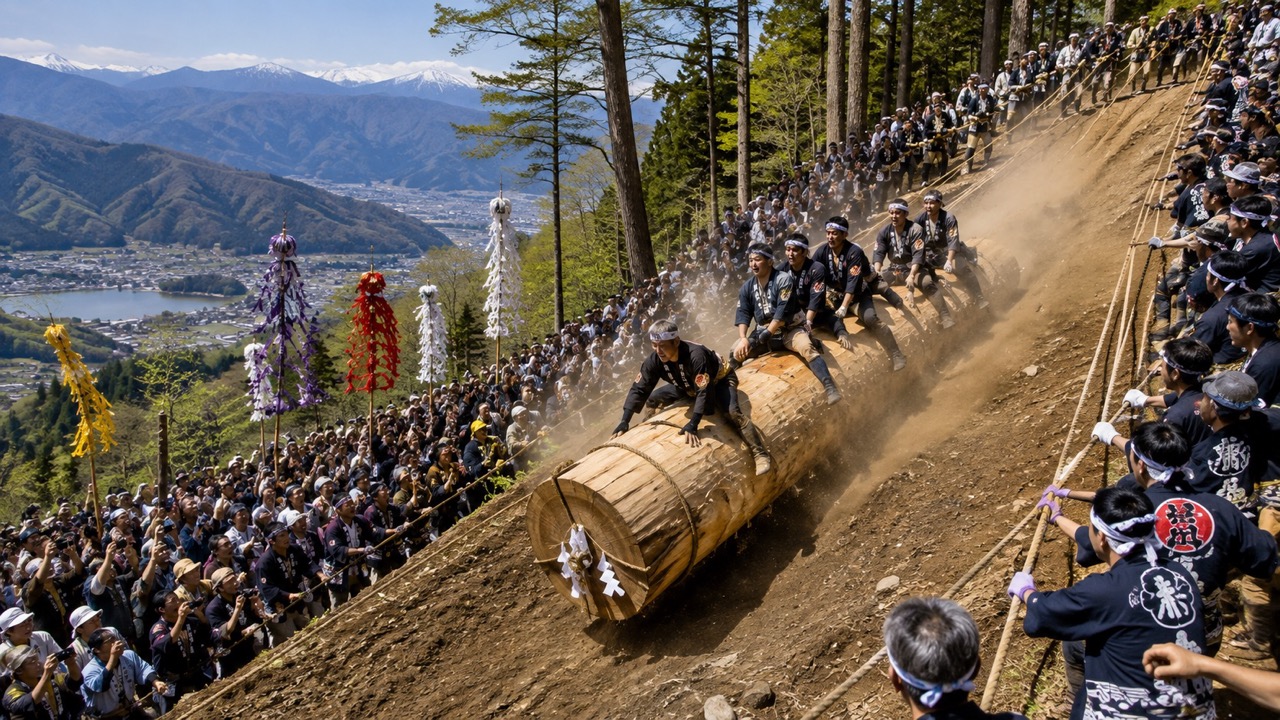
Images of participants riding enormous trunks down steep slopes have given Onbashira an international reputation for danger. Those descents are real, physically demanding and potentially deadly. They are also only one part of a much larger sacred responsibility.

The pillar must travel farther than the slope.

Ropes must remain coordinated. Communities must know which tree belongs to which shrine and which position it will occupy. The landscape must be crossed without losing sight of the ritual purpose waiting at the end.

A tree leaves the mountain horizontally.

An entire region brings it home upright.

Why This Festival Is Special

Onbashira makes renewal physically visible.

At many shrines, periodic rebuilding or ritual replacement occurs behind controlled boundaries. In Suwa, the materials themselves must cross the region in public. The journey from forest to sacred precinct becomes inseparable from the act of renewal.

The sixteen pillars are not interchangeable timber. Each is assigned to a shrine and a specific position. Their movement distributes obligation across communities connected to Suwa Taisha. Knowledge of terrain, ropes, sequence and ceremony must survive from one festival cycle to the next, even though several years pass between them.

The interval changes the people performing the work. Children who watched the previous festival may now be old enough to join their community. Younger adults accept greater responsibility. Experienced participants carry memories of the last journey while knowing that snow, erosion, roads, safety measures and local circumstances may not be identical.

The mountain also changes.

The forest is not a warehouse holding permanent replacements. Trees grow across timescales longer than any participant’s life. Selecting, preparing and moving them connects one brief human generation with a landscape that has been producing sacred material for centuries.

The dramatic passages reveal force. The full festival reveals succession.

No one person can pull the pillar to the shrine, and no one generation can preserve the knowledge alone.

Festival Experience

What to Expect

Onbashira does not occur within one enclosure or over one continuous festival weekend.

The four Suwa Taisha sites are divided between the Upper Shrine group, Kamisha, and the Lower Shrine group, Shimosha. Each group conducts its own Yamadashi and Satobiki phases, using different routes and gathering different communities around the pillars assigned to its shrines.

This creates several distinct visitor experiences.

Yamadashi is dominated by landscape and physical movement. The pillars are hauled from the mountain along established routes. Progress can be slow until terrain suddenly changes what is required. A descent compresses preparation into a few intense moments. A river crossing replaces friction and dust with cold water, unstable footing and coordinated pulling from the banks.

Satobiki brings the pillars into inhabited Suwa. Processions, music, costumes and neighborhood participation become more visible as the logs travel toward the shrine complexes. The final raising transforms the orientation of the entire festival. A pillar that has spent its journey moving lengthwise across the land is gradually pulled vertical.

Spectators do not experience every pillar equally. Routes extend across multiple municipalities, and the Upper and Lower shrine events are separated by geography and schedule. Road restrictions, controlled viewing zones and large crowds make it impossible to follow the complete journey of all sixteen pillars.

Nor is that necessary.

Choose one shrine group and one phase for sustained attention. Watch how the rope teams organize before the log moves. Notice who gives instructions, who maintains space and how the crowd responds when movement begins. The festival becomes more powerful when the pillar is understood as a responsibility rather than an approaching spectacle.

Festival Highlights

  • *The mountain departure**
  • The pillars begin moving away from the forests that produced them. The scale becomes clear only when people gather along the trunk and long ropes extend down the route. Human movement appears small beside the timber until coordinated pulling begins.
  • *Kiyari and coordinated hauling**
  • Traditional calls and songs help gather effort into a shared rhythm. The sound is not decoration added to manual labor. It prepares people to act together and allows instruction, anticipation and collective force to occupy the same moment.
  • *Kiotoshi**
  • At designated slopes, pillars descend steep terrain with selected participants positioned on or around them according to local practice. The passage is fast, dangerous and heavily controlled. Its meaning lies partly in the long preparation before release and the work required to regain control afterward.
  • *Kawagoshi**
  • In the Upper Shrine Yamadashi, pillars cross the river along the established route. Participants enter cold spring water while teams guide the timber from shore. The mountain journey has reached the basin, but the shrine remains ahead.
  • *The Satobiki processions**
  • As the pillars enter towns, Onbashira acquires a broader ceremonial texture. Musicians, performers, mounted participants, banners and community groups accompany the movement. The region is no longer waiting for the mountain to arrive. It is receiving it.
  • *The approach to the shrines**
  • Each destination presents different terrain and spatial challenges. A pillar must be aligned with the shrine precinct, then prepared for the most consequential change in its journey.
  • *Tate Onbashira**
  • Ropes are arranged and tension gathers as the pillar is raised from the ground. Participants coordinate from several positions while the timber slowly leaves the horizontal world of roads and hauling. When it stands, the collective movement of the festival becomes a fixed sacred presence.
  • *The four shrine complexes**
  • Kamisha Honmiya, Kamisha Maemiya, Shimosha Harumiya and Shimosha Akimiya each receive four pillars. Visiting the complete Suwa Taisha complex reveals that Onbashira renews a sacred geography distributed around the lake rather than a single shrine compound.

Getting There & Around

Where It Happens

Onbashira belongs to the entire Suwa basin.

Lake Suwa occupies the center, with mountains rising around it and the four Suwa Taisha sites distributed to the north and south. The festival draws material from the high forest, human effort from surrounding municipalities and sacred purpose from a shrine complex older than the modern divisions among the towns.

Kamisha Honmiya and Maemiya form the Upper Shrine group south of the lake. Their pillars follow routes connected to communities in the southern and eastern basin. Maemiya’s setting retains an open relationship with the surrounding landscape, while Honmiya presents a denser and more architecturally complex sacred precinct.

Shimosha Harumiya and Akimiya form the Lower Shrine group in Shimosuwa. Their relationship with the old post town and historic routes gives Satobiki a distinct atmosphere. Harumiya sits toward the quieter western side of town, while Akimiya occupies a more prominent position within the settlement.

Yamadashi routes begin beyond these shrines. Forest roads, slopes, staging areas and river crossings become temporary ritual geography. Many locations are difficult to reach without local transport arrangements, and some areas offer limited or controlled spectator access.

Satobiki draws the pillars closer to stations, town streets and shrine approaches, but greater accessibility also brings larger crowds.

The four complexes should not be collapsed into “Suwa Taisha” as though they share one entrance. Each receives its own pillars. Each community follows a particular route. Each standing onbashira completes one part of a regional renewal.

The lake does not separate these places.

It holds them within the same landscape.

Getting Around

The JR Chūō Line provides the principal rail connection through the Suwa basin, serving Chino, Kamisuwa, Shimosuwa and Okaya.

These stations create useful bases, but they do not place every Yamadashi or Satobiki location within easy walking distance. Mountain routes may require official shuttles, reserved transportation or long approaches on foot. Festival traffic restrictions can make private vehicles inconvenient even when parking appears available on an ordinary map.

Plan according to shrine group.

Chino and the southern basin are generally more useful for Kamisha events. Shimosuwa provides the clearest access to Shimosha shrine areas. Kamisuwa offers the strongest overall accommodation and rail infrastructure but may require additional movement to reach either group’s specific route.

Official transport plans are essential. A route used during the previous festival cycle may not operate identically several years later. Roads, crowd controls and environmental conditions can change during the long interval.

Walking is unavoidable. Wear footwear suitable for dirt, gravel, mud, shrine approaches and town pavement. A viewing location described as close to a station may still require standing for hours after arrival.

Do not attempt to follow a moving pillar by walking beside its ropes. Working participants require the full route, and spectators can create dangerous compression where terrain narrows.

After major events, board trains from the station most compatible with official crowd routing rather than forcing a return to the original arrival point. Services may be crowded and less frequent than metropolitan visitors expect.

Onbashira crosses a region.

Its transport cannot be planned as though it occupies a festival ground.

Visitor Guide

Festival Food & Drink

Suwa eats from the basin and the mountains surrounding it.

Buckwheat grows in Nagano’s cooler climate, and Shinshu soba belongs naturally to a festival day. The noodles arrive without unnecessary weight, served cold with dipping sauce or warm in broth when spring air remains sharp. Their simplicity leaves nowhere for poor preparation to hide.

Mountain vegetables enter the season through shoots, leaves and bitter greens. Tempura softens some of their bitterness without removing the taste of spring. Local miso brings depth to soups, grilled dishes and everyday meals, carrying the patient work of fermentation into a region preparing for periodic renewal.

Lake Suwa has its own food traditions. Eel became closely associated with Okaya and the lake area, while freshwater fish appear in preserved, simmered or grilled preparations. These flavors belong to a basin where water, settlement and mountain runoff meet.

Kamisuwa’s sake breweries use the region’s water and cold winters to produce distinctive local styles. A small tasting can reveal another form of Suwa craftsmanship, but alcohol should wait until the day’s viewing and transport are complete. Mountain roads, crowds and uneven surfaces require clear judgment.

During the festival, community food stalls and temporary vendors may appear near towns and viewing areas. Their presence varies by phase and location. Carry a substantial breakfast and portable food rather than assuming an isolated route will provide continuous meals.

Return to town after the pillar has stopped moving. Soba, miso and sake allow the body to slow before the onsen completes the transition.

**Must Try**

• **Shinshu soba:** Nagano buckwheat noodles served cold with dipping sauce or warm in a light broth.

• **Sansai tempura:** Mountain vegetables and spring shoots fried in a delicate batter.

• **Shinshu miso:** Nagano’s deeply flavored fermented soybean paste, used in soups, sauces and grilled preparations.

• **Unagi:** Eel grilled and glazed with sauce, particularly associated with Okaya and the Lake Suwa area.

• **Koi no umani:** Carp simmered slowly in a sweet soy-based sauce until richly flavored.

• **Oyaki:** Wheat- or buckwheat-based dumplings filled with vegetables, mushrooms, miso or sweet bean paste.

• **Sanzokuyaki:** Garlic-marinated chicken coated and fried, a substantial regional dish suited to the end of a long day.

• **Suwa sake:** Local rice wine brewed with the basin’s water and Nagano’s cold-season fermentation traditions.

The festival depends upon accumulated strength.

Suwa’s food restores it without pretending the work was light.

Budget & Costs

Public viewing may be free in many areas, but Onbashira requires a larger planning budget than a festival concentrated in one city center.

Accommodation is limited relative to demand and should be reserved early. Kamisuwa’s onsen hotels can be expensive, while business hotels and smaller lodgings in Chino, Shimosuwa and Okaya may provide more moderate options. Minimum stays or special festival arrangements may apply.

Transport costs depend heavily on the selected phase. Rail reaches the basin efficiently, but official shuttles, local buses or other organized transfers may be required for remote routes. Avoid building a plan around repeated taxis; availability can collapse during major events.

Food remains affordable in town, but isolated viewing locations require advance supplies. Carry cash for temporary vendors, shrine offerings and transport situations where contactless payment may not be available.

Reserved viewing or organized packages may provide access certainty, interpretation and transportation. Confirm exactly what is included and whether the arrangement follows current official spectator guidance.

The festival’s long interval makes an extended stay worthwhile. One additional day allows visits to the four shrines, Lake Suwa, the onsen towns and the standing pillars outside the pressure of the main event.

Spend for understanding, not proximity to danger.

Tips for First-Time Visitors

Choose Kamisha or Shimosha, then choose Yamadashi or Satobiki. Those decisions should be made before selecting accommodation.

Study the four Suwa Taisha sites in advance. Visit at least one shrine before the pillar journey and look for the existing onbashira standing near the precinct. The destination will make the labor easier to understand.

Use only designated spectator areas. Do not step into hauling routes, approach working ropes or follow participants into controlled terrain. A pillar can move unexpectedly once tension changes, and ropes under load create dangers far beyond the trunk itself.

Treat Kiotoshi as one passage within Yamadashi. Arrive for the preparation, remain after the descent and watch how the community reorganizes around the pillar. The seconds of greatest speed explain less than the hour surrounding them.

Do not imitate local participation. Riding, hauling, directing ropes and entering river sections belong to authorized community groups operating within inherited structures of responsibility. Enthusiasm does not grant a visitor a role.

Bring water, food, sun protection, rain protection and warm layers. Spring conditions can change quickly, while mountain viewing areas may offer little shelter or retail access.

Keep both hands available on uneven ground. Large tripods, umbrellas and unsecured camera bags become hazards in a moving crowd. Use a lens that does not require crossing boundaries.

Learn the sound of instructions and observe how local spectators respond. Even without understanding every word, coordinated movement away from a route or rope should be followed immediately.

Reserve time for Tate Onbashira. The festival is not fulfilled when the log reaches the bottom of a hill. It is fulfilled when the pillar stands.

Safety

Onbashira involves severe and unavoidable physical hazards.

Massive timber moves across slopes, roads, rivers and shrine grounds under tension from long ropes and large groups of people. Injuries and fatalities have occurred. Visitors must never enter participant areas, touch working ropes or disregard barriers.

A rope under load can snap, shift or sweep across ground far from the pillar. Do not stand inside loops, cross between teams or assume that distance from the trunk guarantees safety.

Kiotoshi viewing areas require strict compliance with official boundaries. The descent can accelerate quickly, and participants or debris may move beyond the line imagined by an inexperienced spectator. Never seek a closer position after staff have established the safe limit.

River crossings introduce cold water, unstable footing and restricted banks. Spectators should remain only in designated areas and avoid slopes made slippery by mud or crowd movement.

During Tate Onbashira, the danger extends in several directions. The pillar, support ropes and teams all require protected space. Follow evacuation instructions immediately if alignment changes or officials clear an area.

Mountain weather can produce cold, sun exposure, rain and dehydration within the same day. Carry appropriate clothing, water, medication and food. Mobile service may be strained or inconsistent along remote routes.

Crowd pressure creates separate risks. Arrive before the route becomes compressed, identify a retreat path and avoid stopping where roads narrow.

Local participants accept responsibility through structures developed across generations.

A visitor’s responsibility is simpler: stay where observation is permitted.

Cultural Significance

Suwa Taisha is one of Japan’s oldest shrine traditions and the center of a distinctive regional religious culture.

Onbashira forms part of a larger periodic renewal historically associated with repairing or rebuilding shrine structures and replacing the great pillars. Earlier records describe an obligation large enough to affect the economic and social life of the entire region. Resources had to be preserved so the rites could be completed.

The onbashira stand at the four corners of each principal shrine site. Their precise religious meanings have accumulated several interpretations, but their presence clearly marks a relationship among sacred space, forest and community. They are neither ordinary structural supports nor monuments installed for visual effect.

Bringing them from the mountain requires cooperation across the six municipalities of the Suwa region. Communities inherit particular responsibilities, songs, routes and forms of participation. The years between festivals make transmission unusually important. Knowledge cannot be refreshed through annual repetition.

Onbashira is sometimes described through courage, especially the willingness of participants to accompany pillars through dangerous passages. Courage is visible, but it is not sufficient. The festival depends on judgment, coordination, obedience to shared decisions and acceptance of responsibility for others.

The pillar eventually stands because thousands of individual actions were prevented from becoming individual performances.

Suwa does not renew its shrines by conquering the mountain.

It renews them by carrying the mountain into relationship with the community.

Plan Your Journey

When to Go

Onbashira is held in spring as part of a recurring cycle traditionally associated with the zodiac years of the Tiger and Monkey.

In ordinary elapsed-time language, the festival occurs every six years. It is also commonly described in Japan as taking place once every seven years because the traditional count includes both the starting year and the festival year. Both descriptions refer to the same cycle.

The complete festival extends across separate Yamadashi and Satobiki periods for the Upper and Lower shrine groups. Travelers must determine exactly which phase they intend to witness before reserving accommodation. A listing that says only “Onbashira Festival” does not provide enough information to plan the visit.

Yamadashi generally offers the strongest relationship with mountain terrain, hauling and the famous descents. Satobiki provides greater access to town processions, shrine approaches and the final raising of the pillars. The latter may be more meaningful for first-time visitors because it reveals what the entire journey is intended to accomplish.

Spring conditions in Nagano are variable. Exposed areas can move between strong sun, cold air, wind, rain and mud. Snow may remain visible on surrounding heights even when lower streets feel warm.

Arrive before the selected festival phase and visit all four Suwa Taisha sites if time allows. Seeing the existing pillars already standing at the shrines gives the coming journey a destination.

This is not a festival to encounter accidentally. Accommodation, transport and viewing information require substantial advance planning.

Where to Stay

Kamisuwa is the most practical general base.

The town sits beside Lake Suwa, has the region’s strongest concentration of accommodation and is connected by limited express rail with Tokyo. Onsen hotels, restaurants and several sake breweries make it a comfortable place to recover after long periods outdoors. Kamisha Honmiya and Maemiya lie south of the lake, though reaching specific festival locations may still require arranged transport and substantial walking.

Shimosuwa is the more intimate base for the Lower Shrine events. Harumiya and Akimiya are connected through a historic townscape influenced by the old Nakasendō and Kōshū routes. Hot springs remain part of local life, and walking between the shrines makes the northern half of Suwa Taisha easier to understand.

Chino provides useful access to the Upper Shrine area and the mountain landscape east and south of the basin. It is a strong choice for travelers prioritizing Kamisha Yamadashi or Satobiki, provided the exact route and transport plan are confirmed.

Okaya lies at the western end of Lake Suwa and may provide additional accommodation when central options fill. Its relationship with the lake, industry and local food culture broadens the experience beyond the most visited shrine districts.

Do not select a hotel simply because it is labeled “near Lake Suwa.” The lake is large enough to divide the festival into significantly different journeys. A room near Kamisuwa Station does not place the traveler within walking distance of every pillar route.

Festival transport may begin early, while road closures can separate accommodations from viewing areas. Confirm whether the chosen lodging provides special access information, shuttles or early meals.

An onsen is more than an attractive amenity during Onbashira.

After a day spent standing on mountain roads, the water returns movement to the body.

Bottom Line & Key Days

Bottom Line

When the pillar first leaves the forest, almost everything about it suggests movement.

Ropes extend down the road. Feet search for purchase in mud and gravel. Calls pass through the teams before effort gathers along the trunk. At the descents, gravity becomes another participant. At the river, the pillar enters cold water. In town, music, banners and entire communities surround its final approach.

The journey appears to be about keeping an immense object moving.

Then the ropes change direction.

Near the shrine, the pillar begins to rise. Its lower end settles toward the earth while the trunk passes slowly through the angle that has defined its entire journey. People pull from positions the spectator cannot fully see. Instructions travel through the crowd. The mountain becomes vertical.

Eventually, the ropes loosen.

The pillar stands at the corner of the sacred precinct, exposed to wind, rain, snow and the passing years. Children who watched it arrive will grow beside it. Some will inherit responsibility when the next trees leave the forest.

The danger will produce the famous photographs.

The stillness reveals why Suwa accepted the journey.

An entire region moved the mountain.

Now it knows where it belongs.

Key Days

**Tree selection and preparation**

Before the public journeys, suitable firs are identified and prepared for their roles as onbashira. These processes establish that the festival begins with decisions in the forest, not with the dramatic descent.

**Kamisha Yamadashi**

The Upper Shrine pillars leave the mountain and travel across their established route. Hauling, Kiotoshi and Kawagoshi reveal the changing demands of slope, road and river.

**Shimosha Yamadashi**

The Lower Shrine pillars follow a separate mountain journey toward Shimosuwa. Its routes and descents belong to different communities and should be planned as a distinct festival experience.

**Kamisha Satobiki**

The Upper Shrine pillars move through the southern Suwa communities toward Maemiya and Honmiya. Processions and ceremonies accompany the final transport and raising.

**Shimosha Satobiki**

The Lower Shrine pillars enter Shimosuwa and continue toward Harumiya and Akimiya. The old post town and shrine approaches create a closer relationship between regional history and the final journey.

**Tate Onbashira**

At each shrine, the assigned pillars are raised into their positions. This is the completion toward which every earlier movement has been directed.

**Closing rites**

Once the pillars have reached their places, shrine ceremonies complete the renewal. Public attention may have followed the most dangerous passages, but sacred completion belongs to the shrines.

Ready to Experience Onbashira Festival?

You've explored what makes this festival special. Now it's time to plan your trip. Compare flights, book your hotel, arrange transportation, and take care of your travel essentials—all in one place.

✈ Find Flights

Loading booking widget...

Booking is completed on Expedia in a new tab.

🏨 Find Hotels

Search places to stay

Powered by Booking.com

Booking is completed on Booking.com in a new tab.

Rail & Bus Travel

Compare train and coach routes for the journey.

Compare Routes

Things to Do

Discover tours and attractions before or after the festival.

Explore Experiences

eSIM Mobile Data

Stay connected abroad without traditional roaming charges.

Get an Airalo eSIM

Travel bookings are provided by our trusted partners. We may earn a commission when you book through these links, at no additional cost to you.

Independent Editorial Standards

Every Follow the Festivals guide is independently researched and regularly reviewed using official festival information, destination resources, and trusted travel references. We also welcome verified updates from festival organizers, destination marketing organizations, tourism partners, and local experts to help keep our guides accurate, current, and useful for travelers.

Represent this festival or have a verified update to share? We'd love to hear from you through our contact page.