
Follow the Festivals

Santarcangelo Festival

Santarcangelo Festival

Santarcangelo di Romagna, Italy

2027-07-02 - 2027-07-11

The Story

Festival Overview

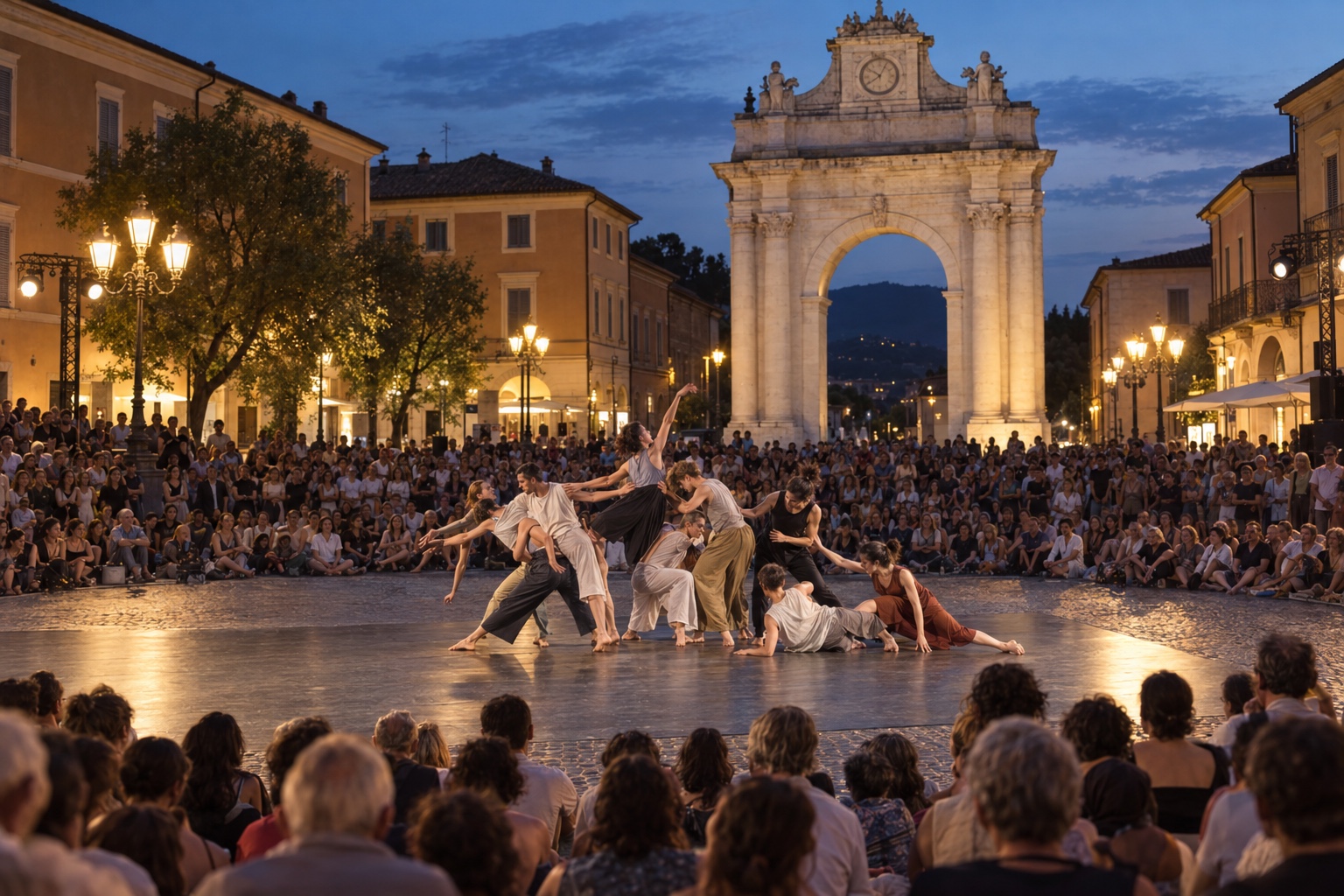
A queue forms beside a stone wall, performers cross a square that residents still need to use, and a familiar lane becomes a stage without losing its life as a lane. Santarcangelo Festival grew from theater in the piazza, and the town remains active material. Contemporary theater, dance, performance, sound, participatory work, and late gatherings spread through a compact Romagna hill town whose scale keeps artists and audiences in repeated contact.

The setting produces unusual intimacy. Medieval streets, caves, civic buildings, courtyards, and open squares alter acoustics and attention, while cafés and temporary meeting points allow debate to continue between works. International artists arrive, but the festival’s authority depends equally on its relationship with residents and on projects developed specifically for local spaces.

Do not treat the program as a list of conventional plays. Some works require walking, standing, consent, conversation, or tolerance for ambiguity. Choose fewer pieces, learn each access condition, and preserve an unprogrammed hour in the center. The town often supplies the transition that makes one performance answer another. The Adriatic hinterland remains present even when the work is radically contemporary. Romagna speech, summer sociability, civic pride, agricultural food, and proximity to Rimini shape the audience gathering in the hill town. Artists enter that existing culture rather than an empty laboratory, and the most persuasive projects acknowledge the encounter.

Why This Festival Is Special

Santarcangelo differs from a conventional theater festival because the town is not a container for productions; it is one of their working materials. Public squares, courtyards, caves, civic rooms, and everyday paths alter what artists can ask of an audience. The compact scale also allows ideas to travel between performances, informal debate, and repeated encounters with the same artists.

Its history provides the second distinction. Few European festivals have sustained experimental theater, dance, and performance for so long while continuing to examine their relationship with local citizens. Choose Santarcangelo when site, participation, political inquiry, and temporary collective life matter as much as polished production. Visitors wanting a predictable sequence of seated proscenium shows will find easier programs elsewhere.

Because artists and residents repeatedly share a small town, accountability remains visible. A project cannot disappear into an anonymous cultural district; it must negotiate streets, businesses, civic institutions, and audiences who will still inhabit the place after the temporary structures leave.

The result is a festival where artistic risk can be measured against accumulated institutional memory and a real civic relationship. New work does not arrive without precedent; it enters a decades-long argument about what theater in public can ask and return.

Festival Experience

What to Expect

Daylight favors installations, talks, and works whose relationship with architecture needs to be seen clearly. Walk the route in advance, identify shade and water, and arrive early when a project uses a small room or moving audience.

Evening expands into theater, dance, public-space performance, and encounters that blur spectator and participant. Read the invitation carefully: participation should be informed, never assumed, and residents must still move through shared streets.

Late programs bring a social, musical, and political afterlife to the day. Eat before the final sequence and leave one work undisturbed by immediate judgment. A festival founded on experimentation rewards disagreement, but the critique should name a choice made by the artist rather than dismiss unfamiliar form as confusion.

Town life continues during every artistic intervention. Bakers open, residents cross squares, children play, and crews rebuild rooms. Notice how a work acknowledges or ignores that coexistence; the answer often explains whether site-specificity is structural or merely picturesque.

Between performances, watch how audiences exchange information. A recommendation in a café queue, disagreement after a square piece, or technician explaining an unusual entrance can redirect the evening. These informal networks are part of the festival’s rhythm, but popularity should not substitute for reading a work’s actual premise.

Festival Highlights

  • Watching contemporary performance reshape a functioning public square
  • Entering courtyards, caves, and civic spaces rarely experienced as theaters
  • Comparing international experimentation with projects rooted in the local community
  • Joining talks and informal debates that extend beyond the scheduled work
  • Experiencing the hill town as the connective tissue between theater, dance, sound, and social life

Getting There & Around

Where It Happens

The historic center and surrounding public spaces, with theaters, courtyards, squares, parks, temporary rooms, and unexpected sites used by contemporary artists turn the hill town into a temporary performance system. Public-space work shares routes with residents; doorways, private steps, technical zones, and gathering points must remain clear.

The festival’s map should be read as a social plan. A courtyard may have one accessible entrance, a cave may impose physical limits, and a square may remain a route for residents. Arrive early enough to learn those conditions without pressuring front-of-house staff.

The caves, upper streets, and lower public squares reveal different histories of use. Pair one enclosed project with one open-air work so architecture can be compared through temperature, sound, visibility, and audience behavior. A pause at the town’s edge also shows how sharply the temporary festival population changes everyday scale.

Getting Around

The center is primarily a walking festival, with walking within town and regional rail or bus connections through the Rimini area handling arrival and departure. Cobblestones and hills make footwear a production decision, not a style detail.

Walking is part of the dramaturgy because each lane changes scale and expectation. Keep the route between chosen works short enough to notice those transitions, and do not let navigation software direct the group through private steps or closed technical passages.

Visitor Guide

Festival Food & Drink

Romagna cooking fits a festival built around streets and late performance. Piadina romagnola is portable without becoming anonymous fast food; Cappelletti and Passatelli reward a seated trattoria meal before the evening sequence.

Reserve before the busiest night, drink water through summer heat, and learn which fillings or broths are local. Ciambella romagnola offers a modest finish that leaves attention intact.

Piadina is useful between venues, but Romagna deserves more than portable eating. Cappelletti or passatelli at a table provides contact with family cooking and gives the body enough recovery for a long, standing performance later.

Piadina fillings should reflect appetite and timing. Squacquerone cheese and greens make a lighter pause, while cured meats provide more weight before a long night. Eat it fresh from the griddle and leave space for a proper pasta meal on another day.

Must Try

• Piadina romagnola — Griddled flatbread folded around cheese, greens, or cured meat.
• Cappelletti — Filled pasta associated with Romagna family cooking.
• Passatelli — Breadcrumb-and-cheese pasta often served in broth.
• Ciambella romagnola — Firm regional cake for dipping in coffee or wine.

Budget & Costs

Accommodation in the small town can tighten early. Protect funds for complete performances, a regional meal, and the safe late connection; local businesses carry more value than generic festival products.

Site-specific work and small capacities make advance tickets worth prioritizing. Keep funds for a local meal and independent cultural publication, then spend with cafés and shops that absorb the temporary population without turning every town interaction into festival consumption.

Tips for First-Time Visitors

Read participation terms before arrival. Wear quiet, stable shoes, carry water, and accept that a work can challenge the audience without granting permission to ignore personal or resident boundaries.

Some projects disclose content warnings or participation demands only through detailed program notes. Read them, discuss personal limits before entry, and remember that declining interaction is legitimate. Consent cannot be inferred from the purchase of a ticket.

Unfamiliar performance can produce uncertainty without requiring instant interpretation. Stay present, identify the formal choice causing the reaction, and discuss it after leaving the active site. Do not demand emotional disclosure from performers or residents. Curiosity becomes useful when it respects the difference between public art, personal boundaries, and the town’s continuing social life.

The program’s density can make every unconventional space appear automatically meaningful. Test that assumption. Ask what the chosen site contributes to sound, movement, history, or public encounter, and whether the work changes when imagined inside a normal theater. This distinction helps a newcomer recognize rigorous site-based creation without praising architecture that the performance has not actually engaged.

Safety

Summer heat, steep lanes, standing performances, late programs, sudden storms, and limited access around site-specific work can turn a short route into a physical test. Follow staff during storms, preserve consent in participatory work, and leave any overcrowded or unsafe room without waiting for artistic closure.

Historic sites differ in ventilation, lighting, exits, and accessibility. Identify the physical demands of each work, carry necessary medication, and tell a companion when attending alone. Artistic intensity never overrides emergency instructions or the right to leave.

Cultural Significance

Founded in 1971 as an international festival of theater in the square, Santarcangelo emerged from the political and cultural energy surrounding the late 1960s and from a belief that performance should return to collective life. It became Italy’s longest-running festival devoted to contemporary stage practices.

Successive artistic directions have expanded its languages while retaining the tension between international research and local public space. Artists, technicians, residents, volunteers, cultural workers, businesses, and municipal institutions repeatedly rebuild a temporary community in which performance is also a question about coexistence.

The town-festival relationship also contains productive tension. International attention brings resources and pressure, experimental work can challenge local expectations, and temporary audiences alter daily space. The festival’s longevity comes not from eliminating those conflicts but from repeatedly making them part of artistic and civic discussion.

The festival’s artistic directions have changed across generations, preventing longevity from becoming a fixed house style. That succession allows different curators and artists to reopen questions about public space, political responsibility, experimentation, care, pleasure, and who is entitled to address the town.

Plan Your Journey

When to Go

The town is most legible during the summer festival period, when warm evenings turn squares, theaters, courtyards, parks, and temporary spaces into a continuous performance landscape. Begin in daylight to understand the spaces, pause through the hottest interval, and return after the streets cool for work designed around public darkness.

Plan around summer heat, steep lanes, standing performances, late programs, sudden storms, and limited access around site-specific work. The day should contract when concentration or footing declines; an unhurried meal protects the final performance better than another rushed booking.

Santarcangelo’s program often depends on sunset, civic activity, and the availability of unusual spaces. Use daytime for orientation and discourse, then treat the evening as two substantial artistic commitments separated by a meal rather than a chain of tight entrances.

Where to Stay

Sleep within the hill town or near a reliable regional-bus connection, favoring a walkable return after late performances. Late work and summer streets make a walkable return valuable, but confirm stairs, access, air-conditioning, and the last regional connection before committing.

A room inside the center protects the late walk but may involve stairs, festival noise, and restricted vehicle access. Lodging beyond town needs a documented final bus, taxi, or driver; vague promises are not enough after an outdoor work ends past midnight.

Bottom Line & Key Days

Bottom Line

Allow Santarcangelo di Romagna to interrupt the timetable. The festival suits audiences willing to walk, stand, question participation, and let contemporary performance remain unresolved for a while. Two carefully chosen works and the route between them can reveal more than a packed day. Listen to residents as well as artists, keep shared streets passable, and recognize the labor behind each temporary room. The closing image is often modest: a square returns to ordinary use while a gesture, sound, or argument from the performance remains attached to its stones. The town keeps carrying that trace after visitors leave. When the temporary audience disperses, the town keeps the argument. That continuity makes Santarcangelo more than a beautiful backdrop for experimental work.

Key Days

Town Reading

Walk the principal spaces in daylight and begin with work tied closely to architecture.

Performance Night

Choose two substantial works, eat between them, and respect every participation boundary.

Collective Afterlife

Use a talk, gathering, or final public-space piece to test how the festival has changed the town.

Ready to Experience Santarcangelo Festival?

You've explored what makes this festival special. Now it's time to plan your trip. Compare flights, book your hotel, arrange transportation, and take care of your travel essentials—all in one place.

✈ Find Flights

Loading booking widget...

Booking is completed on Expedia in a new tab.

🏨 Find Hotels

Search places to stay

Powered by Booking.com

Booking is completed on Booking.com in a new tab.

Rail & Bus Travel

Compare train and coach routes for the journey.

Compare Routes

Things to Do

Discover tours and attractions before or after the festival.

Explore Experiences

eSIM Mobile Data

Stay connected abroad without traditional roaming charges.

Get an Airalo eSIM

Travel bookings are provided by our trusted partners. We may earn a commission when you book through these links, at no additional cost to you.

Independent Editorial Standards

Every Follow the Festivals guide is independently researched and regularly reviewed using official festival information, destination resources, and trusted travel references. We also welcome verified updates from festival organizers, destination marketing organizations, tourism partners, and local experts to help keep our guides accurate, current, and useful for travelers.

Represent this festival or have a verified update to share? We'd love to hear from you through our contact page.