
Follow the Festivals

Santa Fe International Folk Art Market

Santa Fe International Folk Art Market

Santa Fe, United States

2027-07-08 - 2027-07-11

The Story

Festival Overview

A woven basket rests between two people who may never meet anywhere else.

One has travelled to Santa Fe carrying knowledge learned through family, community and years of repetition. The other has entered the Railyard expecting to admire beautiful objects. Between them lies the basket: shaped by local materials, particular hands and decisions made far from New Mexico.

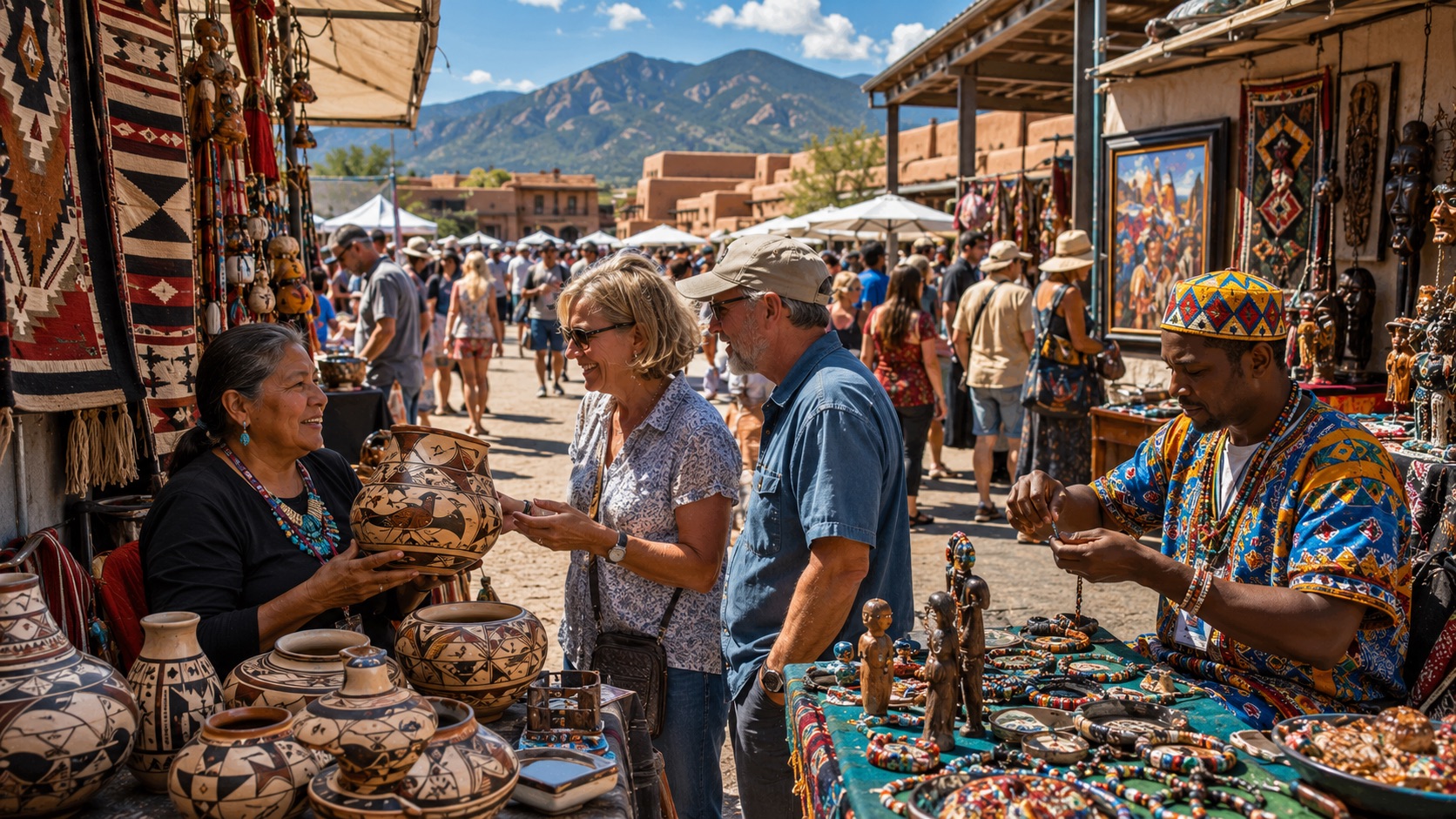
The Santa Fe International Folk Art Market is a juried annual gathering that brings artists, cooperatives and community-based enterprises from countries around the world to sell handmade work directly within an international marketplace. Textiles, ceramics, jewelry, baskets, woodcarving, beadwork, metalwork and other living traditions fill the tents, accompanied by artist demonstrations, music, dance and conversation.

At first, the scale is exhilarating. Color gathers beneath every canopy. Embroidery changes from one booth to the next. Clay carries different soils, fires and inherited forms. A material that seemed familiar reveals an entirely different use several steps later.

Then the market begins asking the visitor to look more carefully.

The objects did not simply arrive from different countries. They emerged from specific communities, working relationships and systems of knowledge. Some were made by the artist standing nearby. Others represent the combined labor of cooperatives or groups whose members could not all travel to Santa Fe. Each purchase carries consequences beyond the market tent.

In a world that routinely separates handmade objects from the people who create them, Santa Fe temporarily closes the distance.

Why This Festival Is Special

Global commerce usually makes the maker disappear.

A label may identify a country. A retailer may describe an object as traditional. By the time it reaches a buyer, the relationships behind it have often been compressed into a material, a pattern and a price.

Santa Fe reverses that process.

Here, a piece can regain its geography. The person or organization presenting it can explain what the design carries, how the technique has changed and why the work matters within its place of origin. Translation may be required. Some booths represent many makers rather than one. The encounter may be brief. Even so, the object no longer appears from nowhere.

Tradition is not treated as an instruction to remain unchanged.

Artists inherit techniques, but they also choose colors, alter forms, respond to new materials and create for lives being lived now. A basket can belong to a lineage without repeating its predecessors. Embroidery can preserve a visual language while speaking about migration, environmental pressure or contemporary identity. Continuity survives because skilled people keep making decisions inside it.

The Railyard holds these traditions beside one another without asking them to merge. Similar materials reveal radically different histories. Nearby booths may share no common aesthetic, language or cultural purpose.

Their proximity does not make them the same.

It allows each difference to become more visible.

Festival Experience

What to Expect

The first impression is abundance.

Rows of booths fill the Santa Fe Railyard with woven cloth, carved figures, painted surfaces, hammered metal and ornament assembled at scales ranging from intimate to architectural. Clothing hangs beside ceremonial forms. Functional vessels share space with pieces created for display. Traditional techniques appear in both inherited designs and unmistakably contemporary work.

Trying to absorb everything immediately makes the market smaller than it is.

Begin with one booth. Notice the material before reading the country name. Ask how it was gathered, shaped, dyed, fired or assembled. Listen for the number of people involved. A single textile may contain the work of growers, dyers, spinners, designers and weavers. A cooperative may use its earnings to support dozens of households. An individual artist may be adapting a community tradition through choices entirely their own.

The market also includes performances, demonstrations and public celebrations, but shopping remains central to its purpose. Objects are not decorative scenery surrounding a cultural festival. Their sale creates economic opportunity for the people and organizations responsible for making them.

Crowds are most concentrated around celebrated returning artists, visually dramatic booths and the opening periods of major market sessions. Timed admission, special evening programmes and entry arrangements can vary. Confirm the current structure before building the day around a particular session.

Once inside, resist the urge to complete a circuit as quickly as possible. The market reveals itself through conversations that delay every plan.

Festival Highlights

  • The artist booths form the heart of the market.
  • Approach them as individual encounters rather than one enormous exhibition. Look for variation within a single tradition. Ask what distinguishes one maker’s work from another. If a booth represents a cooperative, learn how responsibilities are divided and how sales return to its members.
  • Artist demonstrations make labor visible.
  • A finished surface can conceal months of preparation. Watching a tool move through wood, fibre tighten beneath the fingers or pigment settle into cloth restores time to the object. Techniques that appear effortless often reveal extraordinary control once performed nearby.
  • The community celebration and artist procession allow the gathering to introduce itself before commerce begins. Countries, regions and organizations enter the public space with music, dress and movement, but the strongest moments are often personal: artists recognizing one another, volunteers welcoming returning participants and first-time visitors discovering the human scale behind an international event.
  • Performance stages extend the market beyond physical objects. Music and dance carry forms of cultural knowledge that cannot be placed on a table or taken home in a bag. Give them full attention rather than treating them as background entertainment.
  • The final highlight may not be announced anywhere.
  • It occurs when an object that first attracted attention because of color or form becomes inseparable from the person, place and working tradition behind it.

Getting There & Around

Where It Happens

The market occupies Santa Fe Railyard Park, where rail lines, public gardens, performance spaces, galleries, restaurants and a farmers’ market have transformed a working transportation district into one of the city’s most active civic landscapes.

The setting matters.

Objects arrive after long journeys, yet they do not disappear into an isolated exhibition hall. They enter a neighborhood still defined by movement. Trains reach the depot. Cyclists follow the Rail Trail. Residents cross the park with groceries, dogs and children. Market tents temporarily join that existing circulation.

The Railyard also provides a different Santa Fe from the adobe intimacy of the Plaza. The space is broader, more contemporary and visibly connected to the city’s daily life. Its tracks remember the infrastructure that once carried goods and people across New Mexico. During the market, other forms of exchange occupy the same ground.

Museum Hill remains an important companion to the experience. The Museum of International Folk Art can provide historical context, while neighboring institutions require visitors to recognize that “folk art,” Native art and regional Hispanic traditions are not interchangeable categories.

Do not compress them into one cultural afternoon.

Each institution deserves the same attention the market asks visitors to give its artists: enough time to see distinctions.

Getting Around

The Railyard rewards a car-light visit.

Travelers staying nearby can walk to the entrance, while the Rail Trail offers a practical approach by bicycle or on foot from adjoining neighborhoods. Santa Fe Depot connects the district with regional rail service, making arrival from Albuquerque possible without driving into the market crowds.

Parking arrangements, street closures, shuttle routes and designated rideshare points may change with each market. Confirm them shortly before attending. When organizers provide a shuttle or combined rail-and-entry option, using it allows the day to begin with the city’s existing movement rather than a search for a parking space.

The Plaza and downtown are walkable from the Railyard for many visitors, but Santa Fe’s altitude and summer sun make distance feel longer than it appears on a map. Carry water and accept a slower pace.

Museum Hill requires separate transport for most travelers. Place it on another morning rather than forcing it between market sessions.

Large or fragile purchases alter the return journey. Use any available art-valet or holding service instead of carrying delicate work through the crowds. Before buying, ask how the piece can be packed, transported or shipped. International craftsmanship deserves a better plan than an improvised overhead-bin struggle.

Visitor Guide

Festival Food & Drink

Santa Fe receives the world without losing the taste of Northern New Mexico.

Inside the market, food vendors may reflect both local traditions and the international reach of the gathering. Eat there when a performance, conversation or discovery has made leaving feel impossible. But do not attempt to turn lunch into a culinary collection of countries. The artists have arrived with distinct cultures, not portions of a single global buffet.

Beyond the tents, chile returns the day to its setting.

Red chile carries depth and earthiness. Green chile brings heat, brightness and the character of a particular growing season. Asking “red or green?” is not merely a decision about sauce. It places the visitor inside one of New Mexico’s most familiar conversations.

A morning plate of blue-corn pancakes or breakfast enchiladas provides substance before hours of walking. Posole restores energy without demanding ceremony. A stuffed sopaipilla can become a full meal; an unfilled one arrives warm and hollow, ready for honey. Biscochitos wait beside coffee when the afternoon begins to slow.

Meals should create space around the market rather than compete with it. Breakfast prepares the eye. Lunch offers shade and water. Dinner gives the day somewhere to settle while objects, stories and unanswered questions remain in conversation.

### Must Try

• **Red or green chile:** New Mexico’s defining choice, served over enchiladas, burritos, eggs and numerous other dishes. Ask for “Christmas” to try both.

• **Blue-corn enchiladas:** Earthy blue-corn tortillas layered or rolled with chile, cheese and fillings.

• **Posole:** Hominy simmered into a deeply comforting stew, often accompanied by chile and garnishes.

• **Sopaipillas:** Pillowy fried bread served with honey or filled for a more substantial meal.

• **Carne adovada:** Pork slowly cooked in a rich red-chile sauce until tender.

• **Calabacitas:** Squash, corn and chile cooked together in a dish rooted in the agricultural landscape of the region.

• **Biscochitos:** Crisp anise-scented cookies traditionally made with cinnamon sugar.

• **Paletas:** Fruit-based frozen treats particularly welcome during a hot market afternoon.

The work inside the tents may have crossed oceans.

Dinner reminds the traveler where the meeting occurred.

Budget & Costs

The cost of the trip depends less on admission than on what the visitor hopes to bring home.

Market tickets, special evening sessions and donor events occupy different price levels. Choose the session that matches the purpose of the visit rather than assuming the most exclusive entry will provide the most meaningful encounter.

Accommodation becomes a major expense during Santa Fe’s summer art season. Staying farther from the Railyard may reduce the room rate, but daily transport can erase the savings. Regional rail, shuttles and walkable lodging can keep movement more predictable.

Set a purchasing budget before entering, then leave part of it unassigned. The market is built for discoveries that cannot be anticipated from an artist directory.

Prices vary enormously. Small ornaments, jewelry and household objects may provide accessible starting points. Large textiles, intricate beadwork, sculpture and museum-quality pieces can represent months of labor and command substantial prices.

Do not calculate value by comparing an object with mass-produced retail goods. Ask how it was made, how long it required and how many people contributed.

Also budget for packing or professional shipping. Protecting the work is part of purchasing it responsibly.

Tips for First-Time Visitors

Study the participating artist and organization directory before arriving. Do not use it to create a rigid shopping list. Learn enough names, materials and regions to recognize what deserves a longer conversation when you encounter it.

Begin by looking.

The first booths establish how much variation the market contains. Purchasing immediately can be right when a unique piece produces certainty, but urgency should not replace attention. Ask what can be remade, what is singular and whether additional work is stored behind the display.

Speak to the person presenting the work. If that person represents a cooperative, ask who made the piece, how members contribute and how income is distributed. Do not assume every object was made by the person standing in the booth.

Avoid bargaining. The price contains materials, skilled labor, travel, organizational costs and the economic reality of bringing work into an international market. A lower price is not automatically a fairer exchange.

Ask before photographing people, demonstrations or individual works. Some artists welcome documentation; others may restrict it for personal, commercial or cultural reasons.

Wear a hat, supportive shoes and light layers. Santa Fe’s elevation intensifies sun exposure, while summer weather can turn quickly. Water belongs in the plan before thirst announces itself.

Bring measurements if purchasing textiles, baskets or decorative pieces for a particular space. Carry photographs of the room and know any material restrictions required for international travel.

Most importantly, allow a conversation to change the day. The booth that matters most may belong to a country, material or tradition that never appeared on the original list.

Safety

Santa Fe’s elevation is the first consideration.

Visitors arriving from lower elevations may experience headaches, fatigue, disrupted sleep or shortness of breath. Hydrate before the market, limit alcohol during the first day and allow the body time to adjust. Persistent or severe symptoms require medical attention.

High-desert sun can be intense even when the air feels comfortable. Wear a hat, use sunscreen and seek shade throughout the day. Refill water before the bottle is empty.

Summer weather may produce sudden wind, rain or lightning. Follow staff instructions if outdoor tents or performance areas must close. Lightweight layers and a compact rain shell are more useful than an umbrella inside crowded aisles.

Keep walkways clear and avoid placing bags where others can trip over them. Large purchases should be transferred to a holding service when available.

Crowds require ordinary awareness around wallets, phones and children, but the greater risk often comes from fatigue. Hours of visual concentration, heat and altitude can quietly reduce judgment. Sit down before exhaustion decides for you.

Fragile work introduces another responsibility. Handle objects only with permission, supervise children closely and ask the artist or representative how a piece should be lifted.

Respect is part of safety here.

Cultural boundaries protect people and traditions as surely as ropes protect objects.

Cultural Significance

“Folk art” is an imperfect container.

The term has been used to separate community-based traditions from fine art, to romanticize makers as untouched by modern life and to describe extraordinary bodies of knowledge without naming their individual authors. The market does not escape that history simply by assembling beautiful work.

Its importance lies in what it attempts to return.

Artists and participating organizations enter a juried international marketplace where their work can generate substantial income, reach new collectors and support broader networks of makers. Earnings may fund households, apprenticeships, community projects or the continued production of forms that cannot survive on admiration alone.

Economic viability does not freeze a tradition.

It gives artists choices.

A younger generation is more likely to learn a demanding technique when that knowledge can sustain a life. A cooperative can maintain local production when makers are paid for the true value of their work. Innovation becomes possible when artists have the resources and authority to decide what continuity should look like.

The market cannot resolve every inequality involved in global craft commerce. Travel, visas, shipping costs, representation and access remain uneven. Nor should one successful sales weekend become evidence that an entire community has been secured.

What the gathering can do is make those relationships harder to ignore.

A handmade object contains beauty.

It also contains labor, judgment and a person’s right to determine what that knowledge is worth.

Plan Your Journey

When to Go

The market belongs to Santa Fe’s summer art season, when long days, high-desert light and a citywide concentration of exhibitions bring collectors, artists and cultural travelers into town.

Arrive at least one day before the market session you most want to attend. Santa Fe sits at significant elevation, and even experienced travelers can feel the difference. A slower first afternoon allows the body to adjust before heat, crowds and sustained walking begin.

The public artist procession or community celebration, when included in the programme, offers an important beginning. Artists enter not as anonymous exhibitors waiting behind merchandise, but as participants carrying names, places and distinct practices into the Railyard. Seeing that arrival changes how the booths feel later.

Daytime sessions provide the clearest opportunity to study work and speak with artists or representatives. Earlier entry can mean cooler temperatures and greater availability, particularly when individual pieces cannot be replaced once sold.

An evening market changes the atmosphere. Music and performances become more prominent, the heat eases, and the Railyard grows more social. It can deepen the visit, but it should not replace unhurried time with the work itself.

Give the market more than one session if collecting is central to the trip. The first visit teaches the eye. The second often reveals what the first missed.

Where to Stay

The Railyard District provides the most natural base.

Staying nearby allows the day to begin on foot and makes it easier to leave purchases with an art-valet service or return to the hotel before an evening session. The Rail Trail, Santa Fe Depot, cafés, galleries and restaurants keep the neighborhood active beyond market hours.

Downtown and the Plaza place visitors within Santa Fe’s historic center. Adobe buildings, museums, galleries and long-established restaurants surround the stay, while the Railyard remains reachable by walking, local transport or a short ride. Choose this area if the market will share the trip with Santa Fe’s broader cultural life.

South Capitol offers a quieter residential position between the Railyard and several transport connections. It suits travelers who want access without remaining inside the most concentrated visitor districts.

Museum Hill is valuable to the cultural itinerary but less convenient as a current market base. Its museums can deepen an understanding of international folk art, Native arts and regional traditions, yet the Railyard should determine the accommodation plan when that is the confirmed market venue.

Reserve early. Santa Fe’s summer calendar places several major art events close together, and rooms within walking distance of the Railyard disappear quickly.

Bottom Line & Key Days

Bottom Line

Near the end of the market, the Railyard begins to empty.

A textile is folded around tissue. A carved figure disappears into a box shaped for its journey. Someone carries a basket toward the depot, holding it carefully above the crowd. The artists begin counting what remains.

The objects will scatter again.

They will enter homes far from the materials, languages and landscapes that produced them. Some will be displayed. Others will be worn, used or passed from one person to another. Their new owners may eventually forget the heat beneath the tents or the conversation that delayed them at a particular booth.

The work remembers.

Its fibres still carry the decisions of the weaver. Its surface retains the pressure of a tool. Its form belongs to knowledge that existed before the market opened and will continue only if people have reason to teach it.

Money begins travelling in the opposite direction—to an individual artist, a family, a workshop or a cooperative whose other members remained at home. What that exchange makes possible may never be visible from Santa Fe.

One object leaves in the visitor’s hands.

Its consequence travels farther.

Key Days

The market usually unfolds through several distinct phases rather than one continuous public session.

A community celebration or artist procession introduces participants to Santa Fe before the principal sales periods begin. Attend if possible. It allows artists to enter the story before their work enters the transaction.

Opening events may provide early access and a more formal atmosphere. These sessions often attract serious collectors and supporters prepared to purchase quickly.

The principal daytime markets offer the broadest encounter with artist booths, demonstrations, food and performances. Earlier hours are generally cooler; later hours allow conversations to lengthen after the initial rush.

A separate night market, when scheduled, brings music, movement and evening light into the Railyard. It offers a more social experience but may require its own ticket.

The final public session can feel quieter, although available work will have changed. Some booths may contain fewer pieces. Others become easier to approach. What has sold is part of the market’s purpose, not evidence that the visitor arrived too late.

Confirm the current sequence, admission rules and entry times before travelling.

Then allow the booths to rearrange the plan.

Ready to Experience Santa Fe International Folk Art Market?

You've explored what makes this festival special. Now it's time to plan your trip. Compare flights, book your hotel, arrange transportation, and take care of your travel essentials—all in one place.

✈ Find Flights

Loading booking widget...

Booking is completed on Expedia in a new tab.

🏨 Find Hotels

Search places to stay

Powered by Booking.com

Booking is completed on Booking.com in a new tab.

Rail & Bus Travel

Compare train and coach routes for the journey.

Compare Routes

Things to Do

Discover tours and attractions before or after the festival.

Explore Experiences

eSIM Mobile Data

Stay connected abroad without traditional roaming charges.

Get an Airalo eSIM

Travel bookings are provided by our trusted partners. We may earn a commission when you book through these links, at no additional cost to you.

Independent Editorial Standards

Every Follow the Festivals guide is independently researched and regularly reviewed using official festival information, destination resources, and trusted travel references. We also welcome verified updates from festival organizers, destination marketing organizations, tourism partners, and local experts to help keep our guides accurate, current, and useful for travelers.

Represent this festival or have a verified update to share? We'd love to hear from you through our contact page.

Photo Credits