
Follow the Festivals

World Music Festival Chicago

World Music Festival Chicago

Chicago, United States

2026-09-15 - 2026-09-18

The Story

Festival Overview

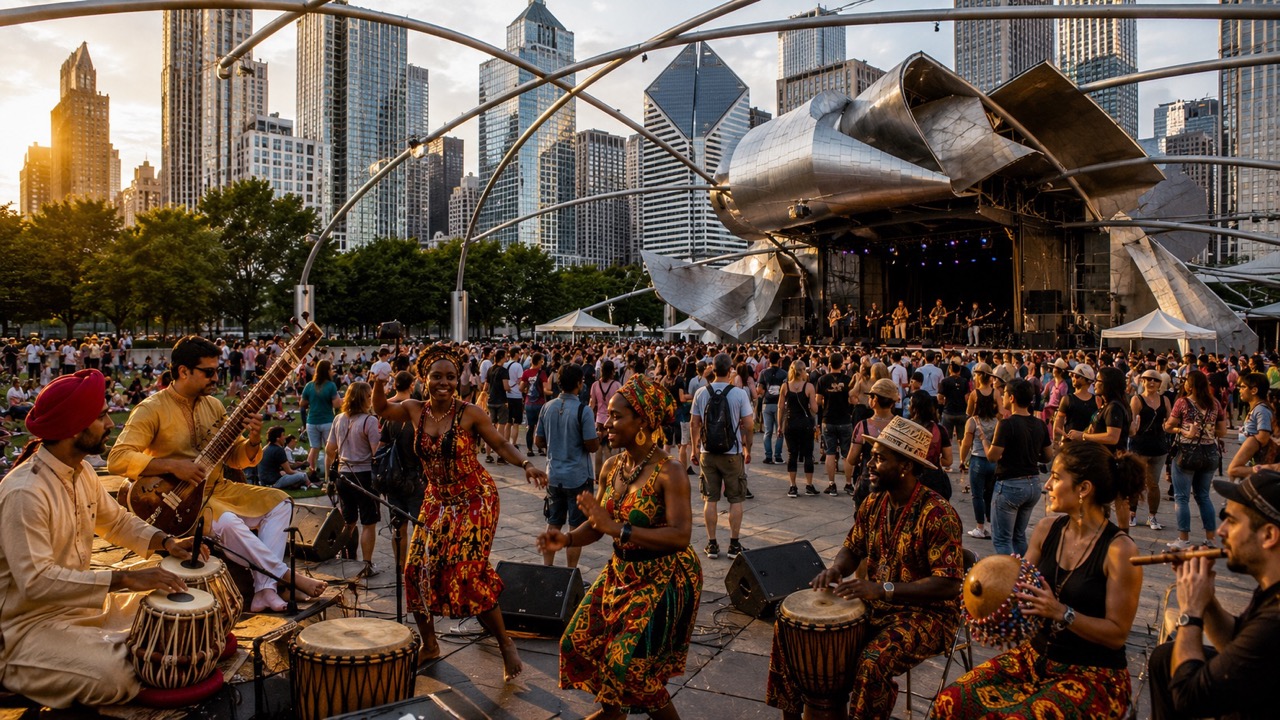
Chicago’s global character is audible long before any festival begins—in Mexican dance halls, South Asian classical concerts, Polish community events, West African churches, Balkan restaurants, and clubs shaped by successive migrations. World Music Festival Chicago draws those living scenes into a free, citywide program without confining them to a single park. Performers move through the Chicago Cultural Center, Millennium Park, neighborhood venues, and community spaces, placing traditional forms beside contemporary hybrids. The itinerary becomes an urban journey: a downtown concert may lead to a late club set or an afternoon in a neighborhood whose residents understand the music differently. Its distinction is access combined with range. Travelers do not purchase entry to an exoticized sampler; they encounter artists within a metropolis already transformed by global sound.

Why This Festival Is Special

This one works less like a standard music festival and more like a downtown listening circuit, where the shift from room to room is part of the experience. Hearing an international multi-genre lineup in the Chicago Cultural Center, then stepping back into the Loop and walking to Millennium Park or another nearby venue, changes the mood of the festival from set to set instead of locking everyone into one stage atmosphere. The free public concerts matter here too, because they pull casual passersby, office workers, and dedicated listeners into the same four-day flow, giving the event a distinctly Chicago rhythm of after-work crowds, quick walks, and sharply different sounds only a few blocks apart.

Festival Experience

What to Expect

On the opening days, the pace starts with people filtering into downtown venues for early concerts and then picking up toward late afternoon and evening as more sets overlap. Daytime can feel scattered across the Chicago Cultural Center, Millennium Park, and nearby halls, especially if Free public concerts are part of the schedule, while after-work crowds thicken the Loop before headline performances. Around the mid-festival peak, evenings are the busiest, with entry lines forming shortly before start times and a noticeable rush back onto sidewalks and CTA platforms after dark. In the closing stretch, afternoons stay easier for venue-hopping, then the final-night performances pull people back into the downtown core for one more concentrated run of music.

Festival Highlights

  • International music showcases across the Chicago Cultural Center and other Loop cultural venues.
  • Free public concerts that can spill into Millennium Park or downtown plazas.
  • Multi-venue downtown performances that let you catch one set, walk a few blocks, and hear something completely different next.
  • A cross-genre global music lineup that brings different languages, instruments, and crowd moods into the same four-day downtown run

Getting There & Around

Where It Happens

Across the Loop, the festival links the Chicago Cultural Center with Millennium Park and other nearby Loop cultural venues, so your night is shaped by downtown blocks rather than one enclosed site. A typical route might start inside the Cultural Center, cut a few minutes south or west through downtown plazas in the Loop, then continue toward a park performance or another hall before the crowd spills back toward CTA stations serving the Loop. Because these places sit close enough for short walks, the geography feels practical on the ground: indoor rooms, outdoor sets, and transit all stitched together in the same compact part of central Chicago.

Getting Around

Use the CTA and group performances by geography. Save venue addresses and last-train or bus options offline, since “Chicago” may mean a long transfer between neighborhoods. Downtown walking is easy, but lakefront weather changes quickly. Free programs with limited capacity require early arrival. After late sets, remain on active streets and use a licensed taxi or rideshare if transit intervals become impractical.

Visitor Guide

Festival Food & Drink

A citywide music festival should be eaten citywide. Pair performances with the communities around them: a South Asian program may lead toward Devon Avenue, Mexican music toward Pilsen or Little Village, and West African sounds toward restaurants on the North or South Side. Avoid claiming a single dish represents an entire region. Chicago classics can anchor travel days, but the festival’s deeper opportunity is to let music guide a meal with its own language, migration history, and service rhythm.

Must Try
• Jibarito — A Puerto Rican Chicago sandwich using crisp fried plantains instead of bread around meat and toppings.
• Polish pierogi — Dumplings filled with potato, cheese, cabbage, meat, or fruit and served boiled or fried.
• Mexican birria — Chile-rich braised meat served as a stew or in tacos with its cooking broth.
• Indian chaat — Layered street snacks combining crisp textures, potato, yogurt, chutneys, and spice.
• West African suya — Skewered grilled meat coated with a chile-peanut spice mixture and served with onion.

Budget & Costs

The strongest value comes if you lean into the festival’s free or low-cost downtown format and use CTA trains or buses into the Loop instead of driving. Food and drinks around the Chicago Cultural Center and Millennium Park can add up quickly over four days, especially if you stay out for evening sets, and downtown parking is the easiest way to overspend. Hotel prices in and around the Loop can be the biggest expense during a September stay, so many visitors save money by sleeping farther out on a CTA line and riding in for the concerts they care about most.

Tips for First-Time Visitors

Pick one anchor for each part of the day instead of trying to zigzag nonstop. Start by fixing your first indoor concert at the Chicago Cultural Center or another Loop venue, then leave enough room to add a second set nearby if timing works. If an evening performance is the one you care about most, get there early enough to avoid a last-minute line at the door. Keep an eye on the weather if outdoor programming lands in Millennium Park or a plaza, since September can swing between warm sun, wind off the lake, and sudden rain.

Safety

The main issues here are ordinary downtown concert-night hassles rather than anything unusual: entry lines near major performances, packed sidewalks and CTA stations after evening sets, and weather shifts if you are heading to outdoor programming. Keep your phone and wallet secure when venues empty at once, give yourself extra time before popular concerts, and do not count on easy street parking in the Loop. If rain or wind moves through, check for schedule changes before crossing downtown for an outdoor set.

Cultural Significance

The festival reflects Chicago’s identity as a city built through migration and neighborhood institutions. Free admission removes a financial barrier, while distributed venues allow global traditions to appear in civic landmarks and communities that sustain them. Programming traditional and contemporary artists together resists the idea that heritage music is fixed in the past. For residents, the event creates cross-neighborhood listening; for visiting musicians, it provides access to audiences with direct cultural knowledge as well as newcomers.

Plan Your Journey

When to Go

Study the venue pattern before choosing days. Opening programs often provide a broad introduction, while weekend neighborhood events support longer, family-friendly listening. Late club concerts reveal a different audience and energy from daytime cultural-center sets. Build around two contrasting performances per day and leave generous transit time. Early autumn can shift from warm afternoons to cool evenings, so carry a layer.

Where to Stay

The Loop is practical for the Cultural Center, Millennium Park, and multiple rail lines, while River North extends late dining. Neighborhood lodging can provide stronger local texture if it sits near an L line connecting several venues. Because the program is distributed, transit access matters more than closeness to one stage. Choose a base that makes a late return comfortable and allows a quiet morning after club performances.

Bottom Line & Key Days

Bottom Line

The strongest itinerary ends far from where it began: perhaps a noon raga beneath a Tiffany dome, an evening dance band in a park, and a late meal in a neighborhood reached by train. That movement is the point. World Music Festival Chicago deserves travel because it turns the city’s immigrant geography into a listening map, revealing a metropolis whose global identity is not branding but daily life carried in rhythm, language, and community memory.

Key Days

Orientation

Map the venues by transit line and choose contrasting programs rather than attempting every concert.

Downtown Opening

Begin at the Cultural Center or Millennium Park, where free civic space gives the festival its broad public welcome.

Neighborhood Day

Follow one performance into its surrounding community and allow time for a culturally specific meal.

Evening

Move to an intimate hall or club where amplification, dancing, and audience knowledge change the music’s effect.

Peak

Arrive early for limited-capacity artists and protect the transfer with a realistic CTA buffer.

Closing

Finish with a final neighborhood program and return by the safest active transit route.

Ready to Experience World Music Festival Chicago?

You've explored what makes this festival special. Now it's time to plan your trip. Compare flights, book your hotel, arrange transportation, and take care of your travel essentials—all in one place.

✈ Find Flights

Loading booking widget...

Booking is completed on Expedia in a new tab.

🏨 Find Hotels

Search places to stay

Powered by Booking.com

Booking is completed on Booking.com in a new tab.

Rail & Bus Travel

Compare train and coach routes for the journey.

Compare Routes

Things to Do

Discover tours and attractions before or after the festival.

Explore Experiences

eSIM Mobile Data

Stay connected abroad without traditional roaming charges.

Get an Airalo eSIM

Travel bookings are provided by our trusted partners. We may earn a commission when you book through these links, at no additional cost to you.

Extend Your Trip

Continue your journey with festivals in the same destination, country, or region.

Nearby Festivals

Independent Editorial Standards

Every Follow the Festivals guide is independently researched and regularly reviewed using official festival information, destination resources, and trusted travel references. We also welcome verified updates from festival organizers, destination marketing organizations, tourism partners, and local experts to help keep our guides accurate, current, and useful for travelers.

Represent this festival or have a verified update to share? We'd love to hear from you through our contact page.