
Follow the Festivals

Carnaval de Nice

Carnaval de Nice

Nice, France

2027-02-09 - 2027-02-28

The Story

Festival Overview

The face begins on paper.

An ymagier—the artist responsible for imagining the carnival’s visual world—draws a public figure with an enlarged forehead, an impossible expression or a body distorted until authority becomes ridiculous. A carnival builder studies the design and decides how it can rise above Place Masséna, move through the procession and survive the Mediterranean wind.

Elsewhere, florists wait.

Their work cannot begin too early. Carnations, roses, mimosa, gerberas and thousands of other fresh stems must still carry their color when the float reaches the crowd.

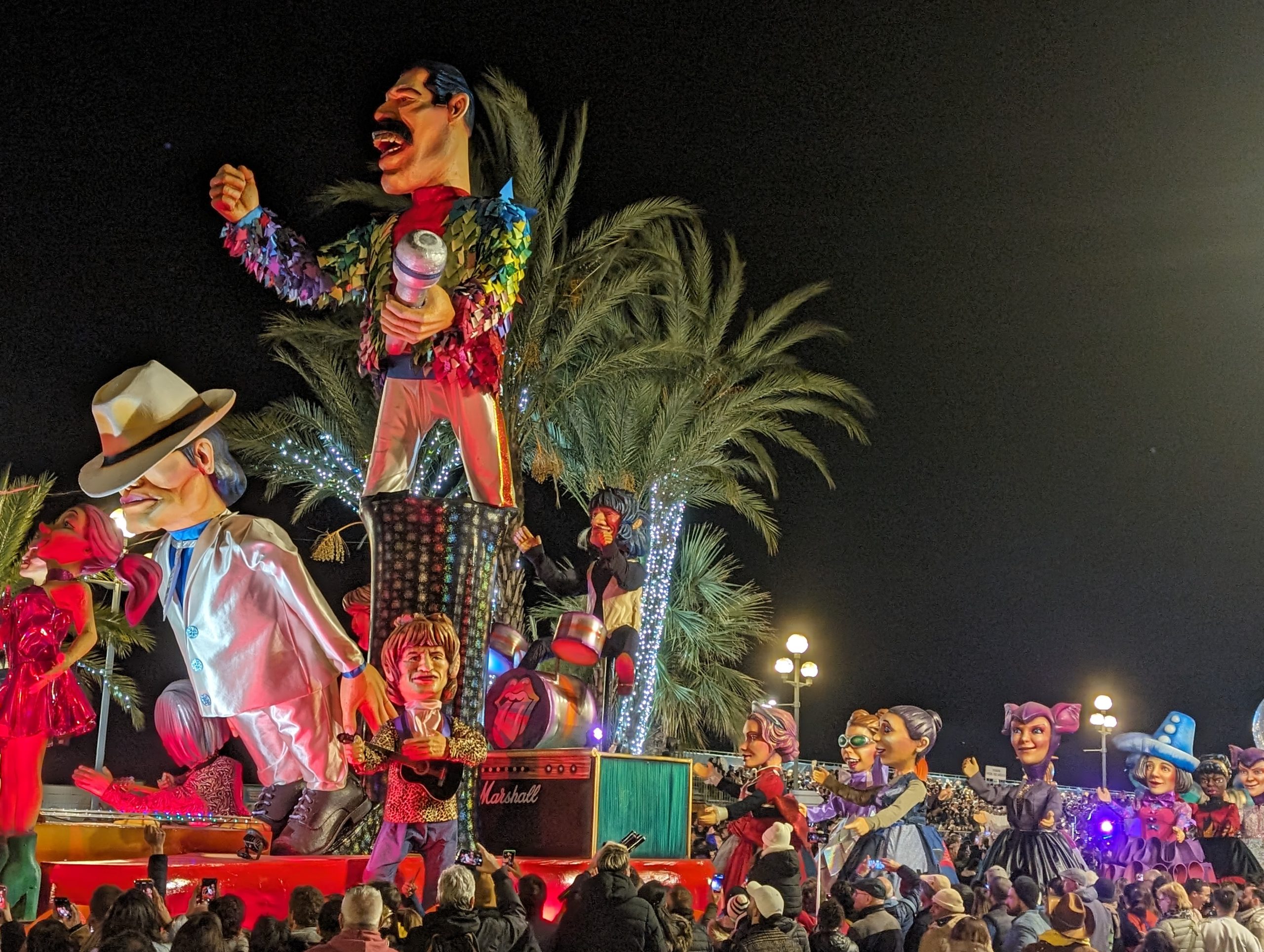
Carnaval de Nice is a multi-week winter carnival held across central Nice. Its principal events are the corsi carnavalesques, processions of monumental satirical floats, musicians and street performers, and the Batailles de Fleurs, floral parades in which elaborately dressed performers distribute flowers from decorated floats.

The carnival’s organized modern form dates to 1873, while the Battle of Flowers followed in 1876. Both grew within a city already known for mild winters, horticulture and visitors arriving from colder parts of Europe.

One procession enlarges the world until it can be mocked.

The other covers a float with flowers and gives them away.

Why This Festival Is Special

Nice spends months creating things that will exist publicly for only a short time.

Ymagiers draw the satire. Builders translate those drawings into enormous figures. Sculptors, painters, engineers, costume makers, florists and performers contribute work that reaches completion only when the procession begins moving.

Carnival gives that labor permission to be temporary.

The satirical figures do not need to become permanent monuments. Their value comes from addressing a particular year while the subjects remain recognizable enough to be mocked.

The flower floats accept another limit. Fresh stems must be placed by hand close to the procession because time has already begun changing them. Their eventual distribution does not damage the work’s meaning.

It completes it.

Nice creates abundance, allows the crowd to approach and then lets the entire carnival disappear.

Festival Experience

What to Expect

Carnaval de Nice is not one continuous street celebration.

The principal corsi and Battles of Flowers are scheduled, controlled and generally ticketed events. Each has its own date, entrance, seating arrangement and atmosphere.

The carnival corso carries the largest satirical figures. A theme changes the subjects from one year to another, while ymagiers and carnival builders transform politics, culture, mythology and public life into monumental moving scenes. Illuminated corsi add projection, artificial light and greater contrast after dark.

The Battle of Flowers is more elegant in appearance but no less carefully constructed. Floats are covered with fresh flowers, unique garments are created for their ambassadors and armfuls of blooms are passed into the crowd as the procession advances.

Reserved grandstands provide assigned seating and clearer elevation. Pedestrian areas place spectators closer to the floats but require prolonged standing and offer less control over the view.

Security screening begins well before each event. Entry must normally be made through the gate printed on the ticket, and leaving the controlled area is final.

Outside the ticketed processions, Nice continues carrying carnival through decorations, public activity, shop windows and the movement of performers across the city.

The boundary matters.

The carnival occupies Nice without turning the entire city into one admission zone.

Festival Highlights

  • – The first encounter with a monumental carnival float changes the scale of Place Masséna. Faces designed in a workshop rise above the arcades, while mechanical movement turns a static caricature into something capable of responding to the crowd.
  • – An illuminated corso allows lighting to become part of the satire. Details disappear, colors intensify and enormous figures seem less constructed as darkness removes the ordinary materials around them. Stand far enough back to see the entire composition before moving closer.
  • – The Battle of Flowers should be watched as a transfer rather than a display. Florists have attached thousands of stems to each float, but the procession does not preserve them at a distance. Performers remove flowers and pass or throw them toward spectators until the original arrangement begins changing.
  • – The costumes belong to the same temporary world. Designed and made specifically for the floral procession, they turn each ambassador into part of the float’s movement rather than an ornament standing above it.
  • – Street performers and visiting groups change the rhythm between major floats. Music, dance, puppetry and physical theater prevent the procession from becoming a sequence of large objects separated by empty road.
  • – The workshops remain invisibly present throughout every event. A turning mechanism, painted expression or flower secured against movement carries the judgment of someone who already imagined how it would appear from the crowd.
  • – The final burning of the Carnival King ends the reign created for that year. Fire removes the figure that presided over the celebration, while fireworks and public attention turn an act of destruction into the carnival’s final release.

Getting There & Around

Where It Happens

Place Masséna forms the principal center of Carnaval de Nice.

Its red façades, arcades, black-and-white paving and broad public space create a strong visual frame for both illuminated corsi and Battles of Flowers. Controlled routes and grandstands transform the square during scheduled events.

The carnival perimeter may extend into adjacent central streets. Exact routes, entrances, pedestrian zones and security boundaries should be checked against the current official map.

Vieux Nice sits immediately beside the main festival area. Its lanes, churches, homes and businesses do not become unrestricted backstage territory. Resident entrances and controlled access must remain clear.

The Promenade des Anglais carries the wider history of Nice as a winter resort and of the flower parade’s development during the nineteenth century, even when the current procession route is concentrated elsewhere.

The workshops where floats and costumes are created hold another part of the carnival’s geography. Public access depends upon officially organized visits or programmes; production spaces should never be entered informally.

The city makes the carnival visible in its center.

The work begins behind doors the audience does not automatically have permission to open.

Getting Around

Walking is the most reliable way to move through central Nice during carnival events.

The city’s tram network connects the airport, railway station and several central neighborhoods, but services may be modified when Place Masséna and surrounding streets are closed. Check operations on the day rather than assuming a normal route.

Nice-Ville railway station provides regional and national connections within walking distance of the carnival center. Arrivals from nearby Côte d’Azur towns can avoid central parking but should account for late-evening train schedules.

Driving into the central festival area creates unnecessary difficulty. Road closures, limited parking and security perimeters separate vehicles from the places most visitors want to reach.

Use the precise entrance printed on the ticket. Approaching the wrong side of the controlled route can require a long detour around barriers with no direct crossing.

After the event, allow the first crowd surge to disperse before requesting a taxi or entering a packed tram stop. A short walk away from Place Masséna often produces a calmer departure.

The floats follow a controlled course.

Everyone else must learn how to move around it.

Visitor Guide

Festival Food & Drink

Nice has always known how to turn modest ingredients into food that belongs outdoors.

Socca leaves the oven thin, crisp at the edges and soft within, carrying chickpea, olive oil and heat onto a sheet of paper. It should be eaten immediately, ideally while the next procession remains far enough away to permit both hands.

Pissaladière gives onions the time carnival construction gives papier-mâché. They cook down slowly before anchovies and olives are added, producing a slice whose depth arrives from patience rather than luxury.

The city’s winter markets connect the meal with the Battle of Flowers. Citrus, greens, herbs and seasonal produce appear while much of Europe remains associated with dormant gardens. Nice’s mild climate once helped establish its identity as a winter destination, and the floral procession made that abundance visible.

Leave the controlled carnival area for a proper meal. Restaurants along the busiest route fill quickly, while several streets of distance can restore both attention and appetite.

The meal should not be rushed simply because another figure is preparing to pass through Place Masséna. Carnival rewards the visitor who accepts that no ticket can contain every moment.

#### Must Try

– **Socca** — A thin chickpea pancake baked at high heat, seasoned with pepper and eaten hot.

– **Pissaladière** — A Niçois tart covered with slowly cooked onions, anchovies and black olives.

– **Pan bagnat** — Bread filled with vegetables, tuna, anchovy, egg, olive oil and other ingredients associated with salade niçoise.

– **Petits farcis** — Small vegetables such as tomato, zucchini, onion or pepper filled with a seasoned meat mixture and baked. **Daube niçoise** — Beef slowly braised with wine, vegetables, herbs and citrus peel, often served with pasta or polenta.

– **Tourte de blettes** — A chard tart that may be prepared in a sweet form with fruit, sugar and pastry or as a savory dish. **Salade niçoise** — Tomatoes, anchovies or tuna, egg, olives and seasonal raw vegetables assembled without disguising their individual character. **Ganses** — Light carnival fritters scented with citrus blossom and dusted with sugar.

The corso builds figures too large for any room.

Niçois food returns the festival to the scale of one hand.

Budget & Costs

Carnaval de Nice can be experienced at several spending levels.

The principal corsi and Battles of Flowers are ticketed, with prices varying between grandstands and pedestrian areas. Each event requires separate admission.

Some public entertainment and city decorations can be enjoyed without charge. Complimentary pedestrian access for visitors in qualifying full costume may be available for certain corsi, subject to current rules and capacity.

Accommodation near Place Masséna becomes expensive during popular weekends. Staying near a tram or railway connection can reduce room costs without separating the visit entirely from central Nice.

Meals around the main route range from portable socca and bakery food to formal Riviera dining. The most expensive table does not necessarily provide the strongest Niçois experience.

A moderate budget should prioritize one corso, one Battle of Flowers, central transportation and enough time for a proper meal between them.

The carnival gives flowers into the crowd.

It does not require every visitor to purchase the best seat beneath them.

Tips for First-Time Visitors

Purchase the corso and Battle of Flowers separately. They are different events with distinct tickets and should not be assumed to occur together.

Choose reserved seating when elevation, personal space or prolonged standing matters. Select the pedestrian zone when closeness to performers and the possibility of receiving flowers matter more than an uninterrupted view.

Arrive when the gates open. Security screening and compulsory ticket entrances make the final hour before a procession less flexible than the map suggests.

Full costume may qualify for complimentary pedestrian admission to certain corsi when the official policy is offered, but strict requirements and capacity limits apply. A few accessories do not constitute a complete costume, and the Battle of Flowers remains ticketed.

Avoid costumes that imitate religious, military or potentially offensive identities. Review the current restrictions before dressing for admission.

Carry minimal belongings. Large bags slow security checks and become difficult within standing areas.

Do not climb barriers, enter the route or reach toward a moving float. Flowers are distributed by the performers; the crowd does not need to pursue them.

Keep one bloom if it reaches you.

The rest of the float has already begun disappearing.

Safety

Security screening and controlled access are central to the contemporary carnival.

Use the entrance printed on the ticket, arrive early and review the prohibited-item rules before leaving the hotel. An incorrect gate may require a lengthy walk around the perimeter.

Crowd pressure increases near barriers and exits after processions. Remain in the assigned area until movement becomes orderly.

Keep phones, wallets and tickets secure, particularly in pedestrian zones and on crowded public transportation.

Coastal winter weather changes quickly. Bring layers and compact rain protection, but avoid large umbrellas that obstruct views or violate event restrictions.

Stay behind barriers when floats turn or mechanical figures move. Performers and drivers require space that may not be obvious from the crowd.

The burning of the Carnival King and associated fireworks must be viewed only from authorized areas. Never approach remnants, launch zones or restricted waterfront space.

Visitors sensitive to pollen, fragrance, smoke or intense sound should choose seating and events accordingly.

Temporary beauty still requires permanent judgment.

Cultural Significance

Written references to carnival celebrations in Nice reach back to the late thirteenth century.

The organized modern carnival took shape in 1873, when the city established a committee and introduced structured float processions and paid grandstands. Artists developed a visual tradition in which the Carnival King, his court and contemporary subjects could be enlarged, distorted and mocked.

The Battle of Flowers followed in 1876. It emerged within a city whose mild climate, horticulture and winter visitors had already made flowers part of Nice’s public identity.

Ymagiers, carnival builders, costume makers and florists continue carrying those practices. Their skills belong to France’s national inventory of intangible cultural heritage, recognizing knowledge transmitted through workshops rather than only the finished floats.

Satire gives carnival permission to challenge ordinary hierarchy. Public figures become grotesque bodies. Serious events are exaggerated until another interpretation becomes possible. The year is allowed to laugh at itself before the figure presiding over it is burned.

The flowers offer another relationship with impermanence. Their freshness limits the work from the moment it begins.

Nice does not attempt to defeat that limit.

It builds the procession around it.

Plan Your Journey

When to Go

Carnaval de Nice is traditionally held during February, sometimes continuing into the opening days of March.

The programme generally extends across several weeks and contains multiple corsi, Battles of Flowers and closing events. Exact dates should remain in the festival calendar rather than the evergreen article.

Choose at least one corso and one Battle of Flowers. Seeing only the illuminated figures can make the flowers feel secondary; attending only the floral procession removes the satire that gives Nice Carnival its other voice.

Weekday events may allow the city to recover slightly between major crowds, while weekends bring the greatest concentration of visitors. Daytime processions reveal construction details, flowers and costumes more clearly. Night events transform the same urban space through lighting and projection.

Nice’s winter is mild by northern European standards, not reliably warm. Sun, rain, coastal wind and cool evenings can all enter the same visit.

Arrive a day before the first reserved event. Security zones, pedestrian routes and tram changes are easier to understand before a ticket’s entrance time begins controlling the day.

Where to Stay

Carré d’Or places visitors close to Place Masséna, the Promenade des Anglais, restaurants and much of the carnival footprint. Prices reflect that convenience, and street activity can continue late.

The Jean-Médecin area offers strong tram connections, shops and a direct walking route toward Place Masséna. Stops and services near controlled events may change, so proximity to the line should not be treated as guaranteed operation.

Vieux Nice provides atmosphere, market access and historic streets immediately beside the celebration. Security barriers and resident-access controls can make certain lanes difficult to enter or leave during major processions.

The Port offers restaurants, waterfront walks and some distance from the most concentrated accommodation area. Reaching Place Masséna remains possible on foot or by public transportation.

Musicians’ Quarter and areas farther west can provide quieter evenings while remaining connected to central Nice. The tradeoff appears after a night corso when many spectators begin moving simultaneously.

Ask whether the hotel entrance remains accessible during carnival closures. A room overlooking a controlled route should be confirmed directly rather than inferred from photographs or a general street address.

Nice may be walkable.

The carnival decides which streets remain connected.

Bottom Line & Key Days

Bottom Line

Carnaval de Nice begins with people making things they already know they will lose.

An ymagier draws a face for one winter. Builders enlarge it until satire can be seen across Place Masséna. Costume makers complete garments for a handful of processions. Florists attach thousands of stems whose freshness has already begun to pass.

Then the city releases everything.

Flowers leave the floats and enter the crowd. Confetti settles across the paving. The Carnival King burns at the end of a reign designed never to survive.

By morning, workers clear the route.

In a hotel room above Nice, one flower stands in a water glass.

Key Days

Opening events introduce the Carnival King, annual theme and visual language that will govern the weeks ahead.

Daytime corsi reveal paint, mechanisms, performers and satirical details under winter light.

Illuminated corsi transform the same forms after dark, allowing projection and artificial light to change how their scale is perceived.

Battles of Flowers bring regional horticulture, costume and direct exchange with the audience into the carnival. Attend early enough to see the floats before distribution changes their surfaces.

The final weekend gathers the last processions and the accumulated energy of several weeks.

The burning of the Carnival King ends the symbolic reign created for that year. Fireworks may follow as the monumental figure is surrendered rather than stored.

The following morning returns Place Masséna to workers removing barriers, confetti and the remains of a temporary kingdom.

Ready to Experience Carnaval de Nice?

You've explored what makes this festival special. Now it's time to plan your trip. Compare flights, book your hotel, arrange transportation, and take care of your travel essentials—all in one place.

✈ Find Flights

Loading booking widget...

Booking is completed on Expedia in a new tab.

🏨 Find Hotels

Search places to stay

Powered by Booking.com

Booking is completed on Booking.com in a new tab.

Rail & Bus Travel

Compare train and coach routes for the journey.

Compare Routes

Things to Do

Discover tours and attractions before or after the festival.

Explore Experiences

eSIM Mobile Data

Stay connected abroad without traditional roaming charges.

Get an Airalo eSIM

Travel bookings are provided by our trusted partners. We may earn a commission when you book through these links, at no additional cost to you.

Independent Editorial Standards

Every Follow the Festivals guide is independently researched and regularly reviewed using official festival information, destination resources, and trusted travel references. We also welcome verified updates from festival organizers, destination marketing organizations, tourism partners, and local experts to help keep our guides accurate, current, and useful for travelers.

Represent this festival or have a verified update to share? We'd love to hear from you through our contact page.

Photo Credits