
Follow the Festivals

Chichibu Night Festival

Chichibu Night Festival

Chichibu, Japan

2026-12-02 - 2026-12-03

The Story

Festival Overview

In daylight, the ropes lie quietly across the road.

They extend from a wooden float so tall and elaborately carved that the surrounding buildings appear to have drawn back to make room. Musicians sit within it. Lanterns wait unlit along its upper frame. Members of the neighborhood move around the wheels, checking what must be secured before the streets fill.

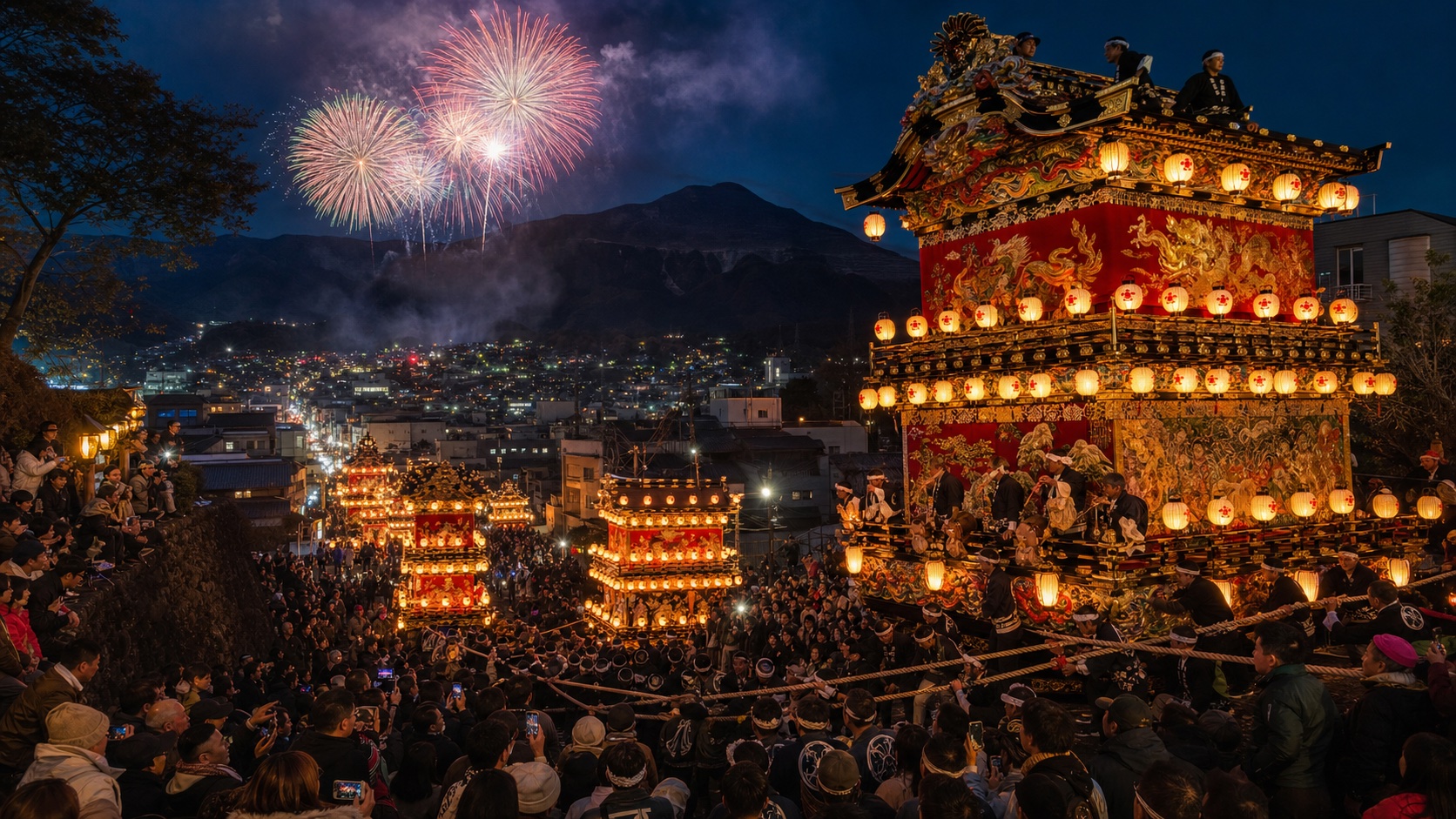
Chichibu Night Festival is the grand annual festival of Chichibu Shrine, held in early winter in the mountain city of Chichibu, Saitama. Six monumental floats—four yatai and two kasaboko—move through the centre with festival music, local performances and a sacred procession. During the main evening, lantern-covered floats are pulled toward the festival plaza as fireworks open above the city.

It is one of Japan’s great float festivals, but scale alone does not explain it. Each float belongs to a particular district. Its carvings, music, movement and preservation carry the identity of the people responsible for it. Some become stages for kabuki or traditional dance. All require coordinated human effort to negotiate streets that were never designed to make their passage easy.

Daylight reveals the construction. Dusk reveals the lanterns. Night reveals the weight.

Near the end of the main procession stands Dango-zaka, a steep incline separating the floats from the festival plaza. Ropes tighten along the road. Musicians continue playing. Pullers lean forward while people behind the wheels control an object that must keep moving without ever becoming uncontrolled.

Above them, the winter sky fills with fireworks.

The night does not simply brighten.

It climbs.

Why This Festival Is Special

A Chichibu float contains several forms of inheritance at once.

The structure is assembled through traditional wooden joinery without nails. Carvers, musicians, performers, rope teams and neighborhood organizers contribute different kinds of knowledge. No single participant creates the festival, yet the absence of any one group would alter how the float moves through the town.

That movement distinguishes Chichibu from a museum of beautiful objects. The floats are not preserved by remaining still. They survive because people continue accepting responsibility for their weight.

Winter gives that responsibility its atmosphere. Chichibu sits within a mountain basin, where darkness and cold gather around the centre. Drumbeats travel through the streets. Fireworks reverberate above rooftops. Lanterns sway against a sky that has already lost the final colour of afternoon.

The contrast is extraordinary: delicately illuminated structures moving through crowded streets by means of ropes, shouted coordination and collective force.

Dango-zaka concentrates everything the festival has been teaching. Beauty requires construction. Movement requires discipline. Celebration requires effort. The ascent is compelling because the town has allowed visitors to see how difficult it is.

Festival Experience

What to Expect

The festival begins long before its most famous evening ascent.

During the daytime, floats move through central Chichibu or stand where their carvings can be studied at close range. Painted figures, gilded details, textiles and wooden joinery appear individually in the winter light. The structure feels architectural, almost too substantial to be moved at all.

Music changes that impression. Chichibu yatai-bayashi emerges from inside the floats through drums, flutes and metallic percussion. The musicians may be partially hidden, yet their rhythm gives the entire structure a pulse. When the ropes begin moving, the float follows with slow, deliberate force.

Some yatai can be converted into stages for kabuki and other local performances. A float that has just occupied the road as a moving shrine becomes a theater, extending the festival beyond procession into neighborhood performance.

After dusk, paper lanterns are lit across the floats. Carvings that appeared intricate in daylight retreat behind warmer outlines. The streets grow denser, food stalls brighten and the cold settles more sharply into any period of waiting.

The main festival evening builds toward the sacred procession from Chichibu Shrine to the otabisho, a temporary resting place for the deities. The six floats eventually gather near the festival plaza, with Dango-zaka creating the most physically demanding point of their journey.

Most visitors will not experience every component from an ideal position. Street controls interrupt familiar routes. Crowds thicken around major intersections. A float may remain hidden for several minutes and then appear so close that its wheels, ropes and musicians fill the entire field of view.

The festival rewards attention more than coverage.

Festival Highlights

  • Chichibu Shrine provides the sacred centre. Its annual festival is not merely the place from which decorated floats depart; it is the reason the town’s movement has direction. Arriving before the largest crowds allows time to notice the shrine precinct before procession routes and spectators transform the surrounding streets.
  • The daytime float procession reveals workmanship that lantern light later conceals. Stand where the float must turn rather than only where it can travel straight. Teams reposition themselves, wheels are controlled and the scale of the structure becomes unmistakable.
  • Yatai kabuki transforms selected floats into neighborhood theaters. Performers appear within the same structures that carry musicians through the streets, connecting popular entertainment with the identity and pride of the districts maintaining them.
  • Lantern lighting is quieter but equally important. One point of light becomes a row, then an entire upper frame. The float does not physically change, yet its relationship with the street does.
  • Chichibu yatai-bayashi should be heard from more than one distance. Close to the float, percussion feels enclosed within the wood. Farther along the route, it announces movement before the float itself can be seen.
  • Dango-zaka provides the celebrated climax. The slope forces pullers, controllers and musicians into one concentrated act as each float is drawn toward the otabisho. Fireworks spread above them, but the most revealing sight remains at street level: ropes under tension and bodies leaning into the climb.
  • The ascent is unforgettable. Understanding everything that carried the float there makes it matter.

Getting There & Around

Where It Happens

Central Chichibu becomes both procession route and gathering place.

Chichibu Shrine anchors the northern side of the experience. The surrounding districts bring their floats toward the centre from different directions, allowing neighborhood identity to remain visible even as the festival draws everyone toward one sacred route.

The streets between Chichibu Shrine, Chichibu Station, Ohanabatake Station and Seibu-Chichibu Station form the practical festival area. Distances are short on an ordinary day. During the procession, a float, barrier or one-way pedestrian route can turn the same journey into a long detour.

The otabisho near the festival plaza provides the destination for the sacred procession. Dango-zaka rises immediately before it, forcing the largest floats to complete their final approach against gravity.

That slope changes the meaning of the town. Streets that first appeared to be passages become tests of coordination. The plaza that seemed close on a map becomes something that must be reached collectively.

Visitors should not treat the route as a continuous corridor they will be free to follow. Crossing points may close before a float arrives, and police or festival officials may redirect pedestrians around controlled areas. Choose which side of the procession matters before movement becomes restricted.

Chichibu is compact.

The festival makes it immense.

Getting Around

Rail is the most practical way to reach the city.

Seibu-Chichibu Station serves trains from the Tokyo direction. Chichibu Station and Ohanabatake Station belong to the Chichibu Railway, with Ohanabatake located close to Seibu-Chichibu. Together, the stations provide several points of arrival, but they do not guarantee an effortless departure once the main procession ends.

Reserve limited-express seats in advance where necessary. Extra services may operate, but reserved trains can fill and local platforms become crowded. Save ticket information where it can be accessed without reliable mobile reception, and load sufficient value onto any transport card before approaching the station.

Within the festival centre, walk. Buses, taxis and private vehicles become less useful as roads close and pedestrian volumes rise. Driving introduces parking restrictions, congestion and the possibility of being separated from the vehicle by procession controls.

Use the afternoon to learn the relationship among the shrine, stations and festival plaza. Once darkness falls, familiar streets can look entirely different beneath lanterns, stalls and moving crowds.

The return journey should be treated as part of the festival plan. Travelers who must catch a particular train may need to leave before the final fireworks or watch from a position closer to their departure station. Those who remain through the climax should expect patience to be required long after the last float completes its ascent.

Visitor Guide

Festival Food & Drink

Chichibu feeds the spaces between movement.

Soba belongs naturally to the afternoon, before the longest periods outside. The region’s buckwheat noodles arrive with dipping sauces developed by individual shops, offering warmth or clean, earthy simplicity without making the body feel heavy. A bowl near the centre also provides something increasingly valuable as the streets grow colder: time seated indoors.

Miso potato began as the kind of small meal eaten between periods of work. Steamed potato is coated in batter, fried and covered with a salty-sweet miso sauce. During the festival, that origin feels unusually close. It is uncomplicated food made to restore energy before people return to what still needs doing.

Festival stalls bring steam, grilled aromas and bright signs into the streets. Their food is part nourishment and part shelter; hands close around a warm serving while the next float approaches. Eating early prevents hunger from becoming another problem after routes grow crowded.

Local sake carries the agricultural, mining and sericulture history of the surrounding region. Enjoy it after the most demanding walking is finished, especially when the return involves icy streets, packed platforms or unfamiliar railway connections. Chichibu’s brewing culture also extends to wine, beer and whisky, but the festival does not require a survey of everything produced in the valley.

The best meal may come after the lanterns have passed. A door slides closed behind the cold, coats settle against chair backs and the sound of fireworks reaches the room as a softened concussion.

Outside, the ropes are still moving.

#### Must Try

• **Chichibu soba:** Locally made buckwheat noodles served cold with dipping sauce or hot in broth.

• **Miso potato:** Battered pieces of potato finished with a salty-sweet miso sauce, descended from Chichibu’s traditional between-work meals.

• **Waraji katsudon:** Pork cutlets served over rice with a savory-sweet sauce, named for their resemblance to traditional straw sandals.

• **Okkirikomi:** Broad noodles simmered with vegetables in a warming regional broth.

• **Chichibu horumon:** Grilled offal associated with the city’s casual restaurants and drinking culture.

• **Local sake:** Sake shaped by the water and brewing traditions of the Chichibu basin.

• **Manju:** Steamed buns filled with sweet bean paste, easy to carry during an afternoon of walking.

The food does not remove the cold.

It sends the traveler back into it.

Budget & Costs

The street festival and shrine areas can largely be experienced without general admission, but transport, accommodation and optional viewing arrangements shape the real cost.

Travelers arriving from Tokyo should budget for regular rail fare and any additional limited-express reservation. Paying for a reserved journey can be worthwhile when the alternative is uncertainty during the busiest departure period.

Central accommodation may command high demand because supply is limited. Its value lies not only in the room but in avoiding a late-night return through packed stations. Staying farther away may reduce the nightly price while adding taxis, transfers or an earlier departure from the festival.

Food stalls allow an inexpensive evening, although a sit-down meal provides warmth that should be considered part of the experience rather than an indulgence. Official reserved viewing areas or guided experiences may be offered for some editions; availability, price and sightlines should be evaluated through current festival information.

Budget for the cold as well. Gloves, heat packs, an extra warm layer or a later transport option may matter more than another souvenir.

Tips for First-Time Visitors

Arrive while the floats can still be seen in daylight. Their carvings, joinery and neighborhood details are easier to understand before the lanterns simplify them into glowing forms.

Choose one primary evening experience. A traveler may prioritize close float movement, a fixed view near the main ascent, fireworks or the freedom to circulate through the streets. Trying to secure all four often produces more frustration than understanding.

Visit the Chichibu Festival Exhibition Hall before the centre becomes difficult to cross. Its float replicas and exhibits clarify construction, performance and festival history, giving the living procession more depth when it appears outside.

Study the official pedestrian map and listen to local instructions. A barrier that seems temporarily inconvenient may be protecting the turning space required by a float. Do not assume that a street will reopen immediately after one procession has passed.

Carry cash, a charged phone, identification and any essential medication. Festival stalls and small shops may not support every payment method, while heavy network demand can make digital tickets or searches slower when they are needed most.

Wear layers suited to prolonged standing, not merely walking between heated buildings. Gloves, warm socks and protection for the neck matter once movement stops. A small insulating pad can make an extended wait more tolerable if seated viewing is permitted in the chosen area.

Let a float pass without photographing every second. Watch the rope teams adjust, listen to the music inside the structure and notice how the people nearest the wheels respond to the road.

The spectacle is not only above them.

Safety

The floats require space that spectators must not occupy.

Remain behind barriers, obey one-way walking controls and never step into a procession route for a photograph. Float teams must manage enormous weight through turns, slopes and narrow streets. Their ability to stop or redirect that weight is not comparable to that of a vehicle.

Keep clear of ropes even when they appear slack. Tension can change quickly, and the working area extends farther than the body of the float itself. Children should remain close to an adult whenever a procession approaches.

Dense crowds create pressure near crossings, the shrine and popular views of Dango-zaka. Avoid forcing movement against the dominant direction. If a position becomes uncomfortable, leave when officials open a route rather than waiting for the next procession to close it again.

Winter cold becomes more serious during long periods of standing. Wear insulating layers, keep extremities covered and enter a warm indoor space before numbness develops. Streets may also become slippery from frost or moisture.

Fireworks create sustained noise and falling debris can remain a concern near controlled areas. Follow designated viewing guidance and bring hearing protection for children or anyone sensitive to loud sound.

Drones are prohibited. Tripods and large equipment may also become unsafe or impractical in dense pedestrian areas even where not expressly forbidden.

A close view is never worth occupying the space the festival needs to move.

Cultural Significance

Chichibu Night Festival belongs to Chichibu Shrine, but it also carries the economic and social memory of the town surrounding it.

During the Edo period, a silk market associated with the festival brought trade into the shrine area and supported the region’s sericulture economy. The celebration became known in connection with silkworms and silk, joining sacred observance with the livelihood of the valley.

The six floats preserve the identities of the six districts responsible for them. Their survival depends upon more than conserving wood and textiles. Music must be learned. Performances must be rehearsed. Routes must be negotiated. Younger participants must understand when to pull, wait and respond.

The float and kagura traditions form part of Japan’s UNESCO-recognized yama, hoko and yatai festival culture. That designation acknowledges living knowledge rather than a collection of historic objects. Chichibu’s achievement is not that its floats have endured untouched. It is that the town still knows how to bring them into the streets.

The festival has sometimes been described as the community’s reckoning with the year—a final collective effort before winter deepens.

The ropes make that idea visible.

Plan Your Journey

When to Go

The festival unfolds across a quieter vigil and a main festival day. Each provides a different relationship with Chichibu.

The vigil offers greater breathing room. Fewer floats circulate, the programme concludes earlier and the streets generally allow more movement. It is the better choice for travelers who want to observe lanterns, music and neighborhood participation without committing to the intensity of the main procession.

The main day begins well before darkness. Arriving in the morning or early afternoon allows time to visit Chichibu Shrine, examine the floats, watch daytime movement and understand the route before crowd controls begin reshaping the centre.

Late afternoon is the hinge. The temperature drops, lanterns are prepared and people begin claiming positions for the evening. Visitors arriving only after dark enter the festival at its most dramatic but miss the transformation that gives the drama meaning.

The main procession reaches its greatest intensity later in the evening, when the sacred journey, float ascent and fireworks overlap. Staying through this period requires a serious plan for cold, crowds and the journey afterward.

Festival operations, train services, viewing restrictions and performance programmes can change. Consult the official Chichibu festival and railway guidance before leaving for the city.

Where to Stay

Central Chichibu is the strongest base because it allows the festival to be experienced as a town rather than an excursion with a departure deadline.

Accommodation near Chichibu Shrine, Chichibu Station, Ohanabatake Station or Seibu-Chichibu Station places visitors within walking distance of the principal streets. The exact route may still be altered by crowd controls, but returning on foot removes the pressure of joining the largest wave toward the railway immediately after the climax.

Rooms in the centre are limited and can disappear early. Nearby areas within the Chichibu region may provide alternatives, but travelers should confirm late-evening transport rather than assuming ordinary connections will remain convenient during the festival.

A Tokyo base is possible. Seibu Railway links Ikebukuro with Seibu-Chichibu, while Chichibu Railway serves Chichibu and Ohanabatake stations from the Kumagaya side. The journey itself is manageable; the difficulty comes when thousands of visitors attempt to leave after the same fireworks.

Anyone returning to Tokyo should reserve an appropriate train where required and understand the last workable alternative before arriving. An all-reserved limited express cannot absorb travelers who decide at the final moment that they would rather not wait for a local service.

Staying overnight changes the ending. The festival can disperse at its own pace, and the town can be seen again the following morning after the ropes and food stalls have gone.

Bottom Line & Key Days

Bottom Line

Chichibu Night Festival will be remembered for its lanterns and fireworks.

The lanterns give the floats their warmth. Fireworks give the mountain sky scale. Drums travel through the winter streets until the town seems to carry a rhythm beneath every conversation.

Yet the festival’s deepest image remains lower to the ground.

It is a rope stretched tight along Dango-zaka. Hands close around it. Bodies lean forward. Musicians continue playing inside a structure whose beauty cannot make it any lighter. The float moves a little, pauses and moves again.

By the time it reaches the festival plaza, the ascent appears to belong to one magnificent object. The day has revealed otherwise. Carvers, performers, musicians, organizers, pullers and generations of neighborhood knowledge have all been climbing with it.

Fireworks eventually fade beyond the rooftops. Lanterns continue glowing while the crowds begin turning toward the stations. The floats remain heavy. Their wheels must still be controlled, their ropes collected and their structures returned through streets that have not become any wider.

Chichibu carries them home.

Only then does the night begin to descend.

Key Days

The vigil introduces the festival at a gentler scale.

A smaller number of floats move through town, lanterns begin warming the streets and fireworks mark the evening without the full pressure of the main procession. Visitors can spend more time changing position and observing how individual neighborhoods inhabit their floats.

The main festival day begins in daylight. Floats circulate, performances may unfold and Chichibu Shrine grows steadily busier. This is the essential period for understanding craftsmanship and community before darkness concentrates attention on spectacle.

Late afternoon brings the transformation. Lanterns are lit, winter settles into the basin and spectators begin committing to their evening positions.

The main evening carries the sacred procession toward the otabisho. All six floats enter the larger movement, fireworks build above the town and Dango-zaka becomes the final physical challenge before the festival plaza.

After the ascent, the festival does not vanish. Floats must be moved again, ropes gathered and neighborhoods restored to themselves. Travelers staying in Chichibu can allow that dispersal to become part of the experience.

Ready to Experience Chichibu Night Festival?

You've explored what makes this festival special. Now it's time to plan your trip. Compare flights, book your hotel, arrange transportation, and take care of your travel essentials—all in one place.

✈ Find Flights

Loading booking widget...

Booking is completed on Expedia in a new tab.

🏨 Find Hotels

Search places to stay

Powered by Booking.com

Booking is completed on Booking.com in a new tab.

Rail & Bus Travel

Compare train and coach routes for the journey.

Compare Routes

Things to Do

Discover tours and attractions before or after the festival.

Explore Experiences

eSIM Mobile Data

Stay connected abroad without traditional roaming charges.

Get an Airalo eSIM

Travel bookings are provided by our trusted partners. We may earn a commission when you book through these links, at no additional cost to you.

Independent Editorial Standards

Every Follow the Festivals guide is independently researched and regularly reviewed using official festival information, destination resources, and trusted travel references. We also welcome verified updates from festival organizers, destination marketing organizations, tourism partners, and local experts to help keep our guides accurate, current, and useful for travelers.

Represent this festival or have a verified update to share? We'd love to hear from you through our contact page.