
Follow the Festivals

Festa de Sant Joan

Festa de Sant Joan

Ciutadella, Spain

2027-06-23 - 2027-06-24

The Story

Festival Overview

Ciutadella’s honey-colored palaces, medieval lanes, and broad Plaça des Born become the setting for Menorca’s most intense civic tradition during Festa de Sant Joan. Black Menorcan horses enter streets already dense with families, music, and anticipation; riders in formal dress guide them through rituals whose order is understood locally long before a newcomer learns the names. The jaleo’s rearing horses create the famous spectacle, but the celebration is larger than that image. Religious observance, social ranks represented by the caixers, processions, games, hospitality, and collective memory bind the old town to the island’s rural and equestrian culture.

Why This Festival Is Special

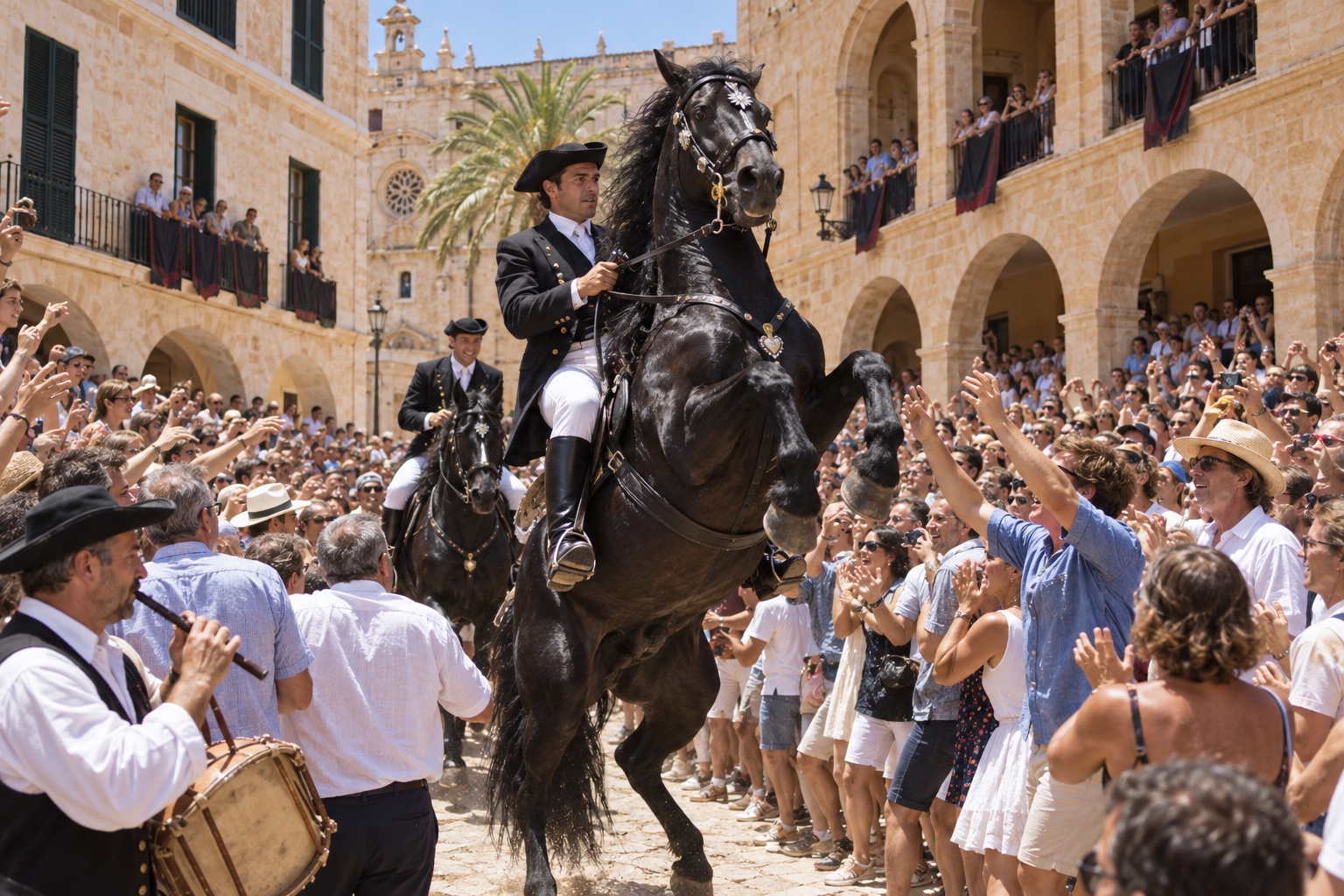
A black Menorcan horse enters a stone square already filled with people, rises above the crowd, and drops back to the paving as hands lift around it. The flabiol sounds again, balconies lean forward, and another rider appears through a narrow street.

That closeness belongs to Ciutadella. The horses, civic ritual, old town, and families gathered along the route form one tradition that cannot be separated into performers on one side and spectators on the other.

Festival Experience

What to Expect

The town begins filling before the largest ceremonies. Families claim familiar corners, visitors study the route, and the sound of flabiol and drum announces movement before the horses come into view.

As riders enter the central streets, the crowd compresses. Menorcan horses move at close range, their coats shining in the summer light, while spectators raise their hands and make space for the jaleo. The atmosphere can shift from waiting to sudden motion in seconds.

Between formal moments, people move toward bars, shaded streets, and family gatherings. The celebration resumes in waves, carrying the crowd back toward the old town until evening, when music, conversation, and the day's accumulated energy remain in the streets.

Festival Highlights

  • Black Menorcan horses and formally dressed caixers entering the old town
  • The jaleo, when horses rear amid music and a tightly gathered crowd
  • Processional movement through medieval streets toward Plaça des Born
  • Drum and fabiol signals marking ceremonial transitions
  • Traditional games and equestrian skill associated with the festival sequence
  • The emotional participation of local families who inherit familiar roles and viewing places

Getting There & Around

Where It Happens

The celebration is concentrated in Ciutadella's old town, where narrow streets open suddenly into larger gathering places and ceremonial routes pass close to historic buildings. Plaça des Born and the surrounding lanes form the public heart of the festival, while processions connect the town's civic and religious spaces.

The setting leaves little separation between performer and spectator. Stone walls, balconies, tight corners, and crowded squares shape the movement of both horses and people, giving the festival an intensity that would disappear in a wider modern venue.

Getting Around

Walking is the only practical way to experience the old town once the festival is underway. Cars should be left well outside the core, and taxis may be unable to approach the busiest streets during processions.

Movement inside the festival depends on timing. Cross the main route before the horses arrive, avoid stopping in narrow access points, and follow local directions when barriers or officials redirect the crowd. A short distance on the map can take a long time when a square is full.

Visitor Guide

Festival Food & Drink

Meals fit around ceremony rather than serving as a separate attraction. Families and groups eat early, then return to the route with pastries, sandwiches, cold drinks, and the island’s distinctive gin-based festival punch. Menorcan cooking links the crowded old town to livestock, fishing, dairy, and baking traditions across the island. Reserve one seated meal away from the most compressed hours; hurried eating near a horse route is uncomfortable and can obstruct circulation.

Must Try
• Pomada — Menorcan gin mixed with lemon, served cold and best paced carefully in heat.
• Formatge de Maó-Menorca — Cow’s-milk cheese with a salty, buttery character that deepens as it ages.
• Coca bamba — A soft spiral pastry traditionally paired with chocolate during island celebrations.
• Caldereta de llagosta — Menorca’s celebrated lobster stew, suited to an unhurried meal rather than a street break.
• Sobrassada — Paprika-seasoned cured pork spread on bread or incorporated into savory and sweet dishes.

Budget & Costs

The public rituals do not require an admission ticket, but lodging and transport become expensive because demand concentrates in a small historic city. A central room buys walkability and an easy retreat from heat or crowd pressure; an outlying base may cost less but depends on bus, taxi, or parking arrangements outside the closed core. Budget for an early seated meal, water, sun protection, and at least one recovery day elsewhere on Menorca. Premium balconies or guided vantage points should never be treated as permission to ignore local crowd and animal-safety rules.

Tips for First-Time Visitors

Learn the horse route before choosing where to stand. A position near an exit street may provide a less dramatic view than the center of a square, but it also gives more room to move when the crowd tightens.

Wear closed shoes, carry water, and keep bags small. Do not step into the path of a horse for photographs, and follow the behavior of local spectators when the animals enter. Families with young children should avoid the densest jaleo zones and choose a viewing point with a clear retreat.

Safety

Horses, heat, alcohol, and extreme crowd compression require constant attention. Stand only where local guidance permits, keep an escape route visible, and never touch, startle, feed, or move behind a horse. The traditional jaleo places animals close to people, but familiarity with the custom does not make every position safe. Children and anyone with limited mobility need a less dense viewpoint. Hydrate before the peak, pace pomada, and leave a packed square before discomfort becomes panic. Follow barriers, riders, volunteers, and emergency personnel without argument.

Cultural Significance

Festa de Sant Joan is one of Ciutadella's defining public traditions, combining religious observance, civic hierarchy, horsemanship, music, and community participation. The riders and horses are not staged as tourist entertainment; they represent roles and customs sustained within Menorcan society.

Its continuity is visible in the crowd. Families return to the same streets, younger generations learn the signals and rituals, and the town's architecture continues to hold the celebration much as it has for centuries.

Plan Your Journey

When to Go

The strongest public atmosphere builds from late morning into the evening, with ceremonial movements, horse processions, and the busiest gatherings drawing people toward the old town. Earlier hours offer more room to understand the route and find a position before the main squares become difficult to cross.

The peak horse rituals bring the greatest intensity and the least freedom of movement. Travelers who want the full spectacle should be prepared to stand for long periods in heat and dense crowds; those who prefer a calmer view will do better along the approaches before the central plazas fill.

Where to Stay

Ciutadella is the best base because the festival belongs to the town's historic center and continues long after road access becomes complicated. Staying within walking distance allows visitors to return without relying on a car or searching for transport through street closures.

Rooms inside or near the old town carry the highest demand. Accommodation farther toward the edge of Ciutadella can offer better value, but the route back should remain simple on foot. Beach resorts elsewhere on Menorca are less convenient for anyone planning to stay through the evening.

Bottom Line & Key Days

Bottom Line

Sant Joan cannot be reduced to the photograph of a horse rising above a crowd. Its force comes from the disciplined ceremonial order beneath the apparent chaos, the pride invested in Menorca’s black horses, and the way Ciutadella’s old stones hold generations of memory. Learn the route, watch from a responsible position, and give local participants space to carry the tradition. The reward is a rare understanding of an island community expressing faith, hierarchy, courage, and belonging in full public view.

Key Days

Ceremonial Opening
Listen for the first musical signals and observe how riders, officials, and families establish the celebration’s formal order.

Old-Town Procession
Follow from a respectful distance as horses move through narrow streets toward the larger civic spaces.

Jaleo Peak
Choose a position with a clear exit and let experienced local participants occupy the closest ground around the horses.

Equestrian Games
Watch skill, ritual, and crowd participation come together while keeping every marked route unobstructed.

Closing Passage
Remain for the quieter final movements, when exhaustion and pride reveal the tradition beyond its most dramatic image.

Ready to Experience Festa de Sant Joan?

You've explored what makes this festival special. Now it's time to plan your trip. Compare flights, book your hotel, arrange transportation, and take care of your travel essentials—all in one place.

✈ Find Flights

Loading booking widget...

Booking is completed on Expedia in a new tab.

🏨 Find Hotels

Search places to stay

Powered by Booking.com

Booking is completed on Booking.com in a new tab.

Rail & Bus Travel

Compare train and coach routes for the journey.

Compare Routes

Things to Do

Discover tours and attractions before or after the festival.

Explore Experiences

eSIM Mobile Data

Stay connected abroad without traditional roaming charges.

Get an Airalo eSIM

Travel bookings are provided by our trusted partners. We may earn a commission when you book through these links, at no additional cost to you.

Independent Editorial Standards

Every Follow the Festivals guide is independently researched and regularly reviewed using official festival information, destination resources, and trusted travel references. We also welcome verified updates from festival organizers, destination marketing organizations, tourism partners, and local experts to help keep our guides accurate, current, and useful for travelers.

Represent this festival or have a verified update to share? We'd love to hear from you through our contact page.