
Follow the Festivals

Tokyo Marathon

Tokyo Marathon

Tokyo, Japan

2027-03-07 - 2027-03-07

The Story

Festival Overview

Before the start, thousands of runners stand inside one of the world’s most organized cities and wait for a controlled release. Tokyo Metropolitan Government buildings rise above the field; later, temple gates, commercial streets and old neighborhoods arrive in sequence.

The city does not present itself as spectacle alone. It presents precision as hospitality. The Tokyo Marathon is a World Marathon Major crossing central districts from Shinjuku toward the ceremonial finish near Tokyo Station. Its governing experience is disciplined flow. Runners, volunteers, spectators and transport systems each perform a limited role so that an enormous event can move without losing respect for shared space.

Travelers experience it best by learning the rules early and letting them support the experience. Timed collection, start corrals, cutoffs, baggage and finish exits are part of the race. Once accepted, they create room to notice how neighborhoods change and how restrained support can still carry extraordinary force.

Why This Festival Is Special

Tokyo transforms precision into atmosphere. Corrals, volunteers, rail lines and controlled streets do not merely manage the marathon; they give it a rhythm in which thousands of separate efforts can remain visible without producing chaos.

The route also resists a single image of the city. Shinjuku scale gives way to eastern history, commercial polish and the broad finish near Tokyo Station. Fatigue removes the distance between these identities, turning them into one embodied map. Travelers should invest attention in the transitions. A volunteer’s exact gesture, a quiet block before a crowded landmark or a spectator bowing after encouragement may reveal more than the famous gate ahead. Tokyo is special because collective discipline does not suppress feeling. It creates the space in which feeling can register clearly. Restraint gives every small act of care greater definition. The marathon makes that social intelligence visible across an entire city.

Festival Experience

What to Expect

Expect exact procedures and a start morning that rewards compliance. Entrance gates, security, bag rules, corrals and cutoff requirements leave little room for improvisation. Runners may spend significant time outside before moving, so warmth and practiced nutrition matter before the clock begins.

The course is urban and visually varied, with long sightlines, turns and repeated encounters with central districts. Crowd support can be enthusiastic without the constant roar found at some majors. Quieter passages expose pacing and allow Tokyo’s street order to become part of the experience.

Spectators face closures and station crowding, but the rail network makes selective movement possible. Tracking remains an estimate. The runner may appear and disappear within seconds, so reach the area early, confirm the travel side of the road and resist blocking pedestrian flow. The event feels generous when every participant respects the system making it possible.

Festival Highlights

  • Shinjuku Start – Towers and controlled corrals make human scale visible before the field moves. Runners should preserve warmth, enter through the assigned gate and allow procedures to set the morning’s pace.
  • Suidobashi Flow – Early kilometers reveal how efficiently the mass field can occupy central roads. Hold back here; excitement and smooth pavement can disguise an unsustainable opening pace.
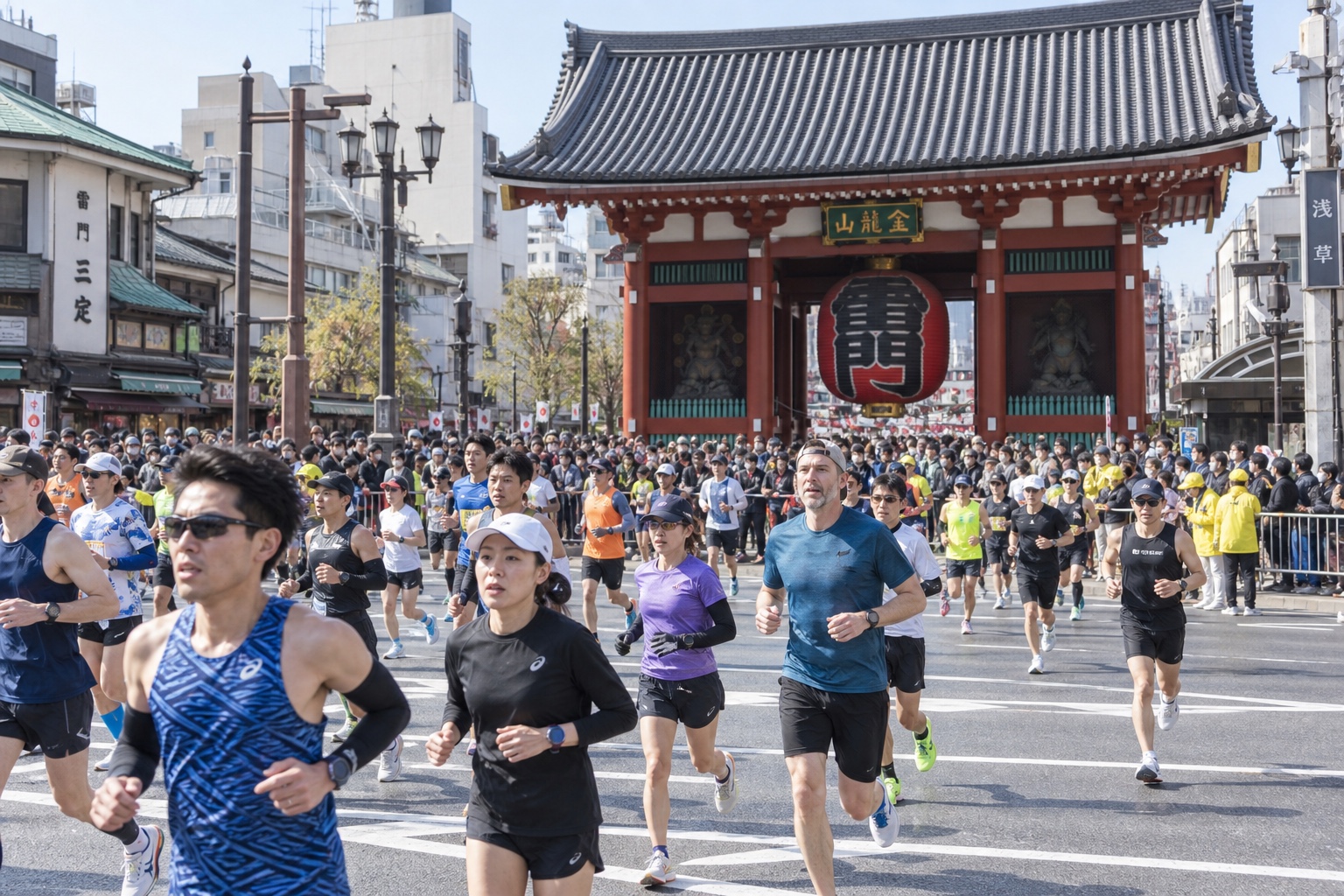
  • Asakusa Approach – The Kaminarimon area brings historic symbolism and strong public energy into the route. Spectators should reach the area early and choose a clear sightline without obstructing ordinary access.
  • Ryogoku and Eastern Districts – The course enters neighborhoods associated with older Tokyo and working cultural traditions. This is a rewarding support zone for travelers who want to feel the district and still return with more than landmark photography.
  • Ginza Passage – Formal retail avenues become racing space, sharpening the contrast between ordinary urban precision and mass physical effort. Runners should notice the city while maintaining fuel and cutoff discipline.
  • Hibiya Return – Fatigue meets central-city recognition. A familiar voice here can matter more than an early sighting, so supporters should keep the later position.
  • Tokyo Station Finish – The broad ceremonial avenue compresses the route into a final controlled approach. Reunion takes time; celebrate after the runner has cleared secure procedures and reached the agreed place.

Getting There & Around

Where It Happens

The course begins at the Tokyo Metropolitan Government Building in Shinjuku and travels through central Tokyo toward areas including Suidobashi, Ueno, Asakusa, Ryogoku, Nihombashi, Ginza and Hibiya before finishing near Tokyo Station.

The route moves between administrative, historic, commercial and waterfront-facing identities across several distinct urban identities, never confined to one entertainment district. Tokyo Big Sight in Ariake serves as the pre-race collection and Expo venue, creating a separate required journey before race day. The start and finish are also far apart, so baggage and hotel plans must respect one-way movement.

Spectators should group viewing points by direct rail relationships. Asakusa and Nihombashi can offer distinct atmosphere, but chasing too many districts turns intended support into platform time. Settle on one early or middle chapter, one later point if practical and a reunion beyond the secure finish. The route becomes understandable when each chosen district has time to feel different.

Getting Around

Runners should use rail to reach the assigned Shinjuku access point and follow official entrance guidance exactly. Large stations have many exits; knowing the line is not enough. Save the station exit, allow time for one wrong corridor and carry only approved belongings.

Spectators should design the day around direct lines and station depth. A transfer that looks brief on a map can involve long underground walking. Select course points near distinct stations, leave before the runner appears only when the next sighting is genuinely more valuable and avoid boarding the same route as the entire departing crowd. The finish near Tokyo Station is controlled, and the runner may emerge far from the spectator’s imagined landmark.

Select a reunion point outside the busiest immediate area, preferably beside a specific numbered exit or hotel entrance. Keep its name in Japanese and offline. Tokyo’s network is exceptionally capable, but only a precise plan converts capability into an easy return for tired legs.

Visitor Guide

Festival Food & Drink

Pre-race eating should remain conservative. Rice, bread, bananas and simple soups can fit a practiced routine, but unfamiliar richness and raw foods offer no advantage before a marathon. Confirm what the hotel can provide at the required hour because ordinary breakfast service may not match the start.

After finishing, choose warmth and easy digestion before a culinary campaign. Tokyo rewards appetite, yet the most satisfying meal may come after a shower and sleep. Reserve nothing that cannot tolerate a delayed finish exit.

**Must Try**
• Onigiri – Portable rice with simple fillings suits a familiar carbohydrate plan.
• Udon – Warm noodles and broth can provide gentle post-race comfort.
• Tamagoyaki – Rolled egg offers mild protein in a compact form.
• Miso Soup – Salt, warmth and familiarity can help recovery begin.
• Wagashi – A small traditional sweet rewards attention without demanding a heavy meal. Let the body determine recovery food by what the body can accept, then save culinary ambition for the following day.

Budget & Costs

International entry, flights and central lodging make Tokyo a significant commitment. Entry routes may include a drawing, charity option or recognized travel arrangement, each with different obligations. Verify every term through official channels and do not treat secondary offers as equivalent access.

Hotel cost depends heavily on station convenience. A slightly higher rate beside the correct line can reduce taxis, missed trains and painful post-race transfers. Compare the room against collection in Ariake, start access in Shinjuku and finish recovery near Tokyo Station.

Public transport and casual food can control daily spending, while shopping, premium dining and extended touring expand it quickly. Budget for practiced nutrition, weather layers, a transit card, recovery meals and at least one low-demand day. Keep contingency funds for replacing gear or changing plans after long-haul travel. The race budget should preserve sleep, navigation and recovery before souvenirs.

Tips for First-Time Visitors

Packet collection requires the runner’s presence and is not a race-morning task. Schedule it early enough to correct any issue and avoid exhausting the legs at the Expo. Read cutoff, baggage and prohibited-item guidance closely; Tokyo rewards exact preparation with no room for optimistic interpretation.

Practice station navigation before race morning. Identify the hotel exit, platform direction and backup route. Carry a transit card with sufficient value, but keep enough cash for small recovery needs.

Spectators should favor one or two high-quality positions. Stand where the runner can identify a landmark and keep signs compact enough to respect the crowd. Agree on reunion without relying on live messaging. The first-time mistake is assuming excellent infrastructure eliminates the need for personal precision. It does the opposite: the system works because each traveler comes knowing their role. Preparation turns the city’s complexity into confidence and keeps dependence low.

Safety

Runners must train for the distance and understand the official cutoff system. Conservative early pacing supports both health and continued participation. Use familiar fuel, follow aid guidance and seek medical assistance when symptoms exceed ordinary exertion.

Late-winter conditions can produce cold rain or warmer-than-expected sun. Carry permitted disposal layers, cover exposed skin and replace wet clothing quickly after finishing. Jet lag and extensive sightseeing can weaken judgment before the start, so recovery begins several days earlier.

Spectators should follow barriers, keep station circulation clear and avoid sudden course crossings. Earthquake and emergency information should be understood as part of any Tokyo trip, with hotel instructions and official alerts accessible. Both runner and supporters need identification, offline addresses and a precise reunion point. Order provides safety only when individuals continue paying attention. Personal awareness remains necessary even inside an exceptionally managed event.

Cultural Significance

The Tokyo Marathon places mass participation inside a city known for managing shared space with extraordinary attention. Streets that normally prioritize dense movement are given to runners, while volunteers and residents sustain order without draining the event of emotion.

The route links several versions of Tokyo: metropolitan administration, older eastern districts, commercial avenues and the symbolic center near Tokyo Station. International runners encounter the city through repetition and fatigue, not through a curated sequence of attractions. That experience reveals a distinctive public compact. Spectators encourage without treating the street as private property; runners follow rules that safeguard time, safety and reopening; volunteers make care feel procedural and personal at once. Travelers should meet that compact with gratitude. Keeping stations passable, following barriers and listening before improvising are not constraints on celebration. They are how celebration becomes possible at this scale.

Plan Your Journey

When to Go

The marathon is traditionally staged near the end of winter, when Tokyo can offer cool running conditions but also cold rain, wind or an unexpectedly warm afternoon. Come several days ahead to complete required collection in person, recover from long-haul travel and adjust sleep. The city’s density makes it easy to walk far without recognizing the training cost.

Use the final day for preparation and one compact neighborhood, not a cross-city itinerary. Runners should test breakfast timing in the hotel, organize disposal layers and understand the route to the assigned entrance. Spectators should decide which course chapter matters most and which rail line preserves the finish reunion.

Staying after race day is especially valuable. Stairs, swelling and jet lag make immediate departure punishing. Confirm current entry, collection, baggage, cutoff, weather and spectator guidance before travel. Exact edition details belong in the machine fields and official instructions, not evergreen editorial copy.

Where to Stay

Shinjuku offers the simplest start morning for many runners because the course begins beside the metropolitan government complex. The district also provides abundant food and rail connections. The trade-off is a longer return from the finish and an atmosphere that can remain intensely active when rest is needed.

Tokyo Station, Marunouchi and nearby eastern central districts support finish recovery. A runner can reduce the post-race journey, while spectators gain useful access to later sections. Prices are high and the trip to the start requires careful timing. Nihombashi or Ginza can provide a practical middle position with strong rail options.

Decide on the hotel by station access, not neighborhood name alone. A short walk to the correct line is more valuable than theoretical centrality. Check for elevators, breakfast timing and late baggage storage. The best room supports collection at Tokyo Big Sight, the start journey to Shinjuku, spectator movement and a gentle return from Tokyo Station without forcing one perfect location to do everything.

Bottom Line & Key Days

Bottom Line

The Tokyo Marathon asks each participant to surrender a little personal improvisation so that everyone can move. Start gates, cutoff points, station exits and finish procedures may appear administrative from a distance.

Inside the event, they become a shared language of care. The runner travels through many Tokyos while effort reduces attention to immediate things: the next turn, a volunteer’s hand, a voice beside a barrier. Spectators contribute by being exact about where they stand and restrained about the space they occupy.

Near the finish, the city does not suddenly become simple. Tokyo Station contains more routes than tired legs want to understand. Yet the meeting point appears because it was chosen carefully. The group reunites, and precision changes character.

It no longer feels like control. It feels like someone anticipated what exhaustion would need. That anticipation is the city’s final form of hospitality.

Key Days

• Early Collection – Completing mandatory pickup with time to correct problems keeps the final preparation window open. Keep the Expo visit purposeful and resist turning it into a long shopping day.
• Final Preparation Day – Runners test breakfast timing, minimize walking and organize start layers. Spectators confirm station exits and course-side positions.
• Race Morning – Assigned gates, corrals and baggage procedures make precision essential before the field begins moving. Reach the gate early enough that one navigation error remains ordinary.
• Central Course Passage – Shinjuku, eastern districts and commercial avenues reveal different city identities. Spectators should choose compatible points and release any plan to chase the entire route.
• Tokyo Station Finish – Secure exits and dense central movement delay reunion. Use the predetermined landmark and begin recovery before adding celebration plans.
• Recovery Day – Bathing, gentle food and short neighborhood walks allow the body to re-enter Tokyo at human speed. Let the runner choose distances and avoid building recovery around long station transfers.

Ready to Experience Tokyo Marathon?

You've explored what makes this festival special. Now it's time to plan your trip. Compare flights, book your hotel, arrange transportation, and take care of your travel essentials—all in one place.

✈ Find Flights

Loading booking widget...

Booking is completed on Expedia in a new tab.

🏨 Find Hotels

Search places to stay

Powered by Booking.com

Booking is completed on Booking.com in a new tab.

Rail & Bus Travel

Compare train and coach routes for the journey.

Compare Routes

Things to Do

Discover tours and attractions before or after the festival.

Explore Experiences

eSIM Mobile Data

Stay connected abroad without traditional roaming charges.

Get an Airalo eSIM

Travel bookings are provided by our trusted partners. We may earn a commission when you book through these links, at no additional cost to you.

Independent Editorial Standards

Every Follow the Festivals guide is independently researched and regularly reviewed using official festival information, destination resources, and trusted travel references. We also welcome verified updates from festival organizers, destination marketing organizations, tourism partners, and local experts to help keep our guides accurate, current, and useful for travelers.

Represent this festival or have a verified update to share? We'd love to hear from you through our contact page.