
Follow the Festivals

Durbar Festival

Durbar Festival

Kano, Nigeria

2027-03-10 - 2027-03-13

The Story

Festival Overview

Before the embroidered cloth reaches the horse, a handler runs one hand down its leg.

The animal shifts its weight. A fastening is checked, then checked again. Nearby, a rider arranges layers of ceremonial clothing while musicians wait with long trumpets and drums. The procession will eventually fill Kano with movement, but it begins through acts of care almost no spectator will see.

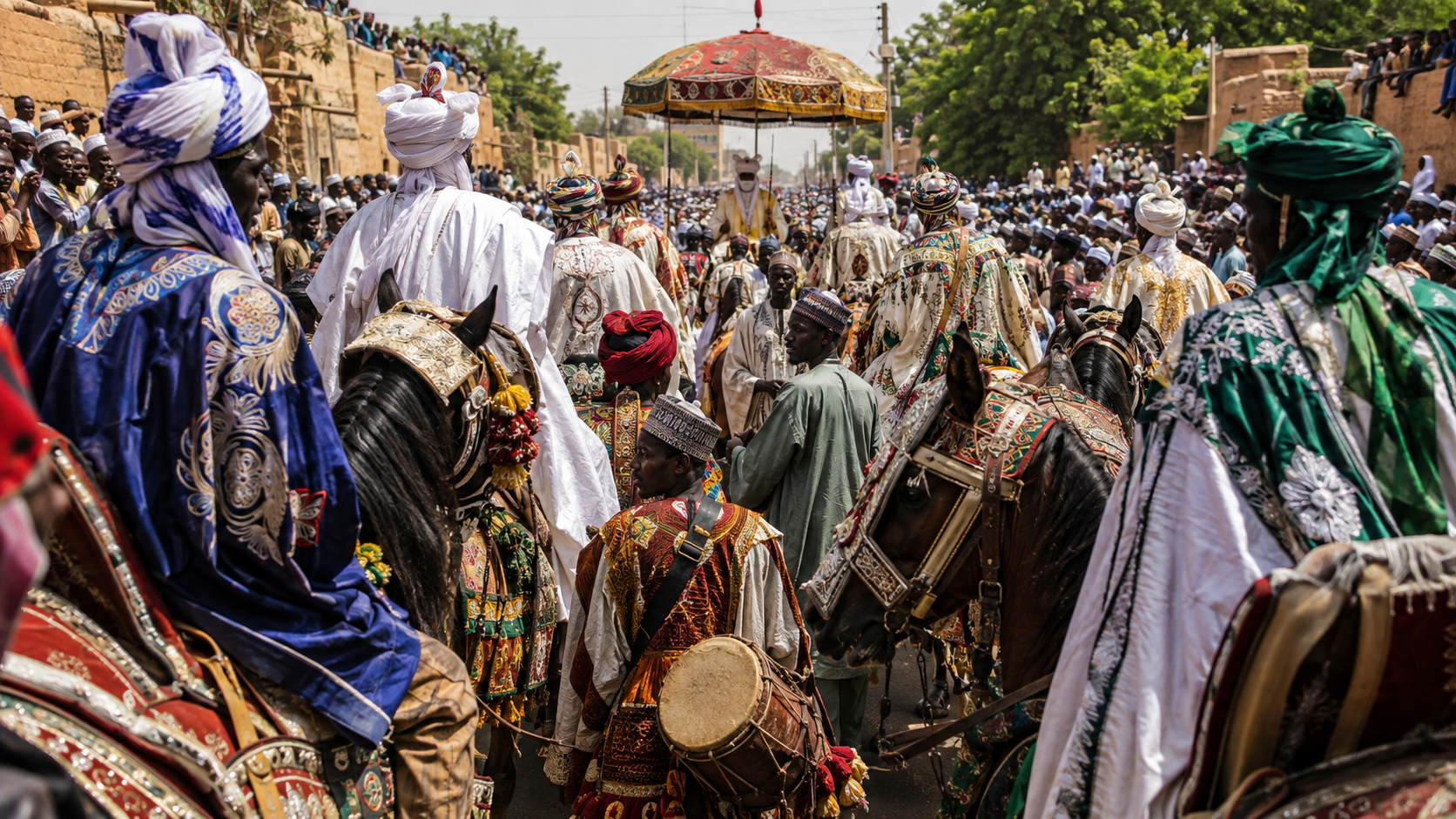
Durbar in Kano is a royal, religious and equestrian tradition held in connection with **Eid al-Fitr and Eid al-Adha**, known locally as Eid el-Fitr and Eid el-Kabir. The Emir of Kano, district heads, titleholders, palace officials, guards, musicians, horsemen and communities participate in a sequence of mounted processions, ceremonial visits and public homage shaped by the Kano Emirate.

Recognized by UNESCO as Intangible Cultural Heritage of Humanity, Kano’s Durbar is not a staged horse show or a single tourist parade. It is a living expression of Hausa culture, Islamic celebration, royal institution, skilled horsemanship and relationships carried between palace, district and city.

Several northern Nigerian emirates maintain their own Durbar traditions. Kano’s processions must not be treated as a generic version representing Katsina, Zaria, Bauchi, Bida, Sokoto or any other emirate. Each has its own leadership, routes, participants and inherited practices.

The horses attract attention first. Their cloth, saddles and controlled movement make the procession immediately visible. Stay longer and another structure appears. Every rider approaches from somewhere. Every entourage carries a district or title into public space. Every route connects people to the palace and to one another.

Durbar sets Kano’s relationships in motion.

Why This Festival Is Special

Kano does not assemble Durbar from one institution.

Horse breeders, handlers, leatherworkers, embroiderers, tailors, musicians, riders, praise singers, palace officials and district communities all preserve different parts of the knowledge required to bring the procession into public life.

The garments make rank, affiliation and ceremony visible. Saddles and harnesses carry the work of artisans who understand that beauty must also survive a powerful animal in motion. Riders inherit physical judgment through practice rather than explanation alone.

Music provides another form of recognition. Long trumpets and drums do not simply accompany the horses. They announce presence, shape movement and help distinguish one approaching group from another.

The processions also make Kano’s geography legible. Gates, streets, palace approaches and historic quarters become parts of a ceremonial route rather than background architecture. The city reveals relationships through the order in which people leave, travel, arrive and return.

The final salute may occupy only seconds.

Everything required to reach it has been carried across generations.

Festival Experience

What to Expect

Durbar follows the Islamic calendar rather than fixed Gregorian dates. It is associated with the major Eid celebrations, but exact processions, routes and public arrangements must be confirmed through current Kano authorities and trusted local contacts.

The experience may unfold across several ceremonial rides. The Emir and royal entourage move between the palace, prayer grounds, historically significant households and public gathering areas. District heads and mounted groups enter with their own attendants, musicians, garments and equestrian traditions.

Crowds gather well before the principal riders appear. Drums, long trumpets, praise singing and the movement of entourages announce who is approaching. Horses can accelerate suddenly during demonstrations of skill or ceremonial salutes, transforming an apparently open area into an active route.

The **Jahi**, a mounted salute in which riders charge toward the Emir and stop under control, is among the most dramatic moments. It must be watched from a position approved by local officials. The performance depends upon trained horses, experienced riders and a clear path; spectators stepping forward for photographs can endanger everyone involved.

Durbar is connected to Eid prayer, family gathering and religious observance. Visitors may see a powerful public procession without entering every space in which its meaning is held. Hospitality should not be interpreted as unrestricted access.

Public arrangements can change because of security conditions, government decisions or circumstances within the emirate. Confirmation must continue until arrival. A published date alone is not enough.

Festival Highlights

  • – The **Eid prayer and ceremonial departure** establish Durbar within religious celebration rather than separating it as a secular spectacle. Visitors should learn from a local host where non-worshippers may respectfully stand and which areas are reserved. The movement that follows prayer carries the Emir and accompanying groups from devotion into public ceremony.
  • – The **Emir’s procession** brings palace officials, guards, titleholders, musicians and mounted attendants into a carefully ordered public movement. Watch how space opens around the Emir and how different groups approach, pause and continue. The procession’s meaning lies partly in sequence, not only in visual scale.
  • – During **Hawan Daushe**, the Emir and entourage traditionally travel through historic parts of Kano, including a ceremonial visit associated with the Queen Mother before returning toward the palace. The exact route and access should be confirmed locally. Following the geography with a knowledgeable guide reveals why particular gates, quarters and households matter.
  • – The **Jahi mounted salute** concentrates horsemanship into a moment of speed and control. Riders charge forward before stopping near the Emir to offer their salute. Spectators must remain behind established boundaries and keep routes clear. A longer lens is safer than attempting proximity.
  • – The **district entourages** allow Kano’s wider emirate to enter the city through horses, garments, banners, musicians and attendants. Spend time observing one group completely. Differences in saddle work, dress, music and organization become visible only when the procession is not treated as one continuous blur.
  • – The **palace musicians and praise singers** carry knowledge that photographs cannot preserve. Listen for how drums and long trumpets change as important figures approach. Sound identifies relationships before many visitors understand what they are seeing.
  • – The **craftsmanship surrounding the horses and riders** deserves attention beyond the procession. With appropriate introductions, visitors may learn about saddle making, embroidery, leatherwork, ceremonial clothing or horse care from people connected to those practices. Never enter preparation spaces without permission or treat working artisans as an unofficial display.

Getting There & Around

Where It Happens

Durbar unfolds through **Kano**, particularly the Emir’s Palace, historic city gates, major streets, prayer grounds and quarters connected to ceremonial routes.

The **Gidan Rumfa**, the Emir’s Palace, provides the central point around which many processional relationships are organized. It is a living palace complex rather than an attraction offering unrestricted access.

Historic gates and old-city roads shape the way mounted groups enter, gather and return. Kano’s walls and gates once organized protection, commerce and movement. During Durbar, that inherited geography becomes active again.

Routes can change. Barriers, security zones and official viewing areas may be introduced close to the event. A location offering a clear view during one celebration may be unavailable during the next.

Visit the old city before the principal procession with a local guide. Kurmi Market, traditional craft areas and historic streets reveal the commercial and artisanal knowledge surrounding the ceremony.

Durbar does not happen in a neutral arena.

Kano itself provides the order.

Getting Around

Arrange transportation through a trusted hotel, guide or established local operator before Durbar begins.

Road closures can prevent vehicles from approaching the palace and procession routes. Agree upon a drop-off point, a separate pickup point and a fallback location outside the densest crowd.

Do not expect to follow every mounted movement across the city. Horses, security controls and local knowledge will always move differently from an unfamiliar visitor. Select one approved viewing area and allow the procession to come through it.

Walking may be necessary near the old city, but distances increase quickly in heat and crowds. Wear closed shoes, carry water and remain with the guide when routes change.

Save addresses and contact numbers offline. Mobile service may become strained, and landmarks can be more useful than street numbers inside historic quarters.

Private vehicles should not attempt to penetrate a closing route. A driver who knows when to stop is more valuable than one promising access that local authorities have restricted.

After the procession, wait for the first crowd pressure to ease before moving. The horses may have passed while attendants, spectators and vehicles still occupy the route.

Visitor Guide

Festival Food & Drink

Kano’s Eid tables reveal gathering through generosity.

Meals move between households, relatives and guests. Rice, grains, meat, soups and drinks restore people after prayer, preparation and hours outside. Food is not a break from Durbar. It belongs to the same relationships the procession carries into view.

**Tuwo shinkafa** brings rice into a soft, shaped accompaniment for richly seasoned soups. **Miyan kuka**, made with powdered baobab leaves, offers a distinctive texture and earthy depth. Together they turn staple ingredients into a meal designed to be shared and eaten deliberately.

**Masa**, small fermented rice cakes cooked in rounded molds, suits breakfast or a pause before the streets become crowded. **Suya** brings skewered meat, spice and smoke into the evening, while **kilishi** preserves thin sheets of seasoned dried meat for longer keeping.

Drinks matter in Kano’s heat. **Kunu** is a grain-based drink served in several forms, while **fura da nono** combines grain dumplings with fermented milk. Accept hospitality warmly, but follow the host’s lead around handwashing, seating and shared dishes.

Kano is predominantly Muslim. Alcohol should not be expected as part of the celebration, and visitors should respect local religious practice rather than introducing it into festival spaces.

#### Must Try

– **Tuwo shinkafa** — Soft rice formed into a smooth accompaniment for soups and stews.

– **Miyan kuka** — A Hausa soup made with powdered baobab leaves, spices and meat or fish.

– **Masa** — Fermented rice cakes cooked in rounded molds and served with savory or sweet accompaniments.

– **Suya** — Skewered meat seasoned with a ground-peanut spice mixture and grilled over heat. **Kilishi** — Thinly sliced, seasoned and dried meat associated with northern Nigerian food traditions.

– **Fura da nono** — Millet-based dumplings served with fermented milk. **Kunu** — A refreshing grain drink prepared in several regional forms.

A festival meal fills the space between prayer and procession.

Another place is made before the guest asks for it.

Budget & Costs

The procession itself may be publicly visible, but a responsible visit carries substantial planning costs.

A reputable guide and reliable driver are essential expenses. They provide cultural interpretation, route judgment and current local knowledge that cannot be replaced by an online map.

Accommodation prices may rise around Eid, especially at properties offering stronger visitor services and transportation support. Book after the celebration is officially confirmed, then select terms flexible enough to respond to changes.

Flights and overland travel require careful coordination with current security advice. The cheapest route may introduce additional risk, difficult transfers or arrival after dark.

Food can remain affordable, but festival hospitality should not be treated as a budgeting strategy. Pay fairly for meals, guides, drivers and artisan work.

Build flexibility into the trip. A procession may be rescheduled or cancelled, and insurance may exclude events affected by government action or security conditions. Read coverage rather than assuming every disruption is protected.

Spend on judgment before proximity.

Tips for First-Time Visitors

Use the name **Durbar in Kano**. Do not describe the event as though one northern Nigerian Durbar represents every emirate.

Engage a knowledgeable local guide before arrival. The guide should understand current palace protocol, procession geography, photography expectations and security arrangements rather than offering access based only on proximity.

Dress modestly in clothing suited to heat and dust. Shoulders and knees should remain covered, and loose, breathable fabrics are generally more useful than clothing selected for photographs.

Ask before photographing individuals at close range. Avoid blocking prayer, preparation or ceremonial interaction for an image. Restrictions around the palace or security personnel must be followed immediately.

Watch the horses rather than only the riders. Ears, head position and sudden changes in movement can signal agitation before a crowd responds.

Do not reach toward a horse, costume, saddle or weapon. What appears decorative may be functional, ceremonial or physically supporting the rider.

Learn enough about the Emirate to recognize district heads, palace relationships and the purpose of homage. Without that context, the procession can be reduced to speed and clothing.

Remain willing to leave. If local contacts, authorities or current conditions indicate that a location is unsafe, no photograph justifies staying.

Safety

Review current travel advice from your government and reliable Nigerian sources before planning Kano. Security conditions can change, and some advisories may recommend against travel to Kano State or northern Nigeria.

Confirm the Durbar through official local channels. Political or security circumstances can affect whether processions proceed, which routes open and where visitors may stand.

Use an established local guide and prearranged transportation. Share the itinerary with accommodation staff and a trusted person outside the trip. Avoid independent wandering after dark.

Horses create the most immediate festival-specific danger. Remain behind barriers, keep escape space around you and never stand inside a processional or Jahi route. Riders need distance to accelerate, turn and stop.

Crowd movement can intensify when a major entourage approaches. Stay near the edge rather than pressing toward the front, and leave before density prevents voluntary movement.

Carry limited valuables, keep identification secure and avoid displaying large amounts of cash or expensive equipment. Ask the guide before using professional camera gear.

Heat, dust and long waits require water, sun protection and any essential medication. Food and water should come from sources your local hosts consider dependable.

Follow instructions from police, palace officials and event stewards without delay. If local advice changes, the plan changes with it.

Cultural Significance

Durbar in Kano brings Islamic observance, Hausa culture, royal institution and community participation into one public sequence.

The Emir serves as the central figure, but the tradition depends upon far more than a single office. District heads, titleholders, horsemen, guards, musicians, artisans, handlers and spectators each occupy distinct roles.

Ceremonial homage expresses relationships within the emirate. Those relationships have changed across precolonial kingdoms, colonial rule, Nigerian independence and contemporary political life, yet Durbar continues to provide a public form through which continuity is enacted.

Horsemanship carries histories of mobility, authority and defense while serving a ceremonial purpose in the present. The skills are transmitted through repeated practice: how to prepare an animal, control speed, maintain formation and stop under pressure.

The associated crafts preserve other forms of knowledge. Embroidery, leatherwork, saddle making, garment construction, music and oral praise all allow the procession to carry more than riders.

UNESCO recognition belongs to the communities and practitioners who maintain Durbar. It should not encourage visitors to treat the tradition as globally owned.

Recognition increases responsibility to listen.

Plan Your Journey

When to Go

Durbar in Kano is associated with **Eid al-Fitr**, marking the end of Ramadan, and **Eid al-Adha**, known locally as Eid el-Kabir. Because the Islamic calendar is lunar, these observances move earlier through the Gregorian calendar over time.

Do not rely upon a generic online date or assume that Eid automatically guarantees a full public Durbar. Confirm the current programme through official Kano sources, accommodation contacts and a reputable local guide before purchasing nonrefundable travel.

Arrive before Eid rather than on the morning of the principal procession. An earlier arrival allows time to confirm routes, understand local expectations, arrange a guide and become familiar with the old city without festival crowds.

Different ceremonial rides may occur on different days. The most famous procession is not necessarily the only one worth witnessing. A smaller movement through a historic quarter may reveal relationships and details concealed by the largest crowd.

Weather conditions vary with the shifting calendar. Kano can be intensely hot and dusty, while seasonal rain can alter roads and procession arrangements. Plan for the actual month rather than packing according to a fixed image of northern Nigeria.

Remain flexible. If authorities alter or cancel a procession, accept the decision. Durbar is not owed to a traveler who has already booked a flight.

Where to Stay

Stay within Kano only after reviewing current security advice and confirming the trip with trusted local contacts.

Accommodation near the **central city and old Kano** can reduce travel time to palace-related routes, but access may change during processions. A property described as close to the Emir’s Palace may become difficult to reach once roads close.

Hotels in more modern parts of the city may provide stronger vehicle access, security procedures and visitor services. The tradeoff is greater dependence upon a driver who understands festival traffic and can adjust when routes change.

Choose accommodation able to arrange or verify transportation, communicate current local conditions and recommend an experienced guide. A low room rate is poor value if the property cannot help guests move responsibly during Eid.

Ask about electricity backup, water, air-conditioning or ventilation, secure vehicle access and late return procedures. These practical conditions matter in Kano’s heat and during periods of heavy demand.

Avoid changing hotels during the celebration. Luggage movement through road closures introduces difficulty without improving the experience.

Bottom Line & Key Days

Bottom Line

The Jahi ends in dust.

A rider who appeared to be moving without hesitation brings the horse under control. The salute is offered. Music continues, another entourage approaches and the city’s attention shifts along the route.

Later, away from the crowd, embroidered cloth is loosened from the horse. Fastenings are inspected. Sweat is wiped from its neck. The rider’s ceremonial layers are folded rather than displayed.

The procession carried Kano’s relationships into public view.

The handler runs one hand down the horse’s leg again.

Key Days

Durbar in Kano is linked to the two principal Eid celebrations.

**Eid al-Fitr** marks the end of Ramadan and may bring prayer, mounted processions and palace ceremonies into Kano’s streets.

**Eid al-Adha**, widely known locally as Eid el-Kabir, provides another major period for Durbar traditions.

**Hawan Sallah** is associated with the ceremonial Eid riding connected to prayer and public procession.

**Hawan Daushe** traditionally carries the Emir and entourage through significant parts of the city before returning toward the palace.

Other ceremonial rides, including **Hawan Nassarawa** and **Hawan Doriya**, may form part of the wider programme, depending on current arrangements.

The exact sequence, route and public access must be confirmed each time. Islamic calendar calculations may establish likely Eid timing, but they do not confirm that every procession will occur.

Ready to Experience Durbar Festival?

You've explored what makes this festival special. Now it's time to plan your trip. Compare flights, book your hotel, arrange transportation, and take care of your travel essentials—all in one place.

✈ Find Flights

Loading booking widget...

Booking is completed on Expedia in a new tab.

🏨 Find Hotels

Search places to stay

Powered by Booking.com

Booking is completed on Booking.com in a new tab.

Rail & Bus Travel

Compare train and coach routes for the journey.

Compare Routes

Things to Do

Discover tours and attractions before or after the festival.

Explore Experiences

eSIM Mobile Data

Stay connected abroad without traditional roaming charges.

Get an Airalo eSIM

Travel bookings are provided by our trusted partners. We may earn a commission when you book through these links, at no additional cost to you.

Independent Editorial Standards

Every Follow the Festivals guide is independently researched and regularly reviewed using official festival information, destination resources, and trusted travel references. We also welcome verified updates from festival organizers, destination marketing organizations, tourism partners, and local experts to help keep our guides accurate, current, and useful for travelers.

Represent this festival or have a verified update to share? We'd love to hear from you through our contact page.