
Follow the Festivals

Ananda Pagoda Festival

Ananda Pagoda Festival

Bagan, Myanmar

2027-01-14 - 2027-01-14

The Story

Festival Overview

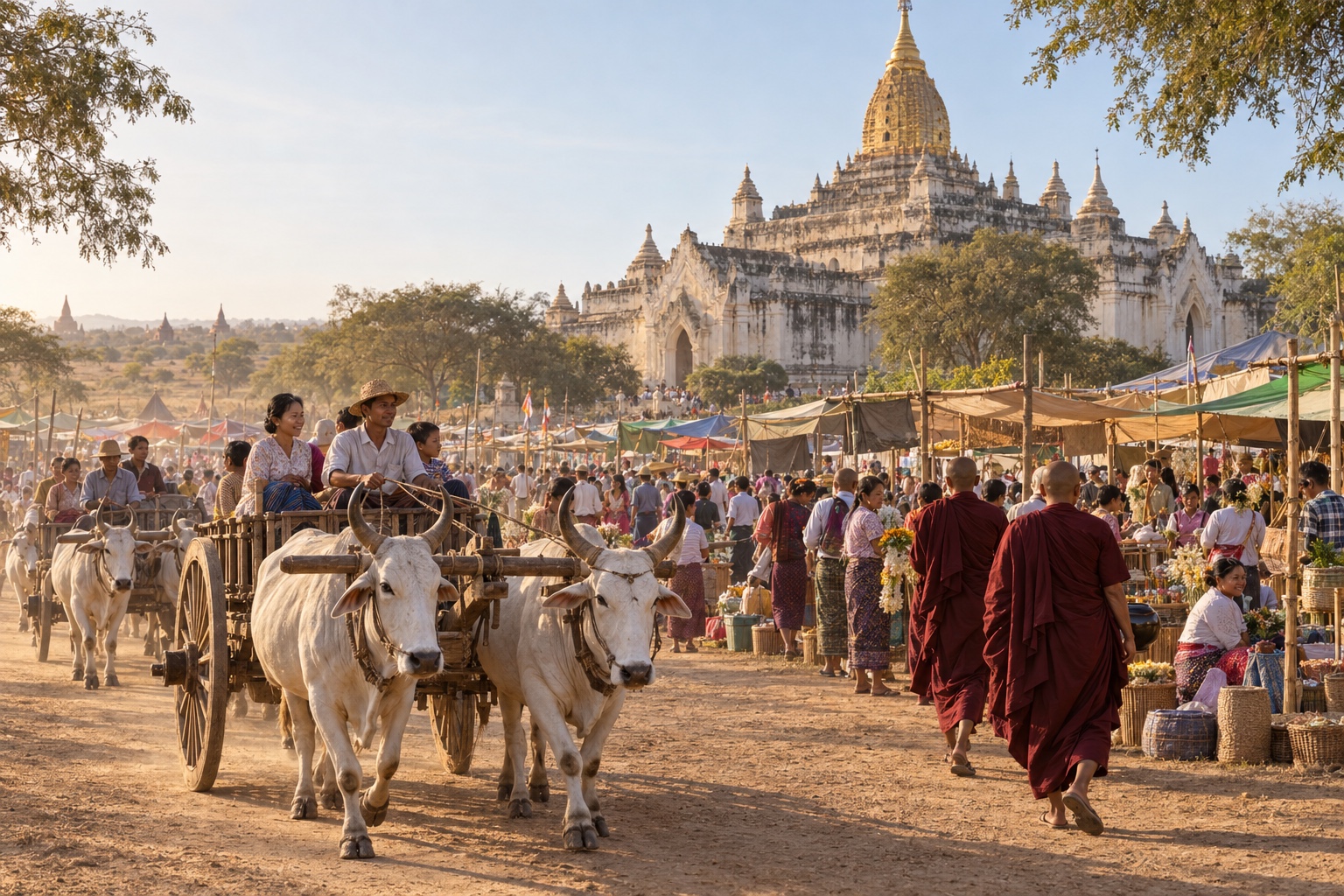
Before the market becomes loud, pilgrims move toward Ananda Temple with offerings while monks receive alms and ox carts stand beyond the sacred approach. The festival joins forms that outsiders often separate: Buddhist worship, rural travel, household shopping, temporary camps, food, and entertainment. Ananda’s white-and-gilded architecture remains the fixed center around which this post-harvest gathering forms.

Bagan contains thousands of Buddhist monuments across a dry plain shaped by the Pagan kingdom. Ananda Temple, built under King Kyanzittha in the early twelfth century, is among the landscape’s most revered and architecturally distinguished sites. The annual festival brings living religious practice into a place often consumed primarily as archaeology.

Visitors must place worship before sightseeing. Remove shoes where required, dress modestly, keep offering routes open, never enter pilgrim camps without invitation, and avoid using monks or ox-cart families as portrait props. Conditions in Myanmar require current, authoritative security judgment outside the evergreen article.

Why This Festival Is Special

Travelers choose Ananda over a general the host destination visit because the archaeological landscape becomes visibly alive through pilgrimage, almsgiving, rural camps, and post-harvest trade centered on one revered temple.

The ox-cart presence and market function provide an unusual connection between devotion and household economy. Few temple festivals allow visitors to see sacred architecture, rural mobility, merit-making, and practical exchange operating together at this historic scale.

The timing after harvest gives commerce additional meaning. Rural visitors historically use pagoda festivals to worship, reunite, exchange news, and purchase household goods, clothing, tools, or food after the agricultural cycle. Ananda is therefore the stronger choice for travelers seeking a living Buddha pujaniya festival rather than a monument-only itinerary. The temple’s architectural stature, the scale of the the host destination plain, and the visible ox-cart pilgrimage allow sacred, economic, and social functions to be understood in one place. Living pilgrimage restores human time and purpose to the monumental plain. That continuing social function separates the gathering from heritage reenactment and makes respectful observation far more important than unrestricted access.

Festival Experience

What to Expect

Arrive before sunrise with a local guide who understands temple etiquette. Observe almsgiving from the edge, enter the shrine quietly, and save architectural photography for a moment when worshippers are not blocked. Eat breakfast before exploring the market lanes.

By midday, dust, sun, animals, and commerce intensify. Walk slowly, buy directly from sellers, and recognize that many rural families historically used the fair for practical post-harvest purchases. Leave before fatigue weakens respect for sacred space or protected archaeology.

Ananda Pagoda Festival changes character as its defining program approaches. Preparation reveals skill, peak activity reveals collective confidence, and dispersal reveals the labor required to restore ordinary space. Eat before fatigue becomes urgency, refill water, and take one genuine pause away from amplified sound or dense visual material. The event becomes more memorable when attention can linger on a person, object, performance, or exchange instead of being consumed by navigation.

Festival Highlights

  • Entering Ananda Temple as a worshipper’s space rather than an archaeological attraction
  • Seeing rural pilgrims arrive and camp by traditional ox cart
  • Watching almsgiving and offerings organize the sacred rhythm
  • Walking market lanes that historically served post-harvest household needs
  • Understanding why trade and devotion coexist at a Myanmar pagoda festival

Getting There & Around

Where It Happens

Ananda Temple and its surrounding festival grounds within the Bagan cultural landscape, where pilgrims, monks, ox carts, market stalls, camps, and devotional programs gather form the event’s working geography. Read the layout before arrival and distinguish the public entrance, performance or exhibition areas, food zones, toilets, first aid, and the gate needed for departure. The most famous building or route is an anchor, not the whole experience; surrounding barns, streets, memorials, gardens, or neighborhood spaces often carry the destination’s more revealing detail.

Place affects behavior. In Bagan, Mandalay Region, Myanmar, allow working participants, residents, worshippers, exhibitors, and service crews to move before taking a photograph or stopping in a doorway. Do not enter animal, backstage, assembly, private, or memorial areas unless they are clearly open. A deliberate route should connect two or three meaningful zones and return naturally toward transport instead of drawing a decorative line across every corner of the map.

Getting Around

A licensed local driver, bicycle only on permitted routes, and walking around the temple precinct without crossing protected ruins or pilgrim camps connects most directly with Ananda Temple and its surrounding festival grounds within the Bagan cultural landscape. Save that anchor and the real departure edge offline; crowds gathering for the principal Buddha pujaniya observances, when monks, pilgrims, offerings, ox-cart camps, commerce, and Ananda Temple’s sacred architecture converge can turn a short final approach into the longest movement of the day.

End the last program on the side of Ananda Temple and its surrounding festival grounds within the Bagan cultural landscape that leads toward lodging. Surface, access, and shuttle questions need answers specific to cold dawns, dusty days, strong sun, smoke, crowded temple entrances, animals, uneven archaeological paths, and complex regional security conditions. After the principal Buddha pujaniya observances, when monks, pilgrims, offerings, ox-cart camps, commerce, and Ananda Temple’s sacred architecture converge, remain with companions and use only the licensed, authorized, or organized transport described in the plan, even when an unlit shortcut looks faster.

Visitor Guide

Festival Food & Drink

Mohinga supplies a concrete taste of Bagan, Mandalay Region, Myanmar before the principal Buddha pujaniya observances, when monks, pilgrims, offerings, ox-cart camps, commerce, and Ananda Temple’s sacred architecture converge. Eat a substantial local dish while queues remain manageable, then use smaller portions to carry energy through the program. Ask cooks about the ingredient, family method, farm, fisher, or regional history behind the plate. Share rich servings, drink water, and protect one seated pause for tasting without stage noise or crowd pressure.

Choose vendors with sound hot and cold holding, especially for seafood, dairy, meat, and ice. Allergy questions need direct answers, and necessary medication belongs on the traveler, not at the hotel. A breakfast or late meal beyond the controlled venue can reveal local food at its ordinary pace while keeping the festival budget in check.

Must Try

• Mohinga — Rice noodles in fish broth with herbs and crisp garnishes.
• Mont lin ma yar — Small rice-flour cakes cooked in paired molds.
• Tea leaf salad — Fermented tea leaves with nuts, seeds, garlic, and legumes.
• Palm jaggery — Toddy-palm sweet eaten in small pieces after a meal.

Budget & Costs

In Old Bagan, Nyaung-U, or New Bagan with a licensed local driver and a route that avoids restricted archaeological ground is likely to be the largest planning cost, followed by a licensed local driver, bicycle only on permitted routes, and walking around the temple precinct without crossing protected ruins or pilgrim camps and any premium access tied to the principal Buddha pujaniya observances, when monks, pilgrims, offerings, ox-cart camps, commerce, and Ananda Temple’s sacred architecture converge. Price those three pieces before treating the public atmosphere as inexpensive. Set a separate allowance for mohinga, drinks, and programs that carry a second ticket.

Value comes from spending where a Buddhist temple landscape where one of Bagan’s most revered monuments becomes the center of rural pilgrimage and a post-harvest market fair is actually represented: local cooks, makers, musicians, guides, clubs, cultural groups, or working crews. Use recognized sales channels and carry payment methods appropriate to Bagan, Mandalay Region, Myanmar, with emergency funds stored separately..

Tips for First-Time Visitors

Dawn worship and almsgiving before the market lanes and day visitors reach full density provides the clearest orientation to Ananda Pagoda Festival. Build the visit around entering ananda temple as a worshipper’s space rather than an archaeological attraction, one contextual program, and mohinga. Footwear and clothing must answer cold dawns, dusty days, strong sun, smoke, crowded temple entrances, animals, uneven archaeological paths, and complex regional security conditions; phone power, water, and medication belong on the body. Save the exact meeting landmark near Ananda Temple and its surrounding festival grounds within the Bagan cultural landscape before the signal or crowd deteriorates.

Watch how residents, artists, athletes, worshippers, or crews use the space before joining. Close portraits require permission, and working equipment, devotional objects, costumes, boats, art, or competition areas remain untouched. Local names in the Highlights and Key Days sections should guide conversation. Keep one open hour around dawn worship and almsgiving before the market lanes and day visitors reach full density so a destination-specific encounter can develop without forcing the schedule.

Safety

Cold dawns, dusty days, strong sun, smoke, crowded temple entrances, animals, uneven archaeological paths, and complex regional security conditions define the real safety profile at Ananda Temple and its surrounding festival grounds within the the host destination cultural landscape. Prepare the body before arrival with food, water, suitable clothing, and any respiratory, motion, or hearing protection the setting demands. Locate first aid and shelter, secure valuables, and respect every route, marine, stage, devotional, or working barrier.

Crowd pressure will be greatest around the principal Buddha pujaniya observances, when monks, pilgrims, offerings, ox-cart camps, commerce, and Ananda Temple’s sacred architecture converge. The group needs a physical meeting point and a separation plan before that phase begins. Step out laterally when movement tightens, follow local staff immediately during weather or emergency action, and leave through a licensed local driver, bicycle only on permitted routes, and walking around the temple precinct without crossing protected ruins or pilgrim camps. Companions should know when anyone departs; isolated pickups and anonymous rides are never worth a shorter wait.

Cultural Significance

Ananda Temple was built in the early twelfth century and became one of Bagan’s major Buddhist monuments. Its pagoda festival belongs to Myanmar’s tradition of Buddha pujaniya gatherings, combining merit-making, almsgiving, pilgrimage, market exchange, and social reunion.

Monks, pilgrims, ox-cart families, traders, cooks, craftspeople, temple trustees, conservation workers, and nearby communities sustain the gathering. Their needs take priority over tourism, especially where worship, livelihood, and heritage protection intersect.

Plan Your Journey

When to Go

The cool dry-season pilgrimage period after harvest, when rural families camp near Ananda Temple and worship, almsgiving, trade, food, and entertainment share the sacred precinct offers the durable window for Ananda Pagoda Festival. Earlier in the run usually gives displays a fresher feel and makes orientation easier; later visits carry stronger last-chance energy. Weekdays are best for attentive time in exhibitions, barns, or cultural spaces, while weekends bring the fullest public atmosphere and the most difficult movement. The best arrival is near opening for a fair or biennale and in late afternoon for a street carnival whose true peak comes after dark.

Build the day around local conditions rather than a calendar claim. Prepare for cold dawns, dusty days, strong sun, smoke, crowded temple entrances, animals, uneven archaeological paths, and complex regional security conditions. Check the forecast before leaving the hotel, but carry a layer, water, and rain protection even when the morning looks settled. If the priority is the principal Buddha pujaniya observances, when monks, pilgrims, offerings, ox-cart camps, commerce, and Ananda Temple’s sacred architecture converge, conserve energy with dawn worship and almsgiving before the market lanes and day visitors reach full density and a seated meal.

Where to Stay

In Old Bagan, Nyaung-U, or New Bagan with a licensed local driver and a route that avoids restricted archaeological ground gives Ananda Pagoda Festival its most practical base. Test the room against the difficult return after the principal Buddha pujaniya observances, when monks, pilgrims, offerings, ox-cart camps, commerce, and Ananda Temple’s sacred architecture converge, not an ordinary midday map estimate. Closures, rural roads, marina controls, shuttles, or dense pedestrian zones can change the true distance. Confirm late entry and transport with the property, then save its address offline.

A meal and an unprogrammed walk in Bagan, Mandalay Region, Myanmar should remain part of the stay. Central rooms cost more but reduce exposure to the festival’s hardest transfer; outer lodging needs a named driver or dependable route. Weather and operations can shift, so flexible terms carry real value.

Bottom Line & Key Days

Bottom Line

Ananda Pagoda Festival is for travelers who can let devotion outrank the photograph. Arrive before dawn, learn the offering rhythm, buy with respect, and leave pilgrim camps and protected monuments undisturbed. the host destination’s strongest festival image is not a balloon above empty ruins, but a line of worshippers approaching Ananda while ox carts, market fires, and the first light reveal a sacred landscape still in use. The experience suits culturally prepared travelers who accept limited access and place worshippers first. Its reward is a the host destination understood not as abandoned splendor, but as an inhabited field of merit and exchange. Living use is the monument’s most important context.

Key Days

Pilgrim Dawn

Observe almsgiving and temple worship quietly before the market reaches full intensity.

Market Day

Walk the post-harvest fair as a place of household exchange, food, and rural reunion.

Pujaniya Peak

Keep shrine approaches clear as monks, offerings, pilgrims, and sacred ceremony organize the precinct.

Ready to Experience Ananda Pagoda Festival?

You've explored what makes this festival special. Now it's time to plan your trip. Compare flights, book your hotel, arrange transportation, and take care of your travel essentials—all in one place.

✈ Find Flights

Loading booking widget...

Booking is completed on Expedia in a new tab.

🏨 Find Hotels

Search places to stay

Powered by Booking.com

Booking is completed on Booking.com in a new tab.

Rail & Bus Travel

Compare train and coach routes for the journey.

Compare Routes

Things to Do

Discover tours and attractions before or after the festival.

Explore Experiences

eSIM Mobile Data

Stay connected abroad without traditional roaming charges.

Get an Airalo eSIM

Travel bookings are provided by our trusted partners. We may earn a commission when you book through these links, at no additional cost to you.

Independent Editorial Standards

Every Follow the Festivals guide is independently researched and regularly reviewed using official festival information, destination resources, and trusted travel references. We also welcome verified updates from festival organizers, destination marketing organizations, tourism partners, and local experts to help keep our guides accurate, current, and useful for travelers.

Represent this festival or have a verified update to share? We'd love to hear from you through our contact page.