
Follow the Festivals

SXSW

SXSW

Austin, United States

2027-03-13 - 2027-03-21

The Story

Festival Overview

For one week, almost every room in central Austin appears to be asking the same question.

What happens next?

A film enters a theater before anyone knows how audiences will receive it. A band carries equipment into a venue where the right person may—or may not—be standing near the back. A founder condenses years of work into a brief pitch. A comedian tests material after midnight. Inside hotel meeting rooms, restaurants, converted event spaces and temporary stages, people present ideas that have not yet secured their place in the world.

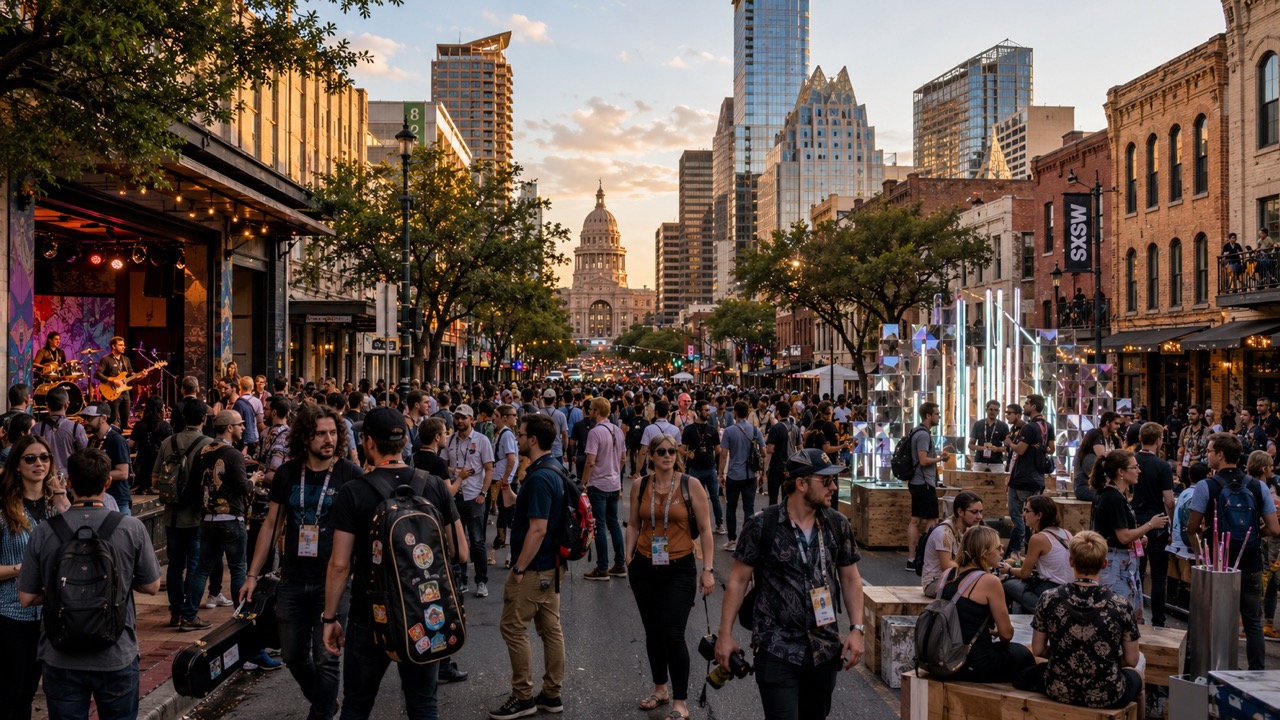
SXSW, formally South by Southwest, is Austin’s annual conference-and-festival gathering across music, film and television, innovation, comedy, business and culture. Its programme combines professional sessions, screenings, premieres, live showcases, exhibitions, competitions, networking events, parties and public experiences across a changing network of venues.

It is not one festival with several side programmes.

A filmmaker, musician, startup founder, conference delegate and casual visitor may all say they are attending SXSW while experiencing substantially different events. Credentials determine access. Venue capacity limits it further. Official showcases coexist with unofficial concerts, brand activations and public events that belong to the wider week without necessarily belonging to the official programme.

Austin holds these separate ambitions close enough to encounter one another.

A theater door opens near a music venue. A conference lobby empties toward a patio where another conversation begins. An attendee heading toward one industry walks through several others before arriving.

The city gives unfinished work a public life.

No one yet knows what it will become.

Why This Festival Is Special

Most professional events separate industries to make them easier to navigate.

SXSW places them beside one another.

Music does not remain inside a music district. Film does not stay inside cinemas. Technology does not disappear into an exhibition hall. The conference moves through a city where creative work, nightlife, food, public space and professional ambition repeatedly overlap.

Austin made that convergence possible before SXSW gave it a global scale.

The city’s clubs, theaters, bars and informal gathering spaces allowed an event founded around music to expand without losing the sense that something significant might happen inside a relatively small room. As film, technology and other industries entered the programme, the distance between them remained short enough for attendees to cross physically.

That proximity creates friction as well as possibility.

Local venues must operate inside a week of temporary demand. Residents encounter street closures, noise and crowds. Independent artists compete for attention beside established companies and expensive activations. Professional access can depend upon credentials, sponsorship and status even while the event celebrates open discovery.

The article should not hide those tensions. They explain why SXSW feels different from a contained festival campus.

Austin does not become neutral ground.

It becomes a city where many definitions of success are temporarily trying to occupy the same blocks.

Festival Experience

What to Expect

SXSW is an event of simultaneous possibilities and finite access.

Conference sessions begin in the morning. Film and television screenings extend from daytime into night. Music showcases occupy clubs, theaters, hotels, outdoor stages and temporary venues. Comedy, exhibitions, pitches, interviews, receptions and sponsored events fill the spaces between them.

The programme is too large for completion.

A useful day usually contains one anchor: a session, premiere, showcase or meeting important enough to organize the surrounding hours. Everything else should remain negotiable. A schedule built from consecutive events in different venues can collapse after one queue, delayed session or conversation lasts longer than expected.

Access operates through several layers. Badges and wristbands are sold for different programme areas. Some credentials provide broader access than others. Certain events use reservations or priority systems. Even correct credentials may not guarantee admission after a room reaches capacity.

Unofficial events create another layer. Some are open to the public, some require separate registration, and others operate through invitations or limited guest lists. A company logo, festival-themed advertisement or downtown location does not make an event part of SXSW’s official programme.

This complexity is not a reason to arrive without a plan. It is a reason to understand what the plan cannot control.

The strongest encounters often occur near the day’s original purpose: an unfamiliar artist playing before the act you came to see, a filmmaker answering questions after a screening, or someone from another industry recognizing a problem similar to your own.

SXSW does not remove uncertainty from creative work.

It gives uncertainty a room full of witnesses.

Festival Highlights

  • *Conference sessions**
  • Keynotes, featured conversations, panels, workshops and presentations bring together creators, researchers, executives and public figures across multiple industries. The strongest session may not be the one with the most recognizable speaker. Smaller rooms often allow more specific questions and more useful exchanges.
  • *Film and television premieres**
  • Screenings range from major premieres to independent features, documentaries, episodic work, shorts, music videos and experimental forms. Audience response becomes part of the experience, especially when filmmakers and performers remain for a conversation afterward.
  • *Music showcases**
  • Official showcases introduce emerging, developing and established artists to audiences that include fans and industry professionals. Sets are often compact, and several artists may share one bill. Arrive for the entire showcase rather than treating every earlier performer as an obstacle before the expected name.
  • *Comedy**
  • Stand-up, podcasts, improv and other formats extend the event’s creative collision into late-night rooms. Comedy can provide relief from professional intensity while remaining a serious part of the programme.
  • *Pitch competitions and exhibitions**
  • Founders and innovators present products, companies and ideas before judges, investors, media and potential users. The revealing moments occur not only in polished presentations but in the questions that expose what remains unresolved.
  • *Audience conversations**
  • A question after a film, a discussion following a panel or a brief exchange beside a stage can change the meaning of the work just presented. Stay for these transitions when access permits. SXSW is built as much from response as presentation.
  • *Austin’s independent venues**
  • The week depends upon rooms with identities formed long before the event arrived. A small club, historic theater or neighborhood bar changes how work is encountered. The venue is not an interchangeable container.
  • *The wider SXSW ecosystem**
  • Unofficial showcases, public installations, brand events and independent gatherings spread beyond the credentialed programme. They can offer genuine discovery, but their access, sponsorship and relationship with the official event should be understood accurately.

Getting There & Around

Where It Happens

SXSW does not occupy one permanent venue.

Downtown Austin forms its principal connective tissue. Hotels, theaters, conference rooms, clubs, restaurants, outdoor spaces and temporary installations create a shifting campus across active city streets. The exact hubs and programme assignments should be confirmed for the intended edition.

The area around Congress Avenue provides a useful orientation through central Austin. The Texas State Capitol rises to the north, while the avenue descends toward Lady Bird Lake. Moving east or west from this line leads into distinct venue clusters and different versions of the event.

The Red River Cultural District concentrates live music within a series of clubs and performance spaces. During SXSW, established venues share attention with temporary stages and sponsored events. The district is most meaningful when its year-round musical identity remains visible beneath the festival branding.

East Austin contains additional bars, restaurants, galleries, venues and event spaces. Some programming belongs to official SXSW; much does not. Crossing into the district should be a choice to experience that part of Austin, not an assumption that the entire neighborhood is a credential-free extension of the festival.

Theaters and screening rooms distribute Film & TV programming across the central city. Conference sessions may cluster in hotels or temporary industry hubs. Music can appear almost anywhere capable of supporting a safe performance.

This fluid geography is one of SXSW’s strengths and one of its practical difficulties.

Austin becomes the venue, but the entire city does not become accessible.

Getting Around

Walking connects more of SXSW than any other form of transport.

Central Austin’s grid makes distances appear manageable, but repeated crossings accumulate. A traveler moving among downtown, Red River, East Austin and areas south of the lake can cover several miles before the evening programme begins.

Group the day geographically. Two good events within nearby blocks are usually more valuable than three ideal events separated by uncertain transport.

Public buses, local rail, festival shuttles and circulator services may support the current edition. Routes and temporary stops should be confirmed close to arrival. Road closures can move boarding locations away from their ordinary positions.

Rideshares become expensive and slow during peak transitions. Designated pickup areas may be several blocks from venue entrances, and surge pricing can turn a short ride into a major daily expense. Taxis encounter the same traffic.

Bicycles and scooters can shorten certain trips, but dense pedestrians, unfamiliar streets, rail tracks, uneven surfaces and impaired nighttime riders create risks. Use designated lanes, park only where permitted and never assume a blocked sidewalk is an acceptable return point.

Driving is rarely useful for moving among central events. Parking is limited, streets close and a car left near one morning session may become difficult to retrieve after the district changes for the evening.

Comfortable shoes are an access credential of their own.

They cannot open a venue, but they determine how many doors the traveler can still reach.

Visitor Guide

Festival Food & Drink

Austin begins long SXSW days with a tortilla folded around something hot.

Breakfast tacos fit the event because they do not require ceremony. Eggs, potatoes, beans, cheese, bacon, chorizo or vegetables arrive in combinations substantial enough to carry someone through a morning session and portable enough to eat before the first queue forms.

Migas extend the same logic onto a plate. Eggs, tortilla strips, peppers, onions and cheese create a breakfast that feels improvised without being accidental. Add salsa slowly; the day is long.

Barbecue asks for a different relationship with time. Brisket, ribs and sausage cannot be treated as another appointment squeezed between two distant venues. The smoke, queue and shared table deserve their own space. Choose one meal when missing something else has already been accepted.

Food trucks belong naturally to SXSW’s temporary geography. They feed patios, parking areas, venue districts and people whose next event begins too soon for a conventional meal. The best choice is often the truck already serving the block where the day has carried you, not the famous one requiring another journey.

Queso appears at tables where a brief drink becomes a longer conversation. Tacos stretch far beyond breakfast. Kolaches and their savory Texas relatives provide early fuel. Local beer accompanies showcases and patios, while Austin’s expanding nonalcoholic options allow late nights to remain social without making every venue visit an exercise in drinking.

Eat before hunger becomes another line.

Downtown restaurants fill quickly, reservations interrupt uncertain schedules and venues may restrict outside food. Carry water and a small snack even when the day appears to contain several meal opportunities.

**Must Try**

• **Breakfast tacos:** Flour or corn tortillas filled with eggs, potatoes, beans, cheese, meat or vegetables and finished with salsa.

• **Migas:** Scrambled eggs with tortilla strips, peppers, onions and cheese, often served with beans, potatoes and tortillas.

• **Central Texas barbecue:** Smoked brisket, pork ribs, sausage and other meats served by weight with simple sides.

• **Queso:** Melted cheese dip served with tortilla chips and often supplemented with peppers, beans, meat or guacamole.

• **Kolaches and klobásníky:** Sweet Czech pastries and savory sausage-filled pastries that became part of Central Texas food culture.

• **Food-truck tacos:** A broad Austin category extending through Mexican, Tex-Mex and internationally influenced fillings.

• **Chicken-fried steak:** Tenderized beef breaded, fried and served with cream gravy.

• **Local beer or a nonalcoholic alternative:** Austin offers both a deep craft-beer culture and a growing range of alcohol-free drinks suited to long festival nights.

The meal does not need to become another achievement.

It needs to return enough attention for the next room.

Budget & Costs

SXSW can be expensive before the first event begins.

Credentials range substantially in price according to programme access and purchase period. Buy only after identifying the primary purpose of the trip. Registration policies, transfer rules and included access should be reviewed carefully.

Accommodation is often the largest expense. Downtown convenience carries a premium, while less central lodging adds transport time and cost. Reserve early, but confirm cancellation terms in case professional plans change.

Food can remain moderate through tacos, food trucks, casual counters and grocery supplies. Barbecue destinations, client dinners, hotel restaurants and repeated venue drinks increase the daily budget quickly.

Transport appears inexpensive when each journey is considered separately. Several rideshares during surge periods can overturn that assumption. Walking and public transport reduce costs when the day is geographically coherent.

Unofficial events advertised as “free” may still require registration, invitations, data sharing, early arrival or purchases. Free admission does not guarantee entry.

Professional attendees should also account for the cost of time away from work, materials, follow-up and the possibility that no immediate opportunity will emerge. SXSW offers exposure and proximity, not a guaranteed return.

Budget for the event you can actually sustain.

Exhaustion makes even expensive access difficult to use.

Tips for First-Time Visitors

Decide why you are attending before buying a credential.

A music traveler, filmmaker, innovation professional and multidisciplinary visitor need different access. The most expensive badge is not automatically the correct one, and a lower-cost credential is not a bargain if it excludes the programme that justified the trip.

Learn the official access hierarchy for the intended edition. Understand reservations, priority entry, secondary access, capacity rules and credential pickup before the first event. These systems can change.

Build each day around one anchor. Add a second event nearby and keep one alternative available. A schedule with no room for queues, meals or conversation is a list of disappointments waiting for opening time.

Distinguish official SXSW programming from the wider ecosystem. Check who operates the event, what registration is required and whether an invitation or separate ticket overrides festival credentials.

Arrive early for anything that would be painful to miss. Correct access does not create another seat after the room is full.

Protect periods without programming. An unscheduled hour allows food, notes, transport and accidental conversation to occur without making the traveler late for something else.

Do not collect business cards or contacts without context. Remember why the conversation mattered, then follow up after the week with enough specificity that the other person can remember it too.

Respect Austin outside the event. Do not block residential entrances, leave scooters across sidewalks or treat service workers as temporary festival infrastructure.

When a room is full, let it be full.

Another door is already preparing to open.

Safety

The principal risks come from crowding, traffic, weather, alcohol, hearing exposure and fatigue.

March weather can change quickly. Carry water, sun protection and a light layer even when the morning appears settled. Outdoor events may be delayed or altered by thunderstorms, wind or temperature changes.

Venue capacities are enforced for safety. Do not argue with staff, obstruct exits or remain in a doorway after entry has closed. Identify emergency exits when entering densely occupied rooms.

Use hearing protection during repeated music showcases. Damage accumulates across the week, especially when several loud performances occur each night.

Alcohol is readily available, but professional receptions and showcases can extend from afternoon into early morning. Eat, alternate with water and preserve enough judgment to navigate streets and transport safely. Never leave a drink unattended.

Downtown traffic patterns change during the event. Cross at designated points, remain alert around rideshare zones and do not assume a closed street is free from authorized vehicles.

Scooters and bicycles require particular care after dark. Wear a helmet when one is available, avoid riding while impaired and watch for tracks, potholes and pedestrians entering lanes unpredictably.

Keep credentials, identification and essential medication secure. Badge replacement policies vary, and displaying professional information publicly can create additional privacy concerns.

Fatigue changes decisions before it feels like illness. Missing one late event may preserve the following day.

SXSW rewards attention.

It cannot return what exhaustion has already spent.

Cultural Significance

SXSW began in Austin as a music event created to bring wider industry attention to artists working beyond the dominant coastal centers.

Its growth reflected both Austin’s creative identity and the increasing overlap among industries shaping culture. Film entered. Interactive and technology programming expanded. Comedy, education, gaming, media, design and other fields found places within the larger system.

That expansion changed the event and the city around it.

SXSW helped establish Austin as a global gathering point for creative and technology industries. It created opportunities for artists, filmmakers, founders and speakers while attracting corporate investment, temporary activations and enormous visitor demand. Success increased the number of people seeking access to the same rooms that had made discovery feel intimate.

Austin changed as well. Population growth, rising costs, redevelopment and pressure on independent venues complicated the image of an endlessly accessible creative city. The event cannot be separated from debates about who benefits from Austin’s cultural growth and who struggles to remain part of it.

Those tensions do not invalidate SXSW.

They make its central question more urgent.

Who receives a room? Who reaches an audience? Which work becomes visible? Which venue survives long enough to host another beginning?

SXSW celebrates what may come next.

Austin reminds it that every future occupies someone’s present.

Plan Your Journey

When to Go

SXSW takes place in March, when Austin can move through several versions of spring in one week.

Warm afternoons may encourage outdoor events, while a cold front can make the same patio uncomfortable the following evening. Thunderstorms can disrupt open-air programming, and strong sun can become tiring during long walks between venues.

Arrive before the first programme essential to your visit. Badge collection, hotel check-in and orientation consume more time than expected when completed after the event is fully underway. Use the first walk through downtown to identify venue entrances, transport stops and the distance between the day’s proposed anchors.

The programme structure can change between editions. Music, Film & TV, Innovation and Comedy may overlap differently, while venue hubs, credential privileges and reservation systems can be redesigned. Confirm the current event architecture rather than relying on the rhythm of an earlier visit.

The best arrival period depends upon purpose.

Conference and professional attendees should be present before their principal industry programming begins. Film travelers need to understand the screening and reservation calendar. Music-focused visitors should prioritize showcase nights and preserve energy for late hours. Casual travelers interested in public events may find that a shorter stay captures the wider Austin atmosphere without requiring a full credential.

Remain for one quiet morning after the final personal commitment if possible. SXSW can make Austin feel as though the entire city exists to receive pitches, premieres and performances. Watching ordinary life return prevents the event from becoming the only version of Austin the traveler remembers.

Where to Stay

Downtown offers the greatest convenience and the highest prices.

Many conference spaces, theaters, hotels and temporary venues cluster within walking distance. Staying here allows the day to be divided into shorter outings and provides a place to change clothes, charge devices or rest before late-night programming. That flexibility is valuable during a week extending from morning sessions into music and comedy after dark.

The Red River area suits music-focused travelers who want to remain close to a concentration of clubs and live venues. Noise, street activity and late crowds are part of the location. A room that appears convenient on a map may not provide a quiet night.

East Austin offers restaurants, bars, creative spaces and additional official or unofficial events, depending on the edition. The district’s popularity has also changed its affordability and relationship with long-established communities. Stay here for the neighborhood itself, not because every event advertised nearby will be accessible.

South Congress places travelers within one of Austin’s best-known walking districts, with restaurants, shops and live music beyond the central event footprint. Crossing the river adds time to each downtown journey, especially when streets and transport services are under pressure.

Areas near the University of Texas or farther north can provide more moderate accommodation and a clearer separation from the event’s intensity. Rail or frequent bus access matters more than straight-line distance.

Do not choose lodging based only on an advertisement describing it as “near SXSW.” The event has no single gate. Its venue system changes, and two locations within downtown may serve completely different programmes.

The most valuable hotel feature may be neither style nor nightlife.

It may be the ability to reach the room between versions of yourself.

Bottom Line & Key Days

Bottom Line

At SXSW, beginnings rarely announce themselves clearly.

A song starts in a room that is still half full. A filmmaker waits near the wall while strangers decide what the ending meant. A founder closes a presentation and looks toward a panel whose questions may change the company more than its applause. On a patio outside, two people continue a conversation neither placed on the schedule.

Most of these moments will not become famous.

The band may return home without a deal. The film may search longer for an audience. The idea that filled one conference room may disappear beneath another year of work. Austin cannot promise that exposure will become momentum.

It can provide the first witnesses.

For several days, the city places unfinished ambitions close enough to hear one another through the walls. Music enters professional conversation. Technology encounters storytelling. A screening releases its audience into streets already carrying another beginning.

Then the rooms empty.

Chairs are reset. Cables are gathered. Temporary signs come down, and the doorway that belonged to one person’s possible future prepares to receive someone else.

Austin does not decide what happens next.

It gives the unfinished somewhere to begin.

Key Days

**Credential collection and orientation**

The event begins practically before it begins editorially. Collect credentials, learn the current access system and walk the central venue geography before the first essential programme.

**Opening conference sessions**

Early keynotes and industry programming establish the questions likely to recur across the week. They also create the first major convergence of attendees entering Austin with different professional purposes.

**Film and television premiere period**

Screenings, red carpets, filmmaker conversations and industry events bring finished work into first public encounters. Reservation demand and venue capacity require deliberate planning.

**Music showcase nights**

Official artists perform across multiple venues, often within bills curated by labels, agencies, media organizations, international presenters and industry groups. The complete showcase usually reveals more than one isolated set.

**Innovation exhibitions and pitches**

Products, startups and developing ideas enter public and professional evaluation. These events reveal the language through which unfinished work asks for support.

**Comedy programme**

Comedy occupies late-night rooms, podcast stages and performance venues, allowing another form of work-in-progress to meet an immediate audience.

**Public and unofficial programming**

Independent showcases, sponsored activations and community events expand the week beyond official credentials. Their schedules and access must be verified separately.

**The final showcases and departures**

As programmes close, temporary venues begin disappearing and attendees turn toward follow-up. The event’s practical value often depends on what happens after Austin is no longer holding everyone in the same place.

Ready to Experience SXSW?

You've explored what makes this festival special. Now it's time to plan your trip. Compare flights, book your hotel, arrange transportation, and take care of your travel essentials—all in one place.

✈ Find Flights

Loading booking widget...

Booking is completed on Expedia in a new tab.

🏨 Find Hotels

Search places to stay

Powered by Booking.com

Booking is completed on Booking.com in a new tab.

Rail & Bus Travel

Compare train and coach routes for the journey.

Compare Routes

Things to Do

Discover tours and attractions before or after the festival.

Explore Experiences

eSIM Mobile Data

Stay connected abroad without traditional roaming charges.

Get an Airalo eSIM

Travel bookings are provided by our trusted partners. We may earn a commission when you book through these links, at no additional cost to you.

Independent Editorial Standards

Every Follow the Festivals guide is independently researched and regularly reviewed using official festival information, destination resources, and trusted travel references. We also welcome verified updates from festival organizers, destination marketing organizations, tourism partners, and local experts to help keep our guides accurate, current, and useful for travelers.

Represent this festival or have a verified update to share? We'd love to hear from you through our contact page.

Photo Credits