
Follow the Festivals

Saint Lucia Carnival

Saint Lucia Carnival

Castries, Saint Lucia

2027-07-01 - 2027-07-21

The Story

Festival Overview

Inside a Castries mas camp, Carnival begins with unfinished things.

Wire frames wait against a wall. Fabric lies folded beside boxes of beads and feathers. A designer bends one stubborn piece into place while someone nearby tests how a costume will move when its wearer begins dancing. Nothing yet resembles the complete image that will eventually fill the road.

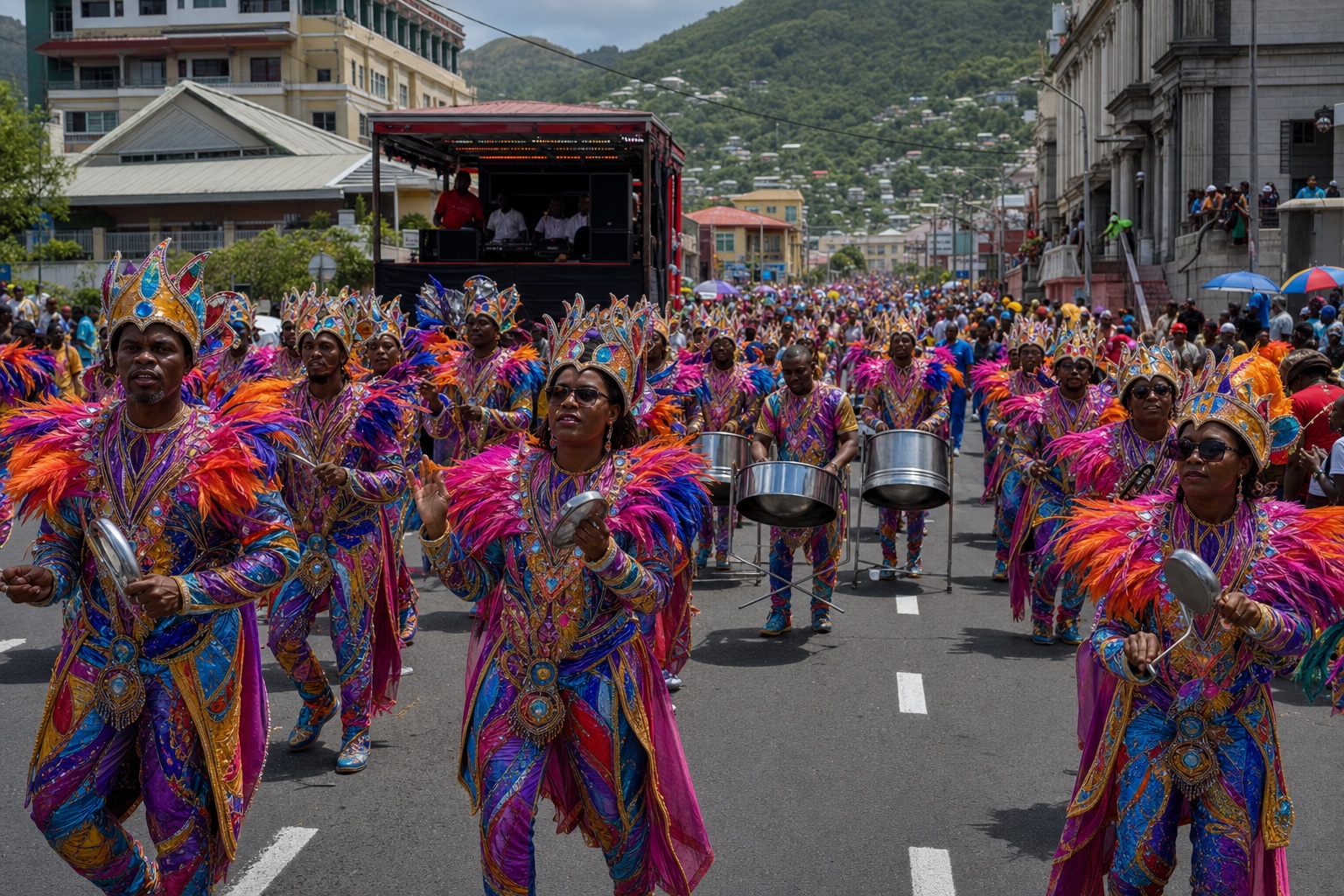
Officially known as **Lucian Carnival**, Saint Lucia Carnival is an island-wide cultural season of calypso, soca, steelpan, pageantry, costume-making, J’Ouvert and community celebration. Competitions and performances build toward the national Parade of the Bands, when thousands of masqueraders carry months of private work through Castries in public.

The road provides the most visible moments, but it does not create them. Calypsonians have written and sharpened their commentary. Steelbands have rehearsed until separate notes move as one. Costume makers have translated themes into color, structure and motion. Carnival bands have recruited members, organized sections and prepared for the physical demands of two long days outside.

Visitors can watch from the roadside, register to play mas with a band, join a J’Ouvert group or attend concerts and commercial fêtes. These are distinct experiences, each with its own access, preparation and cost. Understanding those differences allows Carnival to become something richer than a succession of parties.

By the time Castries fills with music, Saint Lucia is not dressing for a celebration.

It is carrying what it has made into public life.

Why This Festival Is Special

A Carnival costume is made to be seen in motion.

Its structure must survive heat, dancing, wind, crowds and hours on the road. Feathers must hold their shape. Decorative pieces must remain attached. The wearer needs enough freedom to move while carrying an idea that may be far larger than the body beneath it.

That relationship between imagination and physical work runs throughout Lucian Carnival. Calypso begins with language but must reach an audience. Soca must move through speakers, streets and bodies. Steelpan music depends upon individual players striking precisely enough for the orchestra to breathe together. Even apparently spontaneous moments rest on rehearsal, organization and judgment.

Castries allows those separate forms of preparation to meet. A song heard during the season returns from a music truck. A costume first seen during judging expands into an entire band on the road. A rhythm practiced repeatedly inside a panyard suddenly belongs to the crowd surrounding it.

Carnival therefore reveals Saint Lucia through creation rather than display alone. The island does not present visitors with a finished cultural object. It lets them witness ideas moving through different hands until they become public.

Festival Experience

What to Expect

Carnival gathers gradually. Calypso and soca competitions, steelpan performances, pageants, children’s events, community celebrations and privately produced parties develop across the season before J’Ouvert and the Parade of the Bands bring the national programme to its climax.

The atmosphere changes with each setting. A calypso competition asks audiences to listen for language, satire and argument. Panorama reveals the precision beneath steelpan’s brightness. A fête is built around sustained music and dancing. J’Ouvert begins before daylight with paint, powder, mud, old mas characters and crowded movement through the streets. The Parade of the Bands replaces that early-morning disorder with elaborate costume sections, judging, road music and coordinated spectacle.

Spectators and masqueraders experience the parade differently. Roadside visitors can watch the bands pass without purchasing a costume, although access conditions and viewing arrangements vary along the route. Playing mas requires registration with a participating band, usually through a package connected to a particular costume section. Registration may include the costume and various road services, but inclusions differ substantially.

The physical experience is intense. Castries can be hot and humid, music trucks are loud, road surfaces reflect heat and large bands move slowly. A short distance on a map can become a long wait behind barriers or road closures. Shade, water, hearing protection and a realistic transport plan matter as much as the programme.

Carnival remains celebratory without becoming culturally empty. Ole Mas can carry satire and social commentary into J’Ouvert and the parade. Calypso turns public concerns into performance. Costume themes may draw from history, fantasy, politics, nature or contemporary life. The surface is exuberant because considerable thought lies beneath it.

Festival Highlights

  • – The **Parade of the Bands** is the great public release of Carnival. Large bands move through Castries in themed costume sections, accompanied by music trucks and judged for design, portrayal, spirit and performance. Choose a viewing area according to shade, access and transport rather than assuming the busiest point will provide the strongest experience. The parade’s scale becomes clearer when one section is allowed to pass completely before attention moves to the next.
  • – **J’Ouvert** begins before sunrise, when the road fills with soca, paint, powder, mud and Ole Mas. Joining a registered group provides a more participatory experience than watching from the edge, but it also requires clothing and footwear that can be discarded afterward. Ole Mas introduces wit, theatrical exaggeration and social commentary into the morning, reminding the crowd that masquerade can question public life while celebrating within it.
  • – At **Panorama**, steelpan orchestras make collective discipline audible. Watch the players beyond the front row. Bass pans, rhythm sections and less visually prominent instruments hold the arrangement together while melodies travel above them. Hearing the music here changes the way steelpan sounds later when it returns amid the noise of the road.
  • – The **calypso competitions** reward careful listening. Performers use melody, character, humor and verbal precision to address political events, social concerns and ordinary frustrations. Local references may not be immediately clear, but tone and audience response provide an entry point. Reading about major Saint Lucian issues before attending helps the sharpest lines reach beyond their surface rhyme.
  • – The **soca competitions** show another relationship between composition and public movement. Groovy performances emphasize rhythm and melodic control, while power soca drives toward speed, repetition and physical release. Songs tested in competition may later dominate fêtes and the parade route, allowing visitors to hear how music travels from stage judgment into collective memory.
  • – **King and Queen of the Bands** brings the largest individual costumes into concentrated view. These structures can rise far beyond the performer carrying them, turning engineering, balance and design into performance. Watching how a masquerader redirects weight or responds to wind reveals the labor beneath the spectacle.
  • – The **Junior Carnival** allows children and young designers to enter the tradition through their own bands and portrayals. It is not simply a smaller rehearsal for adult Carnival. It shows how costume knowledge, music and public confidence move between generations. Families will often find its pace more approachable than the national culmination, while serious observers gain a clearer view of Carnival’s continuity.

Getting There & Around

Where It Happens

Lucian Carnival belongs to Saint Lucia as a whole, but **Castries** provides the national culmination. The capital’s roads, judging areas and gathering points receive the major bands while Vigie and nearby venues host important competitions and performances.

The exact parade circuit must be confirmed for the current festival. Traffic plans can alter road access, barriers and drop-off locations even when the general geography remains familiar. A hotel described as central may stand on the wrong side of a closure.

The city’s relationship with the harbor, hills and narrow movement corridors becomes particularly visible during Carnival. Castries cannot simply absorb thousands of masqueraders without changing shape. Roads become performance space. Ordinary intersections become waiting areas. Routes normally crossed in minutes begin operating according to the pace of bands and music trucks.

Community celebrations elsewhere on the island expand Carnival beyond the capital. Gros Islet, Vieux Fort, Dennery, Soufrière and other communities may host their own events or seasonal programming. These should be approached as locally shaped experiences, not substitutes for identical versions of the Castries parade.

The strongest visit allows the capital to remain central without pretending that it contains the entire island.

Getting Around

Build transportation around the event you are attending, not around an ordinary Saint Lucia map.

For the Parade of the Bands, decide where you intend to watch, where your driver can legally approach and how you will leave if roads remain closed after the final section passes. Establish a second meeting point beyond the central circuit in case mobile service weakens or police redirect traffic.

Registered masqueraders should use their band’s instructions as the primary movement plan. Assembly points, costume transport and end-of-route arrangements may differ from public information. Ask whether the package includes transport and whether any provided vehicle returns to the original starting point.

J’Ouvert requires an especially deliberate plan. Public transport may be limited at the hour participants need to arrive, while ordinary taxis may not accept passengers covered in paint or mud on the return journey. Confirm both directions with a driver who understands the event, and bring a large towel or protective covering for the seat.

Travel between Rodney Bay, Gros Islet and Castries can become slow during major events. Leave more time than the distance appears to require. Renting a car provides freedom elsewhere on the island but does not solve parade-day parking, road closures or alcohol-related safety.

Walking works within selected parts of Castries, provided the current route, crowd controls and lighting make it appropriate. Comfortable closed footwear is more valuable than footwear chosen only to match an outfit.

Visitor Guide

Festival Food & Drink

Saint Lucia feeds Carnival in the hours surrounding the road.

Breakfast may need to happen before sunrise. Lunch is often delayed by a parade section that refuses to move quickly. After dancing, the body asks for salt, starch, water and something substantial enough to replace what the heat has taken. Food becomes part of endurance without losing its connection to the island.

Green fig and saltfish brings boiled green bananas together with seasoned salted cod, vegetables and aromatics. It carries Saint Lucia’s national culinary identity into an everyday plate sturdy enough for a long morning. Bouyon takes another approach, building warmth and substance through provisions, dumplings, vegetables and meat or fish.

Along the coast, grilled fish allows the island’s relationship with the Caribbean Sea to remain immediate. Accra turns salted fish into crisp fritters suited to eating between events. Bakes can arrive fried and warm, filled or served beside other dishes, while cocoa tea belongs naturally to slower mornings when the previous night’s music has not fully left the body.

Carnival travelers should not treat every meal as an attraction requiring a separate journey. A well-timed breakfast near the accommodation and a dependable post-event meal can protect the rest of the day. Ask residents and hosts where they eat during Carnival, especially when road closures make famous restaurants less practical than a nearby cookshop.

Rum appears throughout the celebration, but heat changes its effect. Alternate alcohol with water and eat before entering long road events. The goal is not to retreat from Carnival’s pleasure. It is to remain present long enough to experience it.

#### Must Try

– **Green fig and saltfish** — Boiled green bananas served with seasoned salted cod, vegetables and aromatics.

– **Bouyon** — A filling soup or stew made with ground provisions, dumplings, vegetables and meat or fish.

– **Accra** — Seasoned saltfish fritters fried until crisp.

– **Grilled fish** — Local catch prepared simply and served with provisions, salad or Creole sauces. **Bakes** — Soft fried bread eaten alone, filled or served alongside savory dishes.

– **Cocoa tea** — A spiced Saint Lucian drink made from local cocoa, often enjoyed in the morning. **Creole bread** — Dense, traditionally prepared bread suited to cheese, fish or a simple snack between events.

A road meal rarely arrives looking as elaborate as a masquerader.

Both carry the work of Saint Lucian hands.

Budget & Costs

The greatest cost difference begins with one decision: **watching the parade or joining it**.

Roadside spectators avoid costume registration, while masqueraders may pay for a band package that can include costume components, refreshments, security and other services. Premium costume sections, elaborate designs and additional fête tickets can increase the total substantially.

Accommodation becomes more expensive when convenience, Carnival access and resort amenities are combined. Staying near Castries may reduce transport difficulty. Staying in Rodney Bay or Gros Islet may provide more leisure infrastructure while increasing transfer costs and dependence on prearranged drivers.

Commercial parties operate separately from the national public events. Buying tickets impulsively can make Carnival expensive without producing a more varied experience. Choose a small number of distinctive events and leave room for competitions or community programming.

Flights, sought-after rooms and mas-band registration reward early commitment. Meals and local transportation offer more realistic opportunities to control spending. Shared transfers, accommodation with a kitchen and restaurants near the hotel can reduce the cost of repeatedly crossing the island.

Budget for the less glamorous necessities: costume transport, waterproof phone protection, hearing protection, replacement clothing, late-night transfers and a recovery day. These expenses often determine whether the experience remains enjoyable.

Tips for First-Time Visitors

Decide early whether you want to **watch Carnival or play mas**. Spectating offers flexibility and allows close attention to costume design, music and movement. Joining a band provides immersion but requires registration, costume selection, collection and compliance with the band’s rules. Neither experience is incomplete.

Choose events with different emotional textures. A combination such as Panorama, a calypso competition, J’Ouvert and one parade day reveals far more than attending several similar fêtes.

Learn the songs before the culmination. Music heard casually online changes once thousands of people recognize the same opening rhythm. Familiarity also helps visitors distinguish between a passing hit and a song carrying particular meaning through the season.

Treat the costume as working structure. Ask your band how to store, assemble and repair it. Bring a small emergency kit only if it can be carried securely without interfering with movement.

For J’Ouvert, protect your phone and identification inside a sealed pouch. Remove jewelry, avoid sentimental clothing and assume paint may travel through every layer. Arrange a place to rinse off before entering shared vehicles or accommodation interiors.

Carry less than expected during the parade. A secure phone, essential identification, payment method and small amount of event-approved protection are generally more useful than a large bag.

Leave space for waiting. Bands pause, judging takes time and routes compress. Those intervals are not outside the celebration. They reveal the communication and adjustment required to keep thousands of people moving together.

Safety

Heat is the most persistent risk. Begin hydrating before reaching the road, use sunscreen and take shade when the band stops. Alcohol does not replace water, and a costume that feels manageable indoors may become far heavier under direct sun.

Protect your hearing near music trucks, speakers and steelbands. Reusable earplugs allow the music to remain clear while reducing fatigue across several events.

J’Ouvert introduces paint, powder, mud, darkness and dense movement. Wear closed footwear with reliable grip, protect your eyes and avoid contact lenses if airborne powder causes irritation. Do not participate if respiratory conditions make smoke, dust or powder unsafe.

Keep valuables minimal and secured against the body. Phone theft or loss becomes easier when both hands are raised and attention is fixed on the music. Establish an offline meeting point with companions.

Costume pieces can restrict vision or increase the space needed to turn. Give large portrayals room, particularly near corners, overhead wires, barriers and judging areas. Never pull on another person’s costume to attract attention.

Use established transportation after late events. Do not drive after drinking, and do not assume an unconfirmed ride will remain available once roads close.

Follow police, event officials and band security when the route compresses. Moving against an advancing band or music truck creates risks that may not be visible from inside the crowd.

Cultural Significance

Carnival gives Saint Lucia a public language built from music, masquerade, satire, competition and collective movement.

Its forms carry layered Caribbean histories. African cultural inheritances, European colonial influence, emancipation, Creole expression and continuing regional exchange have all shaped the ways Saint Lucians create and interpret Carnival. Those histories do not sit in separate display cases. They continue through rhythm, language, character and performance.

Calypso gives social observation a melody capable of reaching large audiences. Ole Mas uses exaggerated dress, humor and theatrical behavior to expose political or everyday contradictions. Steelpan transforms tuned metal and coordinated labor into orchestral sound. Contemporary mas places new materials and design ideas inside a tradition that continues to evolve.

The competitions matter because Carnival is not only expressive; it is evaluative. Bands, performers, costume designers and musicians submit their work to public attention and formal judgment. Titles recognize achievement, but they also preserve standards that future participants will inherit and challenge.

Junior Carnival makes that continuity visible. Children do not enter a frozen custom. They encounter a cultural practice still being designed around them.

Plan Your Journey

When to Go

The national Carnival season usually builds toward its principal Castries celebrations during the summer. Confirm the current calendar before arranging travel, because competition dates, parade days, routes and venues can change.

Travelers interested primarily in the Parade of the Bands should still arrive before the final road events. An earlier arrival leaves time for a calypso or soca competition, Panorama, King and Queen of the Bands, community programming or a visit connected to costume preparation. These experiences reveal the work that the parade alone can conceal.

Anyone registered to play mas should follow the band’s arrival instructions rather than treating the published parade start as a personal reporting time. Costume collection, wristbands, transport, meeting points and section assembly may all occur separately.

Visitors attending J’Ouvert need the previous evening as preparation time. Lay out clothes that can be permanently stained, protect essential belongings and arrange transport before going to sleep. The morning begins too early for improvisation to be useful.

Staying beyond the culmination allows Castries to return slowly to its usual rhythm. The contrast between the crowded road and the ordinary city is part of the experience.

Where to Stay

**Castries and Vigie** provide the closest relationship with the national events. Staying nearby can reduce dependence on long transfers when roads close, although the city’s traffic, music and late activity may limit quiet. Confirm the actual walking route rather than judging convenience solely by distance.

**Rodney Bay** offers the widest concentration of resorts, restaurants, nightlife and visitor services. It suits travelers combining Carnival with a conventional beach holiday, but transportation into and out of Castries becomes a central planning decision. A comfortable room loses much of its value if the return journey after J’Ouvert or the parade has not been arranged.

**Gros Islet** carries its own evening life and places visitors near the north’s restaurants and accommodation. It works well for travelers attending northern fêtes or extending their trip, though it remains removed from the main Castries road events.

Travelers who register with a mas band should ask where costume collection, morning assembly and post-parade transport will occur before booking accommodation. The band’s logistics may make one district far more practical than another.

For groups, a villa or apartment can provide space for costume pieces, wet J’Ouvert clothing and shared transport planning. Check air-conditioning, water reliability, secure storage and access during road closures. A narrow staircase or small room can become unexpectedly difficult when a large costume must pass through it.

Bottom Line & Key Days

Bottom Line

After the final band has passed, Castries begins collecting the pieces.

A feather lies against the curb. Glitter remains where a costume section waited for judging. Music still reaches the city from somewhere farther along the road, but shopfronts, intersections and pavements are slowly returning to their ordinary purposes.

The costume no longer looks untouched. Its wearer has carried it through heat, pauses, crowds and hours of dancing. What began inside a mas camp as wire, fabric and an unfinished idea has survived long enough to become part of the city’s memory.

Nearby, someone lifts a damaged section from the road.

Someone else is already asking how it can be repaired.

Key Days

The programme changes, but the Carnival journey usually develops through several recognizable stages.

**Calypso and soca competitions** bring songwriting, commentary and performance into formal competition before the road culmination.

**Panorama** gathers steelbands for one of the season’s clearest demonstrations of collective musical discipline.

**King and Queen of the Bands** presents the largest individual costumes and reveals the engineering behind major portrayals.

**Junior Carnival** gives children and young participants their own public procession.

**J’Ouvert** begins before daylight with music, paint, powder, mud and Ole Mas.

**The Parade of the Bands** carries the major costume bands through Castries across the national culmination.

Travelers should consult the current official programme before booking event-specific transport, accommodation or tickets. The sequence is durable. Its exact calendar is not.

Ready to Experience Saint Lucia Carnival?

You've explored what makes this festival special. Now it's time to plan your trip. Compare flights, book your hotel, arrange transportation, and take care of your travel essentials—all in one place.

✈ Find Flights

Loading booking widget...

Booking is completed on Expedia in a new tab.

🏨 Find Hotels

Search places to stay

Powered by Booking.com

Booking is completed on Booking.com in a new tab.

Rail & Bus Travel

Compare train and coach routes for the journey.

Compare Routes

Things to Do

Discover tours and attractions before or after the festival.

Explore Experiences

eSIM Mobile Data

Stay connected abroad without traditional roaming charges.

Get an Airalo eSIM

Travel bookings are provided by our trusted partners. We may earn a commission when you book through these links, at no additional cost to you.

Independent Editorial Standards

Every Follow the Festivals guide is independently researched and regularly reviewed using official festival information, destination resources, and trusted travel references. We also welcome verified updates from festival organizers, destination marketing organizations, tourism partners, and local experts to help keep our guides accurate, current, and useful for travelers.

Represent this festival or have a verified update to share? We'd love to hear from you through our contact page.