
Follow the Festivals

Cannes Film Festival (Festival de Cannes)

Cannes Film Festival (Festival de Cannes)

Cannes, France

2027-05-11 - 2027-05-22

The Story

Festival Overview

The train doors open, and cinema appears to belong to everyone.

Film posters cover façades. Camera crews occupy the pavement. Conversations move between languages while evening clothes, equipment cases and wheeled luggage travel toward the Croisette. Beyond them, the Mediterranean remains visible between hotels whose entrances have acquired guest lists.

Then the first badge checkpoint appears.

The Cannes Film Festival, officially the Festival de Cannes, is an international film festival and professional industry gathering held annually in Cannes on the French Riviera. It presents the Official Selection, major premieres, competitive awards, emerging filmmakers, restored cinema and work from around the world while the associated film market brings buyers, sellers, producers and distributors into the same compact city.

The principal festival is not a conventional public ticketed event. Access to the Palais des Festivals, professional zones and most Official Selection screenings requires an approved accreditation. Even accredited attendees may need separate screening reservations, and admission can depend upon badge category, availability and priority.

Ordinary visitors still have legitimate ways to experience Cannes during the festival. Free evening screenings at Cinéma de la Plage bring films onto the beach. Public and application-based programmes create additional access for eligible film enthusiasts. Parallel sections and city cinemas may offer their own admission arrangements. The Croisette, old town, public beaches and most city streets remain open beyond controlled festival zones.

Cannes places cinema everywhere while distributing access carefully.

A traveler can stand within metres of a premiere and remain entirely outside it. Another can sit on the sand beneath a public screen without presenting a professional credential.

Everyone can see Cannes.

Not everyone can enter it in the same way.

Why This Festival Is Special

Cannes compresses the global film industry into a city small enough for its hierarchies to become visible.

A producer hurries toward a market meeting. A first-time director waits outside a screening where years of work will meet an audience. Journalists leave one film while writing about another. Fans gather across the street from performers who will disappear through a guarded entrance within seconds.

The same Croisette holds all of them, but it does not grant them equal movement.

Badge categories determine entrances and booking opportunities. Invitations open rooms that cannot be reached by money alone. Public attention gathers around premieres, while the financial decisions shaping cinema’s future take place behind ordinary conference doors.

Cannes does not hide these distinctions. It organizes the festival through them.

That makes the public experiences more meaningful. Cinéma de la Plage does not imitate a gala. It removes the architecture of prestige and places the screen beside the sea. People arrive early, choose among available seats and watch without needing to establish professional importance.

The contrast reveals two truths about cinema.

Films require an industry capable of financing, completing and distributing them.

They also require people willing to sit together and watch.

Festival Experience

What to Expect

Cannes becomes a layered city during the festival.

At the centre stands the Palais des Festivals et des Congrès, home to major official screenings, professional activity and the famous red steps. Security perimeters, accreditation checks and controlled entrances regulate access around it.

The Croisette carries the festival outward. Hotels become sites for interviews, meetings, hospitality and private events. Temporary signs appear above terraces. Vehicles stop beside barriers while crowds wait to see who emerges.

Behind the visible premieres, the Marché du Film conducts the business through which films find financing, buyers, distributors and future audiences. Much of that work is inaccessible to the general public and produces little street spectacle. A conversation over coffee may matter more to a film’s future than the loudest arrival outside the Palais.

Visitors without accreditation should expect to experience the city around the official event rather than the professional festival itself. Public screenings, festival-related exhibitions, city programming and the atmosphere along the Croisette can create a rewarding visit when approached honestly.

Do not travel with the assumption that unused premiere seats will become ordinary box-office tickets. Do not buy credentials or invitations from unofficial sellers. Do not confuse proximity to an entrance with a route through it.

The festival is glamorous because access appears close.

The guide begins by recognizing where it stops.

Festival Highlights

  • ### The Palais des Festivals
  • The Palais is the institutional centre of Cannes.
  • Its architecture is less romantic than the images projected onto it, but that contrast is revealing. Films arrive through a working complex of theatres, meeting spaces, offices, market stands, security routes and technical infrastructure.
  • Visitors without accreditation can see the exterior and public-facing activity but should not expect to enter controlled festival zones. Respect barriers and keep walkways clear.
  • ### The Red Steps
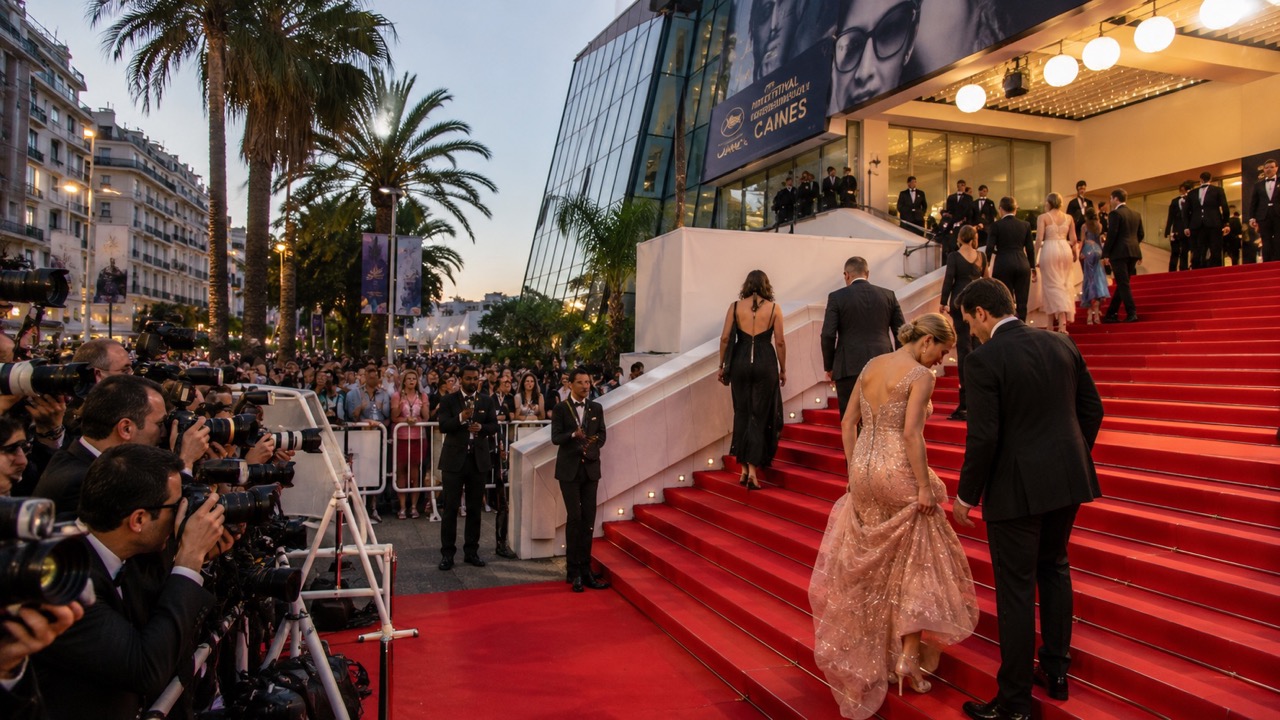
  • The red steps provide the festival’s most reproduced image.
  • Official guests ascend while cameras record the performance of arrival. Formal clothing, precise timing and controlled movement turn the entrance into a short piece of public theatre before the screening begins inside.
  • Viewing areas can become crowded and sightlines uncertain. A visitor may wait a long time for a moment visible mainly through raised phones.
  • See it once.
  • Do not allow someone else’s entrance to consume the entire evening.
  • ### Cinéma de la Plage
  • The public beach cinema provides the clearest open-access experience.
  • Screenings are traditionally held in the evening at Plage Macé, with admission free within available capacity. The programme may include classics, restorations, documentaries or popular films connected to festival history.
  • Arrive early, confirm the current screening and dress for wind from the water. Access procedures and seating arrangements can change.
  • The film is the attraction here, not the possibility of seeing someone arrive for it.
  • ### Cannes Cinéphiles
  • Cannes Cinéphiles can provide eligible film enthusiasts with access to selections screened in participating cinemas across the city.
  • This is an accreditation programme, not a general ticket counter. Eligibility, application requirements, deadlines and available venues must be researched well before travel. Approval should never be assumed.
  • Those who qualify gain a different Cannes: less concerned with red-carpet visibility and more focused upon moving between films.
  • ### Three Days in Cannes
  • The Three Days in Cannes programme offers a limited pathway for eligible younger film enthusiasts to experience part of the official selection.
  • Age requirements, application materials and session arrangements are specific. Applications must be submitted in advance, and acceptance is not guaranteed.
  • This programme deserves to be treated as an opportunity rather than a travel strategy until approval has been received.
  • ### Parallel Sections
  • Independent and parallel programmes bring additional filmmakers, critics and audiences into Cannes.
  • Their venues, ticketing systems and eligibility rules differ. Some screenings may be more publicly approachable than the Official Selection; others still require credentials or advance booking.
  • Consult each organization directly. The phrase “parallel section” does not itself mean public admission.
  • ### Marché Forville
  • Marché Forville returns the city to food, flowers and daily exchange.
  • Visit in the morning, when vendors, residents and festival visitors share a space governed by ingredients rather than credentials. Fruit, vegetables, cheese, olives, fish and prepared foods reveal the Mediterranean city beneath the international event.
  • The market offers no shortcut into the festival.
  • It offers something equally necessary: Cannes without performance.
  • ### Le Suquet
  • The old quarter rises west of the Palais through narrow streets and stone stairways.
  • From above, the festival becomes geography. The harbour, Croisette, temporary structures and hotel façades appear within a compact strip beside the sea.
  • Walk here when barriers and crowds have made the central zone feel smaller than it is. Cannes existed before the first red carpet and continues beyond its edge.

Getting There & Around

Where It Happens

The Palais des Festivals stands beside the harbour at the eastern end of the Croisette and serves as the official centre.

Festival and market zones extend through the Palais, Riviera spaces, International Village and other controlled areas. Entry depends upon accreditation, screening reservations and current security arrangements.

Official and accredited screenings also take place in additional theatres, including cinemas away from the immediate Croisette. Transport requirements should be checked before reserving anything, since “Cannes” does not mean every venue is a short walk from the Palais.

Parallel programmes use their own cinemas and screening rooms. Public city programming may appear at local theatres and outdoor locations.

Cinéma de la Plage traditionally occupies Plage Macé near the Croisette. Exact access, capacity and start times must be confirmed for the intended edition.

Beyond the festival map, Cannes continues through Marché Forville, Le Suquet, Rue d’Antibes, the harbour and neighbourhoods extending toward La Bocca.

The official festival occupies controlled zones.

Its effect occupies the city.

Getting Around

Central Cannes is compact enough to navigate primarily on foot.

The railway station, Palais, Croisette, Marché Forville and lower parts of Le Suquet sit within a manageable area. Security barriers, crowds and temporary closures can make the most direct route unavailable.

Accredited attendees should leave substantial time before screenings. Security checks, badge controls and queues remain part of admission even with a valid reservation. Late arrivals may be refused.

Buses connect central Cannes with La Bocca and cinemas farther from the Palais. Accredited participants may receive specific transport arrangements or benefits, but these should never be assumed by general visitors.

Regional trains connect Cannes with Nice, Antibes and other coastal towns. They provide a useful alternative to expensive central accommodation, but platforms become busy and late-night service may not match the public screening programme.

Driving into central Cannes is rarely efficient during the festival. Traffic, road restrictions and parking costs turn a short distance into an unpredictable journey.

Taxis and private cars gather near major hotels, but professional transport activity does not make spontaneous rides easy to obtain.

The Croisette encourages walking because everything appears close.

A badge determines whether the final metres take two minutes or end at a barrier.

Visitor Guide

Festival Food & Drink

Cannes eats according to access.

Behind hotel doors, private lunches and terrace receptions continue conversations begun inside the Palais. Tables become meeting rooms. A meal may exist to introduce a director, secure another appointment or keep several people in the same place long enough for a decision.

Outside, Cannes remains a Mediterranean city.

Marché Forville provides fruit, bread, cheese, olives, seafood and prepared foods suited to a picnic or fast lunch. Bakeries make the festival manageable through sandwiches, fougasse and pastries that can be eaten between public activities without requiring a reservation.

Along the Croisette, prices often reflect location and visibility as much as cooking. One deliberate waterfront meal can be enjoyable. Repeatedly paying for proximity to the red carpet does not create deeper access to Cannes.

Walk inland for neighbourhood restaurants, market counters and simpler dining rooms. Provençal vegetables, olive oil, garlic, herbs and Mediterranean fish return the meal to the region rather than the industry.

Dinner reservations matter during the festival. So does flexibility. A good plate at an unfashionable hour may be more satisfying than a famous dining room entered only after a long wait.

Food provides one of the few parts of Cannes where an ordinary visitor can stop negotiating access.

The table asks only whether a chair is available.

### Must Try

• **Socca:** A thin chickpea pancake with crisp edges and a soft centre, eaten hot with black pepper.

• **Pissaladière:** An onion tart traditionally topped with anchovies and olives, carrying the flavours of the Mediterranean coast.

• **Fougasse:** Provençal bread prepared in savoury forms with olives, herbs, cheese or other additions.

• **Pan bagnat:** Bread filled with vegetables, tuna, egg, olives and olive oil, practical for a beach or harbour lunch.

• **Petits farcis:** Vegetables such as tomatoes, courgettes or peppers filled with a seasoned stuffing and baked.

• **Mediterranean fish:** A simply grilled local or regional catch whose source and preparation are clearly identified.

• **Tarte tropézienne:** A brioche filled with cream, associated with the Riviera beyond Cannes and widely enjoyed along the coast.

• **Provence rosé:** A chilled regional wine best enjoyed after the day’s walking and screening plans have ended.

The private terraces may hold the industry’s most consequential meals.

The market still provides the better tomato.

Budget & Costs

Cannes becomes expensive before a visitor enters a single screening.

Accommodation prices rise sharply, especially near the Croisette and Palais. Regional lodging can reduce the cost, but transport and late-night limitations must be calculated honestly.

The public Cinéma de la Plage is traditionally free within capacity. Other city programmes may be free, ticketed or restricted according to their organizers.

Professional and film-enthusiast accreditations follow separate application systems. An approved badge may provide access to booking systems rather than requiring payment for each official screening, but it does not guarantee every requested seat.

Restaurants near the Croisette charge premium prices during the festival. Bakeries, market stalls, takeaway counters and neighbourhood restaurants make daily eating more manageable.

Transport within central Cannes can remain inexpensive when the visit is walkable. Regional trains, airport transfers and late-night taxis add costs for travelers staying elsewhere.

Formal clothing, professional materials and market participation can create further expenses for accredited visitors.

Set the budget according to confirmed access.

Paying more cannot turn a public visitor into an accredited guest.

Tips for First-Time Visitors

Determine the form of access before arranging the trip.

If professional accreditation applies, submit the correct application and wait for confirmation. If a film-enthusiast programme appears suitable, read its eligibility requirements and deadlines carefully. If neither applies, build the visit entirely around public experiences.

Never describe an accreditation as a ticket. It establishes a category of participation but may not guarantee a seat at a particular screening.

Use only official reservation systems and programme information. Invitations, badges and unofficial access offers sold through strangers may be invalid, fraudulent or non-transferable.

Save current maps and public schedules offline. Security zones and heavy mobile use can complicate navigation.

Carry identification, sun protection, water, a portable battery and an evening layer. Keep bags small enough for security procedures and crowded pavements.

If attending an accredited gala, read the current dress requirements rather than relying upon old photographs or social-media advice. The dress code applies to the screening, not to ordinary public movement through Cannes.

Do not spend the day waiting outside hotels. Entrances are working environments, and the possibility of seeing a famous person rarely justifies surrendering the city.

Choose one public film experience and treat everything else as atmosphere.

Cannes becomes disappointing only when proximity is mistaken for admission.

Safety

Crowds, traffic, security zones and intense attention around public figures create the principal practical risks.

Keep bags closed and valuables secured, particularly near the Palais, railway station, red-carpet viewing areas and busy terraces. Raised phones and compressed crowds make distraction easy.

Follow all barriers and security instructions. Do not enter restricted zones behind another group or assume an open gate grants public access.

Beware of unofficial sellers offering badges, screening tickets, party invitations or privileged entry. Verify everything through the responsible festival or programme organizer.

May sun can be strong along the Croisette. Carry water, use sunscreen and seek shade before long waits become physically exhausting.

Evenings beside the water can become cool and windy. Bring a layer to Cinéma de la Plage and secure loose belongings.

Alcohol, private invitations and unfamiliar locations require ordinary judgment. Tell a trusted person where you are going, arrange independent transport and leave any situation in which access appears conditional upon unsafe behaviour.

Formal footwear can become hazardous after extensive walking, crowded stairs and late-night events. Carry or choose shoes capable of moving safely through the city.

Cannes sells the appearance that every door may lead somewhere extraordinary.

Safety begins by knowing who opened it.

Cultural Significance

The Festival de Cannes was conceived during a period when cinema, national influence and political control were closely entangled.

Plans for an early festival were interrupted by war, and the first full edition was eventually held in 1946. Cannes developed into a meeting place where artistic recognition, national cinema, criticism, commerce and international prestige could operate beside one another.

The Palme d’Or gives the Official Competition its most visible judgment, but Cannes influences cinema through more than awards. Selection can transform a filmmaker’s international standing. Market activity can determine whether work reaches theatres, broadcasters or platforms in other countries.

That power creates exclusions. Films outside the programme can disappear beneath attention concentrated on selected titles. Countries with limited resources may struggle to bring filmmakers and work into the same professional rooms. Public fascination with celebrity can overwhelm the labour of writers, editors, technicians and producers.

Cannes also preserves a belief that cinema deserves concentrated attention. Films are projected before audiences prepared to discuss them immediately. Restored work returns to large screens. New directors encounter critics and distributors within days of presenting their films.

The contradiction remains visible.

Cinema is treated as a public art inside an event structured through restricted professional access.

Every evening on the beach, the screen opens in another direction.

Plan Your Journey

When to Go

The Festival de Cannes traditionally takes place during May, when the Riviera often offers warm days, bright light and cooler evenings beside the water.

Opening days carry the strongest arrival energy. Major delegations, media teams and industry attendees are establishing routines, while the first premieres bring intense attention to the Palais. Accommodation demand and street congestion are also at their highest.

The middle period provides the clearest view of Cannes at full operation. Screenings, market activity, public programmes and evening events overlap, but the city has learned its temporary routes.

The closing stretch changes the balance. Some industry activity begins thinning, awards speculation grows and the festival moves toward its final decisions. Public visitors may find the city marginally easier to navigate, though access restrictions remain.

Travelers without accreditation should build dates around the confirmed public programme, especially Cinéma de la Plage and any city screenings they genuinely qualify to attend. The presence of a famous premiere means little if every meaningful activity that day remains inaccessible.

Daylight is useful for learning the geography. Walk the Palais perimeter, Croisette, Rue d’Antibes, Marché Forville and Le Suquet before evening crowds alter the routes.

After dark, the red carpet becomes brightest.

The beach becomes cinema.

Where to Stay

The Croisette provides maximum proximity and the highest prices.

Luxury hotels here become part of the festival’s working infrastructure. Lobbies, terraces and entrances may be controlled, crowded or reserved for guests and events. A room does not guarantee access to private festival activity taking place elsewhere in the same building.

The area around the Palais and Cannes railway station offers practical walking access to central festival locations. Rooms sell quickly, street noise continues late and temporary restrictions can alter vehicle access.

Le Suquet provides historic character and some separation from the Croisette, though stairs and sloping streets require consideration. It works well for travelers who want Cannes to remain visible without sleeping inside its most concentrated activity.

La Bocca offers a more residential base west of central Cannes and may provide better value. Public transport becomes important, particularly for late returns and any screenings at cinemas outside the centre.

Nearby Riviera towns can reduce accommodation costs, but rail schedules and late-night connections must be examined carefully. A hotel that appears close on a regional map may become inconvenient after the final train.

Do not book a non-refundable room until accreditation or essential public programming has been confirmed.

Cannes rewards proximity.

It charges accordingly.

Bottom Line & Key Days

Bottom Line

Cannes begins by making every door appear close.

The Palais stands beside a public pavement. The red steps can be seen from across the street. Hotel terraces rise above the Croisette while conversations drift down from rooms most people will never enter.

Inside, films meet critics, buyers, distributors and audiences whose reactions may change where those films travel next.

Outside, the city keeps watching.

By evening, people begin gathering at Plage Macé. They arrive early, find available seats and turn toward a screen standing between the Croisette and the sea. Behind them, badges continue opening guarded doors.

The light lowers. Conversations soften. The first image appears above the sand.

For the next two hours, nobody’s chair knows how they entered Cannes.

Key Days

Opening day carries the first major gala, concentrated media attention and the public spectacle of the festival beginning.

The opening weekend brings large crowds and intense pressure on accommodation, restaurants and central streets. Public visitors should confirm programming rather than relying upon the atmosphere alone.

Mid-festival provides the fullest overlap of official selection screenings, industry activity, parallel programmes and public cinema. It is the best period for observing Cannes as a working film city.

The closing stretch moves attention toward awards and the final screenings. Some professional activity begins to ease, but access policies remain in place.

Cinéma de la Plage operates according to its own nightly programme, weather and capacity. Each screening should be treated as a distinct event.

Application-based public-access programmes occupy specific periods and require confirmation well before arrival.

The famous premiere is not automatically the most useful day.

The accessible film is.

Ready to Experience Cannes Film Festival (Festival de Cannes)?

You've explored what makes this festival special. Now it's time to plan your trip. Compare flights, book your hotel, arrange transportation, and take care of your travel essentials—all in one place.

✈ Find Flights

Loading booking widget...

Booking is completed on Expedia in a new tab.

🏨 Find Hotels

Search places to stay

Powered by Booking.com

Booking is completed on Booking.com in a new tab.

Rail & Bus Travel

Compare train and coach routes for the journey.

Compare Routes

Things to Do

Discover tours and attractions before or after the festival.

Explore Experiences

eSIM Mobile Data

Stay connected abroad without traditional roaming charges.

Get an Airalo eSIM

Travel bookings are provided by our trusted partners. We may earn a commission when you book through these links, at no additional cost to you.

Independent Editorial Standards

Every Follow the Festivals guide is independently researched and regularly reviewed using official festival information, destination resources, and trusted travel references. We also welcome verified updates from festival organizers, destination marketing organizations, tourism partners, and local experts to help keep our guides accurate, current, and useful for travelers.

Represent this festival or have a verified update to share? We'd love to hear from you through our contact page.

Photo Credits