
Follow the Festivals

Andong Mask Dance Festival

Andong Mask Dance Festival

Andong, South Korea

2026-09-25 - 2026-10-01

The Story

Festival Overview

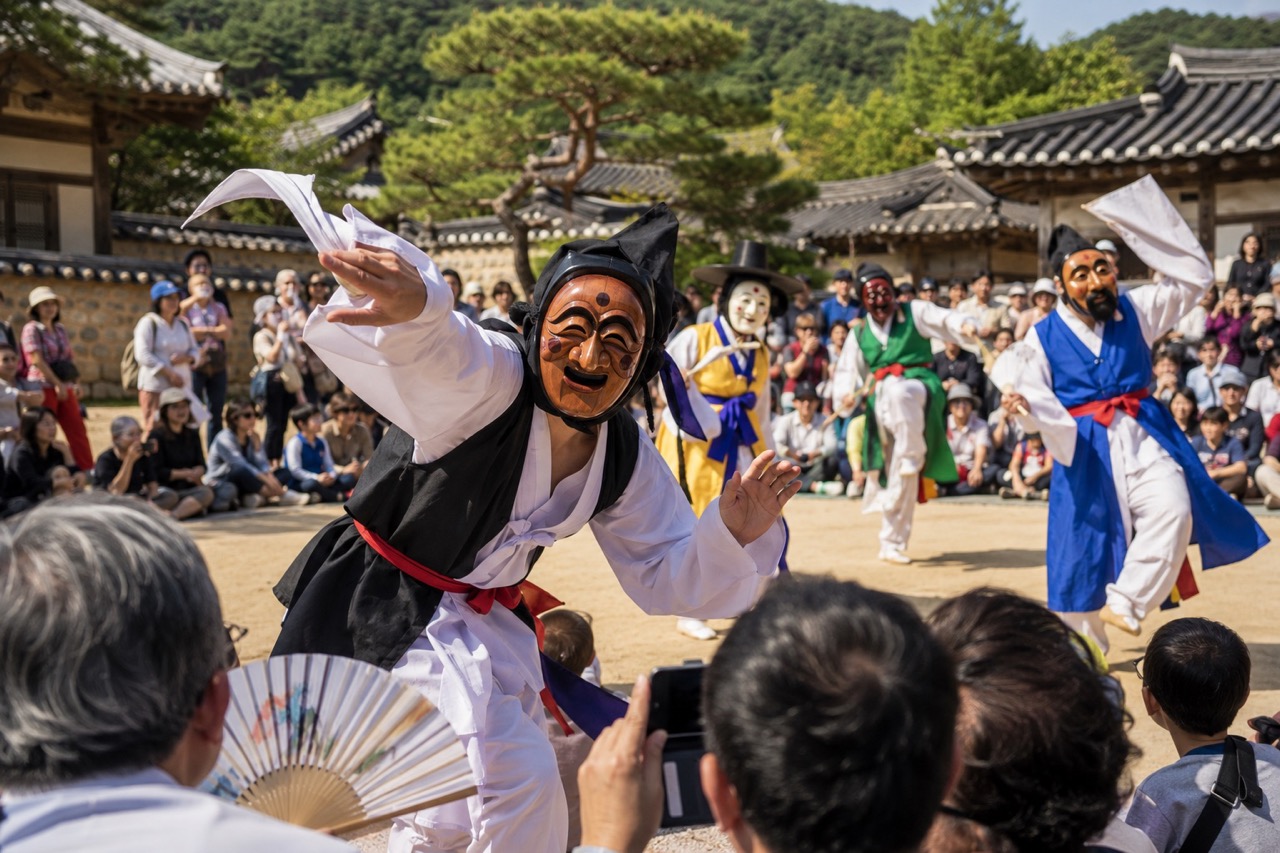
A Hahoe mask does not need a performer to announce its character.

The nobleman’s smile already carries self-importance. The scholar appears convinced of his own seriousness. The butcher bares his teeth. The old woman’s face holds a lifetime that the more powerful characters would prefer not to notice.

Then someone puts on the mask.

Andong International Mask Dance Festival is a major cultural festival presenting Korean *talchum*, international mask-dance traditions, street performance, competitions, parades and participatory dancing. Its principal venues extend through central Andong, the former station area and Talchum Park, while related performances connect the festival with Hahoe Village.

The city’s own cultural foundation is Hahoe Byeolsingut Talnori, the mask dance drama preserved in Hahoe Village. Its characters embody social roles—nobleman, scholar, monk, butcher, servants, bride, young woman and elder—through which performers can satirize power, desire, hypocrisy and inequality.

The mask does not simply conceal the person wearing it.

It gives criticism a face no individual must claim as their own.

Andong carries that inherited understanding into an international festival where mask traditions from other communities arrive with different histories, purposes and forms of authority. The visitor’s task is not to search for one universal meaning behind every mask.

It is to ask what each mask has been permitted to say.

Why This Festival Is Special

Satire becomes dangerous when everyone knows exactly who said it.

A mask changes that relationship.

The performer temporarily yields an individual face to a role the community already recognizes. The nobleman can be mocked because the character represents more than one arrogant man. A servant can answer power without the answer belonging only to the person underneath the mask. The audience laughs at a fixed expression while recognizing behavior that remains uncomfortably alive.

Hahoe’s masks make this relationship unusually visible. Carved from wood and preserved rather than discarded after use, they have endured as individual characters. Some include separately attached jaws that move as the performer speaks, allowing the same carved face to shift through angle, shadow and motion.

The contemporary festival expands beyond Hahoe without making every invited tradition an extension of it. International performers bring masks carrying their own community memories, religious associations, theater forms and social tensions.

Andong does not prove that all masks mean the same thing.

It creates a place where different cultures can demonstrate why they needed masks at all.

Festival Experience

What to Expect

The central festival combines formal theater performances with open-air stages, parades, competitions, mask-making, folk games and group dancing. Korean traditions appear beside visiting troupes from other countries, giving one day several distinct visual and musical languages.

Some performances use dialogue, satire and exaggerated characterization. Others communicate through movement, percussion, procession, ritual structure or audience participation. A mask may represent social rank in one tradition, a spirit in another or a character whose meaning cannot be separated from a specific community ceremony.

Hahoe Byeolsingut Talnori provides the most important preparation for understanding Andong. Scenes challenge the authority of aristocrats and scholars, expose the misconduct of a monk, confront desire and allow socially marginalized characters to speak within a shared comic space.

The audience is not always expected to remain silent. Laughter, calls, rhythmic movement and visible response can belong to the atmosphere. Follow the performers and local audience rather than importing formal theater etiquette into every open-air encounter.

Evening programmes often loosen the boundary between stage and crowd. Parades and communal dances invite participation after the masks have spent the day showing how roles can be rearranged.

The best visitor does not arrive asking which performance will be most spectacular.

The best visitor learns what kind of attention each one requires.

Festival Highlights

  • Hahoe Byeolsingut Talnori is the festival’s essential Korean performance. Read a scene and character outline beforehand, then allow the actors’ movement, vocal delivery and relationship with the audience to supply what translation cannot.
  • Other Korean *talchum* traditions reveal that no single mask dance can represent the entire country. Regional forms differ in masks, characters, music, choreography and the social behavior they confront.
  • International performances widen the festival’s vocabulary. Watch each troupe on its own terms. The most valuable comparison may not concern costume or technique, but who speaks, who is mocked and how the audience is invited to respond.
  • Street parades bring masks out of designated theaters and into central Andong. Scale increases, but detail remains important: how a performer sees, how the costume distributes weight and how musicians guide movement through a crowd.
  • Mask-making workshops can teach the relationship between shape, color and character. They should not create the illusion that a quickly decorated souvenir carries the same authority as a ritual or inherited performance mask.
  • The World Mask Dance Competition and creative performances show how artists are adapting mask language rather than preserving it only as historical form.
  • Participatory group dancing provides the festival’s release. After spending hours watching fixed characters rearrange social hierarchy, visitors are invited to enter a space where age, status and nationality temporarily matter less than the shared rhythm.

Getting There & Around

Where It Happens

Central Andong holds the contemporary festival.

Stages, food areas, participatory programmes and street events gather around the former station area, downtown streets and Talchum Park. Venue boundaries can change between editions, making the annual map essential.

Hahoe Village lies outside the city center within a bend of the Nakdong River. Its tile-roofed and thatched houses, clan traditions and surrounding landscape provide the cultural setting associated with Hahoe Byeolsingut Talnori.

The village remains inhabited. Lanes passing historic homes are not theatrical scenery, and open gates do not erase residential privacy.

The performance space near Hahoe allows visitors to encounter the mask dance close to its place of transmission. The experience differs from watching the same characters on a central festival stage because the village, river and social history remain present around them.

The Hahoe Mask Museum and related heritage displays help distinguish original masks, performance traditions and contemporary reproductions. Seeing the masks at rest teaches how carving, jaw construction and angle prepare expressions that movement later changes.

Buyongdae Cliff overlooks the village from across the river. From above, the Nakdong curves around Hahoe and reveals why the settlement’s name evokes water turning back upon itself.

Andong places the festival in the city.

The river shows where one of its most enduring faces learned to speak.

Getting Around

Andong can be reached by intercity rail or bus from major Korean cities. The railway station and bus terminal sit outside parts of the traditional downtown core, so onward transportation should be planned rather than assumed walkable.

Central festival venues can largely be explored on foot once visitors reach the main area. Road closures, parades and crowds may alter bus stops and taxi access.

Hahoe Village requires a separate journey. Public buses connect downtown Andong and the transportation terminal with the village, but service is limited enough that the return time should be chosen before departure.

Festival shuttles may supplement ordinary transportation. Treat them as edition-specific services and confirm routes immediately before the visit.

Taxis provide flexibility for groups and travelers combining Hahoe with nearby heritage sites, but finding a return vehicle from rural locations can require advance arrangement.

Do not place Hahoe Village between two tightly scheduled central performances. The road, shuttle from the visitor entrance and time required to walk the village will turn cultural context into a transportation problem.

Give the village its own day.

The performance should not have to compete with the bus home.

Visitor Guide

Festival Food & Drink

Andong cooks as though distance has always required memory.

The city lies inland, yet salted mackerel became one of its defining foods. Before modern refrigeration, fish traveling from the eastern coast was salted to survive the journey. Time and preservation changed its texture and flavor until what began as necessity became preference.

Heotjesabap carries ritual food into an ordinary meal. The name suggests a ceremonial table without the ceremony: rice, vegetables and dishes associated with ancestral rites are assembled for eating beyond the formal ritual context. The meal preserves structure while changing occasion.

Andong jjimdak belongs to the old market. Chicken, vegetables and glass noodles absorb a dark soy-based sauce in a wide shared dish. The noodles continue thickening the sauce as the table eats, making pace part of the meal.

Andong sikhye surprises visitors expecting the sweet rice drink found elsewhere in Korea. This regional form combines fermented rice with radish, chili and ginger, producing a sharper and more savory flavor.

Traditional Andong soju completes another form of preservation. Distilled from grain, it can carry considerable strength while finishing more cleanly than its first heat suggests. It should be tasted slowly and never treated as an ordinary diluted soju.

Eat in the old market rather than relying entirely upon festival stalls. The market returns each dish to the trading history, preservation knowledge and shared tables that made it local.

### Must Try

• **Andong jjimdak:** Chicken braised with vegetables and glass noodles in a rich soy-based sauce.

• **Heotjesabap:** Rice and side dishes modeled on foods associated with ancestral rites but served without the ceremony.

• **Andong gangodeungeo:** Salted mackerel whose preservation method reflects Andong’s inland distance from the coast.

• **Andong sikhye:** A regional fermented rice preparation flavored with radish, chili and ginger.

• **Andong soju:** Traditional grain-based distilled liquor known for its strength and clean finish.

• **Andong hanwoo:** Locally prized Korean beef served grilled or in regional dishes.

• **Hemp rice:** Rice cooked with hemp seed, associated with local agricultural traditions.

• **Nokdujeon:** Savory mung-bean pancakes cooked until crisp at the edges.

• **Kalguksu:** Hand-cut wheat noodles served in broth.

A mask preserves a role by giving it a form that can be worn again.

Andong’s food often preserves something the same way: through salt, fermentation, repetition and a table prepared to remember.

Budget & Costs

Much of the outdoor festival activity can be experienced freely, while certain theater performances, workshops or special programmes may require admission.

Accommodation and transportation to Andong form the largest fixed expenses. Rooms near central venues can fill quickly, particularly on weekends.

Hahoe Village charges separate admission, and transportation must be added to the day’s budget. A museum, workshop, local guide or cultural commentary can deepen the visit without requiring premium festival access.

A modest trip can use public buses, central guesthouses, free outdoor stages and meals in Andong’s markets. A midrange budget allows a comfortable downtown hotel, paid performances and a full Hahoe day. A larger budget may include a hanok stay, private transportation and guided interpretation across several heritage sites.

Festival souvenirs vary greatly. A quickly made decorative mask and a work created by a skilled carver carry different materials, meanings and prices. Ask who made the object and whether its design reproduces a protected traditional character.

The most valuable purchase may not be a mask.

It may be the performance explanation that finally lets the visitor understand why everyone laughed.

Tips for First-Time Visitors

See Hahoe Byeolsingut Talnori early in the visit. Its social characters provide a vocabulary for watching the wider festival without claiming to explain every other tradition.

Read performance summaries before the masks appear. Translation during live dialogue may be limited, and satire loses force when the visitor spends every scene trying to identify basic characters.

Watch how the mask changes when the performer tilts the head. A fixed smile can appear arrogant, foolish or suddenly vulnerable when light reaches it from another angle.

Do not describe every masked performance as a ritual. Some are devotional, some theatrical, some satirical and others created specifically for contemporary stages. Allow practitioners to define their own form.

Join when participation is clearly invited. Open dancing and mask workshops exist to reduce distance between performer and visitor. A formal stage, sacred sequence or preparation area does not offer the same permission.

Do not touch masks, costumes or instruments without invitation. A mask’s visibility does not determine whether it is a prop, artwork, sacred object or protected cultural inheritance.

At Hahoe Village, remain on visitor paths, lower voices near residences and request permission before photographing identifiable residents.

Learn a few Korean performance terms, but do not turn the article or journey into a vocabulary test. Recognition should deepen attention rather than display expertise.

Most importantly, listen to the laughter.

The moment an audience laughs together may identify the exact social behavior the mask has made safe to confront.

Safety

Large parades and participatory dances can create sudden crowd movement. Keep clear of performance routes, follow staff instructions and avoid stepping backward into the street while photographing.

Outdoor stages may offer limited shade. Autumn sun can remain strong during the day, while temperatures fall after dark. Carry water and use layers rather than preparing for only one part of the day.

Rain makes temporary surfaces, grass and stone lanes slippery. Hahoe Village requires walking across uneven ground that may be difficult for visitors with limited mobility.

Children should remain within reach during parades and open dancing. Establish a meeting point that does not depend upon mobile service or an easily moved festival landmark.

Drink Andong soju cautiously. Traditional varieties can be substantially stronger than the green-bottle soju familiar to many visitors.

At Hahoe, respect barriers near buildings, riverbanks and heritage structures. The village is not a reconstruction designed to absorb unrestricted visitor movement.

Masks may change how performers move and see. Give costumed participants additional space, especially when headpieces, restricted vision or wide garments extend beyond the visible body.

The mask allows a character to cross social boundaries.

It does not remove physical ones.

Cultural Significance

Korean *talchum* encompasses multiple regional mask-dance dramas rather than one standardized national form. Traditions vary in their characters, stories, music, masks and relationships with ritual or popular entertainment.

Many share an ability to challenge hierarchy through humor. Aristocrats become pretentious. Corrupt religious figures lose authority. Servants answer masters. Desire, poverty, age and social exclusion enter public conversation through characters larger than individual biography.

Hahoe’s surviving wooden masks are especially significant because many Korean performance masks were historically made from less permanent materials and discarded or burned. The Hahoe and Byeongsan masks were preserved, allowing individual carved characters to endure across generations.

Hahoe Byeolsingut Talnori was historically connected to communal rites for village well-being and agricultural abundance. Its contemporary transmission includes regular public performance, education and safeguarding by practitioners.

The international festival adds another responsibility. Inviting global troupes can create genuine cultural exchange, but only when differences remain visible. A mask from another community should not become evidence for a convenient universal theory about hidden selves.

Andong’s strongest contribution is not claiming ownership of the mask.

It is providing a city in which masks can introduce themselves.

Plan Your Journey

When to Go

The festival generally occupies the transition from late September into early October, when Andong begins moving from humid summer toward cooler autumn.

Arrive before the first weekend if possible. Opening programmes introduce the participating traditions, while later days allow visitors to recognize performers and understand how the central stages relate to the wider city.

Weekdays provide more room at exhibitions, workshops and food areas. They are also useful for visiting Hahoe Village without combining its residential lanes with the largest festival crowds.

Weekends bring the fullest programme, stronger street participation and increased demand for transportation and accommodation. Families and tour groups often arrive from elsewhere in Korea, changing the pace around major performances.

Stay for at least two full days. Use one for central Andong and the international festival programme. Give another to Hahoe Village, its landscape and Hahoe Byeolsingut Talnori.

Autumn days can remain warm beneath direct sun, while evenings cool quickly. Rain may alter outdoor performances without ending the festival’s indoor programme.

The masks retain their expressions in every kind of weather.

The human face underneath must prepare for all of it.

Where to Stay

Downtown Andong is the most practical base. It provides access to central festival venues, restaurants, markets and evening programmes without requiring a late return from the outskirts.

Accommodation near the former Andong Station area works well for travelers prioritizing festival activity. Confirm the exact relationship between the hotel and current stages, since road closures and temporary venues can change the easiest walking route.

The area around Andong’s intercity bus terminal and railway station provides convenient arrival but lies away from some central evening activity. Local buses or taxis may be necessary.

A hanok stay offers another experience of Andong’s architectural heritage. Ondol floor heating, courtyards and traditional room arrangements reveal domestic space differently from a conventional hotel, although bedding, bathrooms and sound insulation may not match every traveler’s expectations.

Staying near Hahoe Village creates quieter mornings and deeper access to the surrounding landscape. It also separates visitors from the central festival after dark and makes transportation planning more important.

The strongest itinerary may divide the stay: central Andong for the festival, followed by one quieter night near the village.

One reveals the mask in public.

The other restores the landscape from which it came.

Bottom Line & Key Days

Bottom Line

At the end of the performance, the mask comes away from the face.

The performer breathes differently without it. Sweat marks the hairline. The body that appeared noble, foolish, predatory or powerless returns to one person standing beside the stage.

The carved expression does not change.

It has mocked authority before this performer wore it and can do so after another person ties it into place. The character survives because no single actor owns the arrogance, hunger or suffering it was made to show.

Around Andong, other masks are being removed.

Some return to cases prepared by international troupes. Some belong to contemporary performances and will change with the next production. Hahoe’s wooden faces return to the care of people entrusted with carrying their roles forward.

The laughter they produced remains with the audience.

For a few minutes, everyone recognized the same behavior beneath a face that belonged to no living individual. Power became ridiculous. Hypocrisy became visible. A person who could not safely accuse anyone stood behind a mask that had already said enough.

The performer leaves the stage with an ordinary face.

The mask waits for someone else brave enough to wear it.

Key Days

Opening programmes introduce the festival’s central theme, participating troupes and relationship between Andong’s heritage and the international stage. Parades or communal events begin turning downtown streets into performance space.

Weekday programmes provide the strongest opportunity to compare Korean regional mask dances without the heaviest crowds. Workshops and exhibitions can prepare visitors for the larger weekend stages.

International performance days bring traditions whose meanings may extend far beyond satire. Programme notes and troupe introductions become especially important here.

A dedicated Hahoe Village day allows the traditional mask dance, historic settlement and Nakdong River landscape to remain connected.

Competition finals and creative performances reveal how contemporary dancers and theater makers are adapting the mask rather than treating it as a closed historical language.

Closing celebrations commonly move toward collective participation. Performers and visitors who arrived through separate traditions enter a shared dance without requiring those traditions to become identical.

The masks do not erase difference.

The rhythm makes room for everyone carrying it.

Ready to Experience Andong Mask Dance Festival?

You've explored what makes this festival special. Now it's time to plan your trip. Compare flights, book your hotel, arrange transportation, and take care of your travel essentials—all in one place.

✈ Find Flights

Loading booking widget...

Booking is completed on Expedia in a new tab.

🏨 Find Hotels

Search places to stay

Powered by Booking.com

Booking is completed on Booking.com in a new tab.

Rail & Bus Travel

Compare train and coach routes for the journey.

Compare Routes

Things to Do

Discover tours and attractions before or after the festival.

Explore Experiences

eSIM Mobile Data

Stay connected abroad without traditional roaming charges.

Get an Airalo eSIM

Travel bookings are provided by our trusted partners. We may earn a commission when you book through these links, at no additional cost to you.

Independent Editorial Standards

Every Follow the Festivals guide is independently researched and regularly reviewed using official festival information, destination resources, and trusted travel references. We also welcome verified updates from festival organizers, destination marketing organizations, tourism partners, and local experts to help keep our guides accurate, current, and useful for travelers.

Represent this festival or have a verified update to share? We'd love to hear from you through our contact page.