
Festival Overview
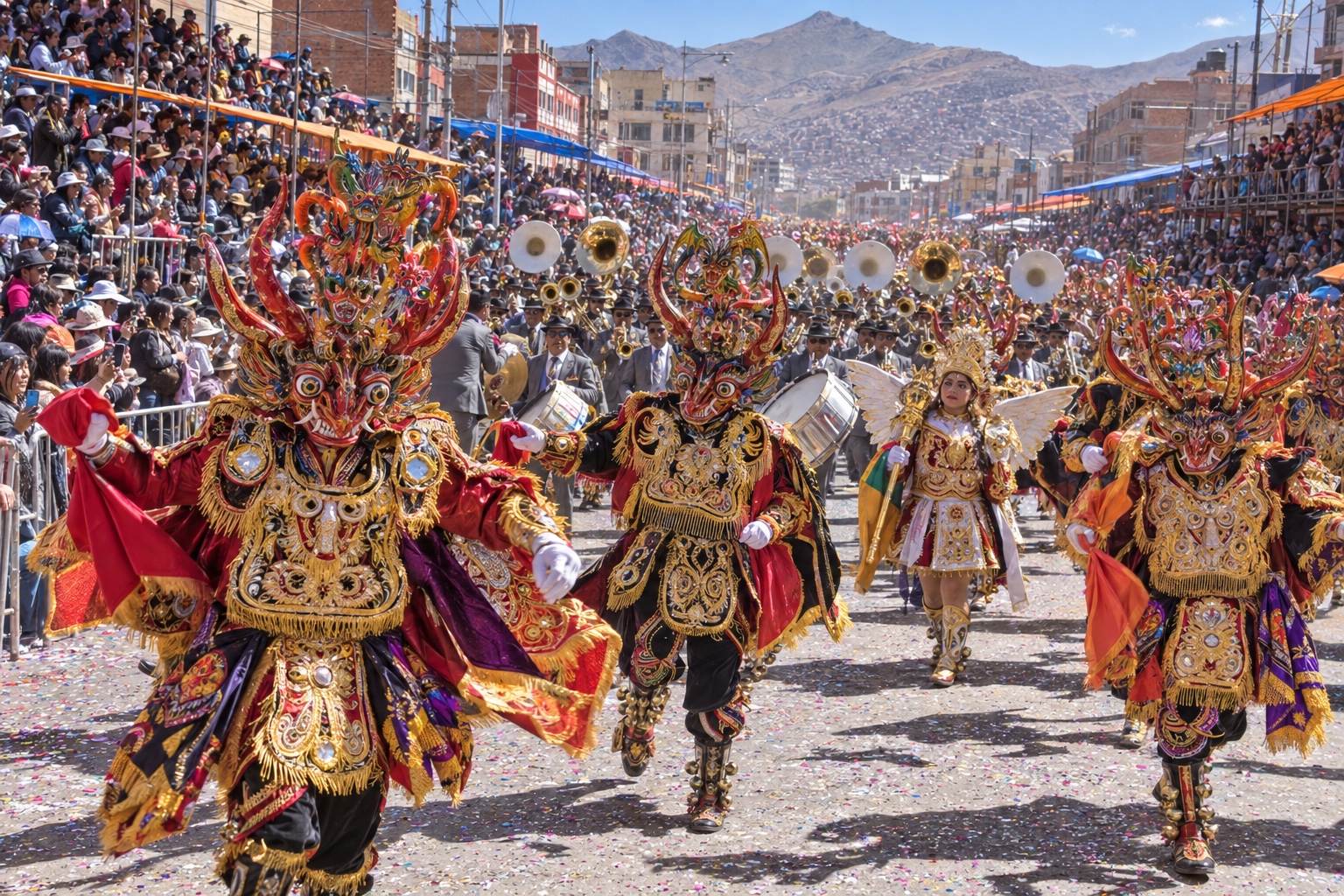
Before sunrise, brass bands and dancers already fill Oruro’s high-altitude streets. Costumes glitter, masks enlarge human faces into devils and archangels, and each fraternity moves toward the Sanctuary of the Socavón. The procession is spectacle, but its governing logic is pilgrimage. Participants dance the route as an offering, carrying devotion through fatigue, music and public display.
That purpose changes how a traveler should watch. The carnival is not a sequence of interchangeable parade acts. Diablada, Morenada, Caporales and other forms hold distinct histories, rhythms and social identities. Staying long enough to notice those differences reveals a city presenting belief through disciplined collective movement.
Oruro’s altitude, cold nights and enormous crowds make preparation essential. A good visit balances reserved route viewing with time near the sanctuary and space to recover. The reward is one of the world’s most powerful demonstrations of how ritual can remain sacred while becoming vast public theater.