
Follow the Festivals

Jewish Culture Festival Krakow

Jewish Culture Festival Krakow

Krakow, Poland

2027-06-30 - 2027-07-04

The Story

Festival Overview

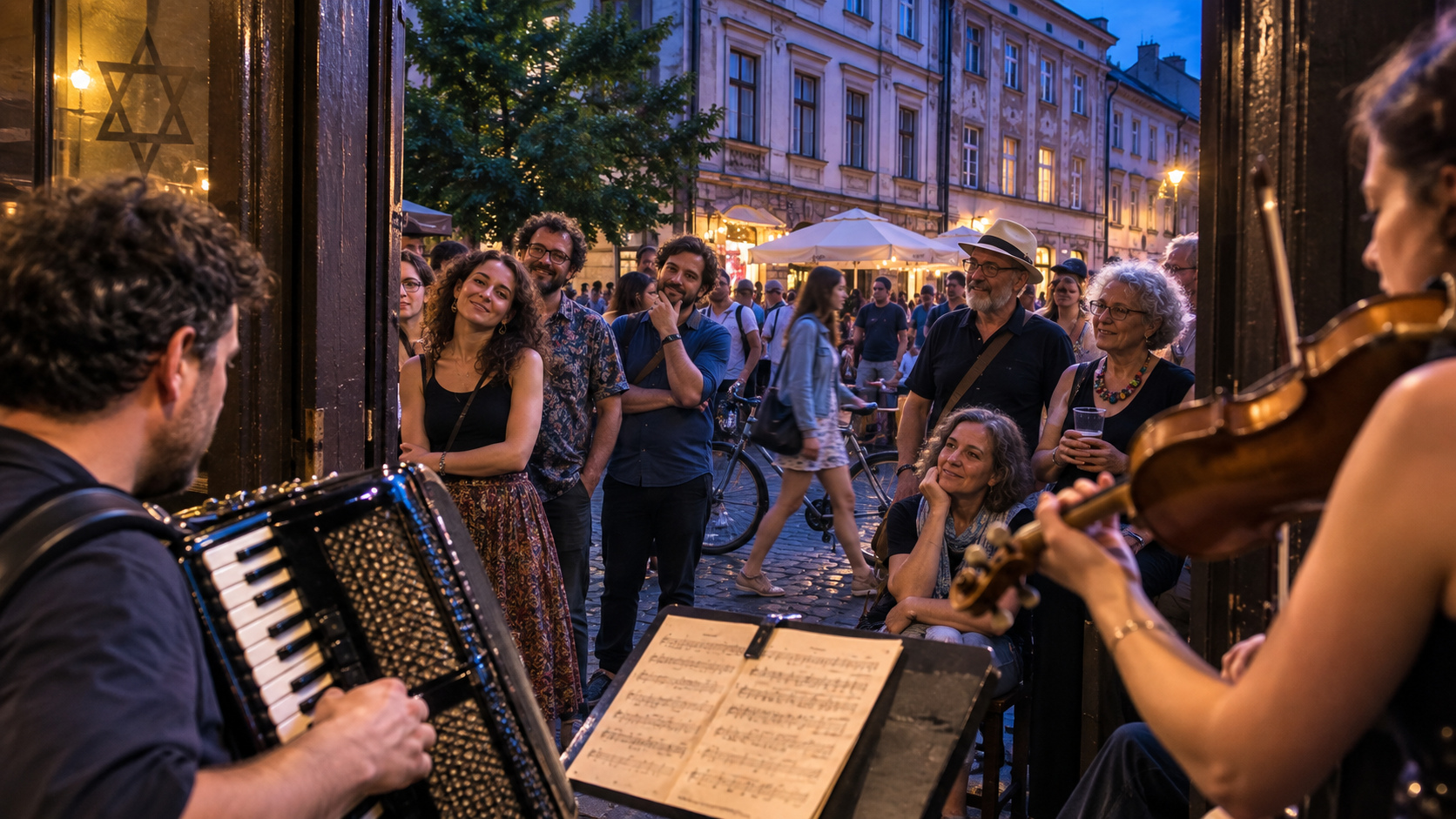
A musician tests a note inside the Tempel Synagogue.

The room receives it differently from a concert hall. Sound rises toward painted patterns, passes beneath chandeliers and returns through a building that has already heard generations of prayer, departure, silence and return.

Then the musician plays something new.

The Jewish Culture Festival is a multi-day celebration of contemporary Jewish culture centered in Kazimierz, Kraków’s historic Jewish district. Concerts, workshops, discussions, guided walks, exhibitions and communal gatherings bring artists, teachers and audiences from Poland, Israel and Jewish communities across the Diaspora into synagogues, cultural institutions, cafés, courtyards and public spaces.

The festival began as an attempt to restore awareness of the Jewish history that had shaped Poland for centuries before the Holocaust and postwar emigration devastated its communities. That work remains essential, but the programme does not ask Jewish culture to remain inside its own memorial.

Cantorial music enters conversation with contemporary composition. Yiddish songs acquire new arrangements. Scholars disagree in public. Artists carry inherited forms into work their grandparents could not have predicted. A visitor who arrives expecting to encounter Jewish Kraków only through what has been lost begins hearing voices that cannot be confined to the past.

Kazimierz remembers.

The festival asks whether the visitor knows how to listen when memory begins speaking in the present tense.

Why This Festival Is Special

Kraków contains places where absence is impossible to ignore.

Before the Second World War, Jewish life had helped shape the language, commerce, scholarship, religion and culture of the city for centuries. Nazi persecution forced Kraków’s Jewish residents from Kazimierz into the ghetto established across the Vistula in Podgórze. Deportation and murder followed. Survivors returning after the war encountered further displacement, hostility and political pressure.

A visitor can therefore walk through Kazimierz believing that Jewish culture here belongs primarily to history.

The festival interrupts that conclusion without denying any part of it.

Its artists do not gather merely to reproduce a world that existed before destruction. They arrive with contemporary music, film, literature, religious thought, visual art, political disagreement, humor and questions formed across many Jewish communities. Tradition remains present, but no single genre, language, nationality or level of religious observance is allowed to represent Jewish life in its entirety.

Historic rooms become important not because they preserve culture unchanged, but because they receive voices capable of changing what happens next.

The walls carry memory.

Authority belongs to the people still creating inside them.

Festival Experience

What to Expect

There is no single gate through which the entire festival enters.

A morning may begin with a guided walk through Kazimierz, continue with a discussion inside a cultural center and end with music beneath the painted ceiling of a synagogue. Another day may move between a workshop, an exhibition, a meal at Cheder and a late performance in a former prayer house or neighborhood club.

The programme is multilingual and intellectually demanding. Polish and English appear frequently, while Hebrew, Yiddish and other languages enter through music, prayer, literature and conversation. Translation arrangements vary, so the language listed for each event matters as much as its title.

Admission is mixed. Some concerts require individual tickets, workshops and tours may have limited capacity, and certain free events still require advance registration. A festival pass may cover only part of the programme. Read each event description rather than assuming that one purchase opens every door.

Kazimierz remains active around the festival. Residents cross the same streets as tour groups. Restaurants fill beside synagogues. Worship, cultural programming, nightlife and historical tourism may occupy neighboring buildings without sharing the same purpose.

That density creates both richness and confusion.

The festival teaches the difference by allowing each room to introduce itself.

Festival Highlights

  • – Concerts inside the Tempel Synagogue place contemporary performance within one of Kazimierz’s most visually distinctive religious buildings. Arrive early enough to enter without rushing, dress with respect for the setting and allow the performer to define the music before assigning it a category. Cantorial singing, piyut, chamber music and experimental collaboration may share the programme without becoming interchangeable.
  • – Guided walks can reveal the district beyond façades and commemorative plaques. Choose routes led by qualified historians, educators or people connected to Kraków’s Jewish institutions. The strongest walks identify former homes, schools, businesses and houses of prayer while also explaining what survived, what was reconstructed and what contemporary organizations are doing now.
  • – Discussions and lectures prevent the festival from becoming a sequence of beautiful performances detached from difficult questions. Attend at least one conversation about contemporary Jewish culture, identity or life in Poland. Listen for disagreement. No speaker should be expected to represent every Jewish community, and the presence of competing interpretations is evidence of a culture thinking publicly rather than presenting a finished exhibit.
  • – Workshops return knowledge to the body. Language, song, dance, calligraphy, cooking and religious or artistic traditions require different degrees of participation and prior understanding. Read the description carefully, respect the teacher’s framing and enter prepared to learn rather than perform familiarity.
  • – Cheder functions as the festival’s year-round cultural home. Coffee, food, lectures, intimate concerts and informal conversation occupy a former Jewish prayer space restored for contemporary use. Spend time there without treating it as a themed café. Its significance lies in the programme continuing after the temporary festival schedule has ended.
  • – The streets around Szeroka have hosted some of the festival’s largest public gatherings, including the celebrated Shalom concert. Large outdoor events are not guaranteed and may change according to programme, security or circumstance. When one occurs, its scale should not erase the smaller encounters that gave the week its meaning.
  • – Partner institutions extend the festival beyond a single organizational voice. The Galicia Jewish Museum, Jewish Community Centre, synagogues, universities, galleries and neighborhood venues may contribute programmes under their own authority. Check who has organized each event and let that institution explain the purpose of the room you are entering.

Getting There & Around

Where It Happens

Kazimierz was once a separate town before becoming part of Kraków. Its Jewish quarter developed around synagogues, schools, cemeteries, workshops, homes and places of trade. Catholic churches and Christian streets existed nearby, giving the district a history of proximity that was never as simple as the modern phrase “Jewish quarter” suggests.

The Tempel Synagogue, Old Synagogue, Remuh Synagogue and Cemetery, High Synagogue and other surviving or repurposed buildings reveal different periods of religious and communal life. Their present functions vary. Some remain active sacred spaces, some operate as museums, and others host cultural activity under specific conditions.

Szeroka Street provides one of the district’s most recognizable public spaces. Its restaurants and visitor economy can make it appear like an open-air reconstruction, but the surrounding buildings carry histories too complex for decorative nostalgia.

Józefa Street brings the festival into smaller rooms, courtyards, galleries and Cheder. Here the district feels less like a sequence of monuments and more like a place where people are still deciding how culture should be presented.

Across the river, Podgórze contains Ghetto Heroes Square, surviving fragments associated with the wartime ghetto and institutions addressing Nazi occupation and the Holocaust. This landscape is essential to understanding what happened to Kraków’s Jewish population, but it should not consume the entire cultural journey.

Kazimierz holds the past close.

The festival prevents closeness from becoming confinement.

Getting Around

Most festival venues lie within walking distance of one another in Kazimierz, but the programme may also reach Podgórze, the Old Town and institutions elsewhere in Kraków.

Walk whenever the schedule allows. The route between events reveals doorways, courtyards and distances that disappear when the district is treated as a list of sites. Cobblestones and uneven pavements make supportive footwear important.

Trams connect Kazimierz with the Old Town, central railway station and Podgórze. Stops around Stradom, Miodowa and the river provide useful access, though temporary diversions and summer street works can alter familiar routes.

Allow more time than the map suggests when crossing the district during busy evenings. Restaurant tables, tour groups and event queues narrow the pavements, while security checks can slow admission to synagogue venues.

Cycling is useful for wider exploration but unnecessary between closely grouped events. Leave bicycles outside pedestrian congestion and never secure them to religious buildings, memorials or cemetery railings.

Auschwitz-Birkenau is not another stop on the festival route. Anyone choosing to visit should reserve a separate day, arrange transport and entry in advance, and allow emotional space before returning to Kraków. It should never be fitted between a morning workshop and an evening concert.

Visitor Guide

Festival Food & Drink

Kazimierz serves memory at tables where cultural authority is not always easy to identify.

Some restaurants draw from Polish Jewish recipes. Others reproduce the appearance of prewar dining rooms for visitors. Israeli and Middle Eastern cooking bring different histories into the district. A menorah in the window, live klezmer music or a menu printed in stylized lettering does not establish Jewish ownership, kosher practice or a direct relationship with the community.

The uncertainty should create curiosity rather than suspicion.

Ask how a restaurant describes itself. Listen when a cook, educator or festival host explains where a dish comes from. If kosher certification matters, confirm it directly; “Jewish-style,” vegetarian and kosher are not equivalent claims.

Polish Jewish cooking developed through the ingredients, religious practices, migrations and economic realities of communities that lived across the region. Challah, gefilte fish, herring, goose, stuffed dishes, soups and baked sweets acquired household and regional variations. No single plate can reconstruct that world.

Contemporary Jewish food travels differently. At Cheder, coffee brewed in a finjan, fresh mint tea, hummus and vegetarian dishes inspired by Israeli and Middle Eastern kitchens place Kazimierz within a much wider cultural conversation. The flavors do not pretend that geography has remained still.

Kraków contributes its own table through bread, dairy, seasonal produce, soups and market traditions. Allow Polish food and Jewish food to overlap where history made them overlap without treating either culture as the property of the other.

A festival food workshop or meal led by someone speaking from personal, family or professional knowledge may reveal more than a restaurant chosen for historical décor. Eat slowly enough for that person’s story to remain attached to the dish.

#### Must Try

– **Challah** — Braided bread associated with Shabbat and Jewish holidays, prepared in many household traditions.

– **Jewish-style Kraków bagel** — A ring-shaped bread connected to the long history of Jewish baking in Poland; distinguish it from the twisted obwarzanek sold throughout Kraków.

– **Herring** — Prepared with onions, oil, cream or other accompaniments across Polish and Jewish culinary traditions.

– **Gefilte fish** — Seasoned ground fish served in regional and family variations, often associated with Sabbath and holiday tables. **Tzimmes** — A slowly cooked sweet dish commonly made with carrots and dried fruit, with recipes varying widely.

– **Hummus** — A contemporary festival meal reflecting connections with Israeli and wider Middle Eastern food cultures. **Finjan coffee** — Strong coffee prepared in a small pot and served at Cheder as part of its contemporary cultural identity. **Mint tea** — Fresh nana tea suited to the intervals between summer programmes in Kazimierz.

A recipe may preserve an inheritance.

The person preparing it decides how that inheritance continues.

Budget & Costs

The festival combines free public programming with individually ticketed concerts, workshops, walks and events requiring advance registration.

Create a programme before setting a budget. Several major concerts can become the largest expense, while a day built around free discussions, exhibitions and public events may cost very little beyond food and transport. Passes should be checked carefully for what they include.

Kazimierz accommodation commands higher prices during busy summer periods. Stradom, Podgórze and areas along direct tram routes may provide better value without distancing the traveler from the festival.

Guided walks deserve room in the budget. A qualified guide can distinguish original structures from reconstructions, active institutions from museums and documented history from stories repeated for tourism.

Meals vary from inexpensive bakeries and casual cafés to highly priced restaurants in the most visited parts of Kazimierz. Spend according to the knowledge and cooking offered, not the quantity of historical decoration.

Set aside something for the institutions preserving and creating the culture being encountered. Museum admission, books, artist purchases and direct donations return value more meaningfully than another souvenir using Jewish imagery without explanation.

Tips for First-Time Visitors

Build each day around one question rather than the maximum number of events. A guided walk, lecture and concert connected by curiosity will reveal more than a schedule assembled only by available time.

Read the presenter biographies. Jewish culture spans countries, languages, religious traditions, secular identities and political perspectives. Knowing who is speaking prevents one individual from being unconsciously assigned authority over everyone else.

Reserve small-capacity events early. Free admission does not necessarily mean open entry, and popular workshops or tours may fill before the festival begins.

Distinguish a synagogue concert from a religious service. Photography, dress and movement may be treated differently in each setting. When uncertain, follow the host rather than the behavior of other tourists.

Avoid photographing people at prayer, security arrangements or community members without permission. A public street does not eliminate the right to personal boundaries.

Do not call religious garments costumes, describe every Jewish musician as a klezmer performer or assume that Hebrew, Yiddish and Polish Jewish culture are interchangeable.

Leave room for discomfort. Historical walks, contemporary political discussions and personal testimony may complicate ideas brought into the festival. The purpose is not to leave every room feeling affirmed.

Enter ready to listen before searching for the language to describe what you heard.

Safety

Kraków is generally manageable for visitors, but crowded summer streets require ordinary awareness around phones, wallets and bags.

Synagogue concerts and community events may operate under heightened security. Arrive early, carry only what is necessary and follow bag restrictions without photographing or discussing security arrangements casually.

Political tension and antisemitism can affect programming, demonstrations and access conditions. Check official festival communication before attending each event, especially large public gatherings. Do not treat visible security as spectacle or invite strangers into political confrontation outside a venue.

Summer heat can build inside historic spaces without modern climate control. Carry water where permitted, eat between events and leave a crowded room if you begin feeling unwell.

Cobblestones, tram tracks and uneven pavements become slippery after rain. Late programmes may also end after some quieter routes through Kazimierz have emptied. Use well-lit streets and established transport when walking alone.

Emotional safety matters differently here. Holocaust testimony, family histories and contemporary discussions may be difficult to absorb. Do not schedule every hour. A walk beside the Vistula or a quiet meal can provide necessary space without turning reflection into another task.

Respect is not demonstrated by enduring more than you can meaningfully receive.

Cultural Significance

For centuries, Jewish communities helped shape Kraków and the wider Polish Commonwealth. Religious scholarship, trade, printing, music, language, family life and political thought developed here through periods of achievement, restriction, coexistence and persecution.

The Holocaust did not conclude that history. It murdered people, destroyed institutions and ruptured the transmission of knowledge on an almost unimaginable scale. Postwar antisemitism and state campaigns drove additional Jewish residents from Poland.

When the festival began, recovering public memory was urgent. Many Polish visitors had inherited cities filled with Jewish absence but little understanding of the lives that had preceded it.

Remembrance remains an obligation.

Yet remembrance becomes incomplete when Jewish people appear only as historical subjects or victims. The festival presents culture made by Jews around the world now: religious and secular, inherited and experimental, harmonious and argumentative.

That distinction carries unusual importance in Kazimierz, where commercial representations of Jewishness can sometimes appear more visible than Jewish people themselves. The answer is not to abandon the district to silence. It is to recognize who possesses the authority to speak, teach, create and disagree.

A culture is not preserved by deciding what it must continue to look like.

It remains alive because its people retain the freedom to change it.

Plan Your Journey

When to Go

The festival usually takes place during early summer, when Kraków’s long evenings allow programmes to move from daytime walks and discussions into concerts that finish after dark.

A stay of at least three nights gives the experience room to develop. One day may reveal the district’s history, but several days allow the visitor to recognize recurring speakers, return to the same venues and understand how a concert, workshop and conversation can illuminate one another.

Arrive before the first reserved event. Kazimierz’s narrow streets, courtyards and similar building façades can make an apparently short route slower than expected. An unhurried walk also establishes the difference between festival venues, active religious spaces, museums and businesses using Jewish imagery commercially.

Weekend programming may include events connected with Shabbat, but a public festival event should not be confused with unrestricted access to communal worship. Attend only what the organizer or hosting institution explicitly opens to visitors, and follow the conditions given.

Remain in Kraków after the final programme if possible. Cheder, the Jewish Community Centre, museums, synagogues and other cultural institutions continue working throughout the year. The festival concentrates those conversations.

It does not create them from nothing.

Where to Stay

Kazimierz places the festival outside the door.

Staying within the district makes early walks, evening concerts and returns to Cheder easy. It also means sharing narrow streets with nightlife, restaurant traffic and late conversations. Choose a room away from the busiest squares if sleep matters more than immediate atmosphere.

Stradom lies between Kazimierz and Kraków’s Old Town, offering a quieter base within walking distance of many festival venues. It works especially well for travelers dividing time between the programme, Wawel Hill and the historic center.

Podgórze sits across the Vistula and carries essential parts of Kraków’s Jewish wartime history. Staying there creates a more contemplative daily crossing, but that history should be approached deliberately rather than treated as scenery between accommodation and concerts.

The Old Town provides the greatest concentration of hotels and visitor services. The walk to Kazimierz is manageable, and trams shorten the journey, though repeated returns can make the festival feel like an excursion from Kraków rather than part of the city being inhabited.

Choose a location by the events most likely to end late. A morning lecture is easy to reach from almost anywhere in central Kraków. A quiet walk home after an emotionally demanding concert deserves greater consideration.

Bottom Line & Key Days

Bottom Line

The final chair is returned to its place.

Cups leave the tables at Cheder. A musician closes an instrument case. Someone continues a conversation in the doorway while another person checks the time of tomorrow’s gathering.

Across Kazimierz, synagogues remain beside restaurants, museums, homes and courtyards. The district carries the lives that formed it, the people murdered or driven away, and the responsibility of remembering them truthfully.

But memory does not receive the last word.

The musician steps into Józefa Street carrying something that did not exist before it was played.

Behind them, another voice is still speaking.

Key Days

The opening day introduces the festival’s central theme through the first concerts, discussions and gatherings. Attend something that explains the curatorial direction before choosing how the rest of the programme will unfold.

Weekday mornings and afternoons often provide the clearest access to walks, lectures and workshops. These smaller rooms establish the knowledge that later performances can carry without explanation.

Friday changes the rhythm as Shabbat approaches. Public musical or cultural events may welcome festival audiences, while religious services and communal meals follow their own rules of access. Let organizers and hosting institutions define the boundary.

Saturday evening may bring the programme into its broadest public expression through major concerts or gatherings around Kazimierz. Arrive with the context earned during the preceding days rather than treating the largest audience as the festival’s only essential moment.

The final day often returns to sacred music, reflection or performances that gather several strands of the programme. Resist the urge to force a conclusion from every event.

Cheder will open again after the festival.

Jewish culture does not end because the visitor’s itinerary does.

Ready to Experience Jewish Culture Festival Krakow?

You've explored what makes this festival special. Now it's time to plan your trip. Compare flights, book your hotel, arrange transportation, and take care of your travel essentials—all in one place.

✈ Find Flights

Loading booking widget...

Booking is completed on Expedia in a new tab.

🏨 Find Hotels

Search places to stay

Powered by Booking.com

Booking is completed on Booking.com in a new tab.

Rail & Bus Travel

Compare train and coach routes for the journey.

Compare Routes

Things to Do

Discover tours and attractions before or after the festival.

Explore Experiences

eSIM Mobile Data

Stay connected abroad without traditional roaming charges.

Get an Airalo eSIM

Travel bookings are provided by our trusted partners. We may earn a commission when you book through these links, at no additional cost to you.

Independent Editorial Standards

Every Follow the Festivals guide is independently researched and regularly reviewed using official festival information, destination resources, and trusted travel references. We also welcome verified updates from festival organizers, destination marketing organizations, tourism partners, and local experts to help keep our guides accurate, current, and useful for travelers.

Represent this festival or have a verified update to share? We'd love to hear from you through our contact page.

Photo Credits