Follow the Festivals

New Orleans Jazz & Heritage Festival

New Orleans Jazz & Heritage Festival

New Orleans, United States

2027-04-22 - 2027-05-02

The Story

Festival Overview

Before the largest stages begin, someone is testing a washboard.

A few strikes of metal travel across the Fair Grounds. A brass instrument answers from somewhere beyond the food booths. Inside the Gospel Tent, voices are finding one another. Cooks have already been working for hours.

The New Orleans Jazz & Heritage Festival, known almost universally as Jazz Fest, is a major annual celebration of the music, food, crafts and living cultural traditions of New Orleans and Louisiana. Held across two weekends at the Fair Grounds Race Course, it brings internationally known performers into a programme that also includes jazz, blues, gospel, funk, R&B, brass bands, Cajun music, zydeco, Black Masking Indian traditions, social aid and pleasure clubs, interviews, demonstrations and regional food.

Its size can initially conceal its purpose.

The famous names fill the upper lines of the poster, but the festival’s identity lives elsewhere: inside a family band, beneath the beaded surface of a newly created suit, in a recipe prepared by the same vendor year after year and in the moment a younger musician watches an elder command a stage.

Heritage does not survive here because someone protects it from change.

It survives because people keep playing it.

Why This Festival Is Special

Jazz Fest places global celebrity inside a cultural ecosystem that existed before the headliner arrived and will continue after the touring trucks leave.

That relationship changes how fame behaves.

A celebrated international artist can command an enormous field while, elsewhere, a Louisiana musician performs within a lineage carried through family, church, neighborhood or community. These are not lesser stages waiting to be discovered by the mainstream. They are places where cultural authority already exists.

The programme also refuses the idea that New Orleans can be explained through jazz alone.

Jazz belongs to the city profoundly, but so do gospel, blues, rhythm and blues, funk, brass-band traditions and contemporary forms shaped by the same neighborhoods. Louisiana widens the sound further through Cajun music, zydeco and other regional practices with distinct languages, histories and communities.

The differences matter.

A social aid and pleasure club is not simply a parade organization. Black Masking Indian traditions are not costumes created to decorate the festival. Cajun and Creole identities cannot be collapsed into one convenient Louisiana culture. The festival brings these traditions near one another without giving visitors permission to treat them as interchangeable.

Listen long enough and the programme stops sounding eclectic.

Each stage begins revealing another community that kept its music alive.

Festival Experience

What to Expect

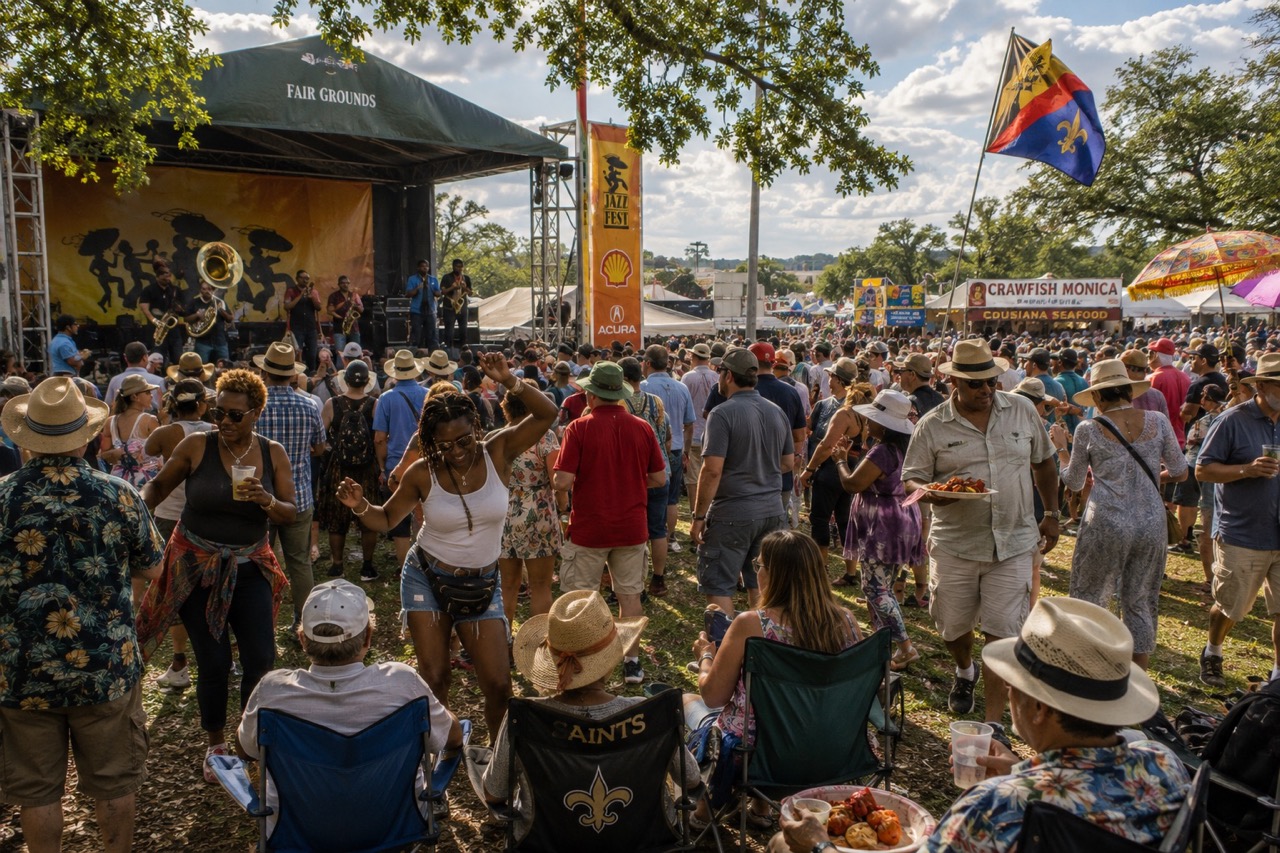
The Fair Grounds contains more possibilities than any single day can hold.

Stages operate simultaneously. The daily performance grid—commonly called the cubes—turns time into a field of competing choices. A major headliner may begin while a gospel choir reaches its final songs, a zydeco band fills a dance floor and a culture bearer explains the work behind a tradition elsewhere on the grounds.

Trying to win against that schedule produces the weakest Jazz Fest experience.

Choose several performances that matter, then leave space between them. New Orleans fills that space quickly. A brass band may cross the route. A voice from a smaller stage may change the direction of the walk. Someone carrying an unfamiliar dish may send lunch in pursuit of its source.

The grounds combine open stages, tents, heritage areas, food zones and craft markets. Distances are manageable, but crowds, heat and mud can make movement slow. Headliner audiences gather early and become increasingly difficult to cross.

Different areas ask for different behavior. The Gospel Tent rewards complete attention. Cajun and zydeco music may pull listeners toward dancing. Interview stages allow musicians and tradition bearers to provide context that performance alone cannot carry.

The festival does not reveal itself through the number of stages visited.

It begins when the visitor stops counting.

Festival Highlights

  • The Grand Marshal parades and second-line movement restore circulation to a festival built from stationary stages.
  • A brass band creates the rhythm. Social aid and pleasure clubs move with practiced style and collective presence. Spectators may join behind the recognized participants when invited by the shape of the procession, but cameras should not obstruct the people carrying the tradition.
  • Black Masking Indians bring extraordinary visual and musical work onto the grounds. Suits can require months of beading, sewing, design and community labor. Look beyond the immediate spectacle. The work carries neighborhood affiliations, family teaching, competition, remembrance and histories shaped within Black New Orleans.
  • The Gospel Tent changes the scale without requiring an open field. Choirs, quartets, soloists and congregational energy fill the space until performer and audience begin sustaining one another. Enter between songs when possible, remain respectful of worshipful moments and do not treat emotional expression as material collected for a photograph.
  • The Fais Do-Do area gives Cajun music and zydeco room to be experienced through dancing as well as listening. Watch how regulars move before joining. The floor becomes more welcoming once rhythm replaces self-consciousness.
  • The cultural and heritage stages provide interviews, demonstrations and conversations that make invisible work audible. A musician can explain how a style travels between generations. A cook can return a familiar dish to its history. A culture bearer can name distinctions that the main programme has no time to teach.
  • The headliners still matter.
  • They simply stop being the only measure of what mattered.

Getting There & Around

Where It Happens

The Fair Grounds Race Course occupies a neighborhood landscape rather than an isolated festival campus.

The racetrack’s oval contains the largest performance fields while permanent structures, paddocks and surrounding spaces hold tents, interviews, food and heritage programming. Once filled, the grounds behave less like a conventional venue than a temporary city whose districts are identified by sound.

Congo Square evokes the Black musical and cultural histories associated with the gathering place near today’s Louis Armstrong Park, where enslaved and free people of African descent once assembled, traded and sustained practices of music and dance. Its festival namesake carries that history into contemporary performances without replacing the importance of the original location.

The Jazz Tent provides concentration. The Gospel Tent creates its own congregation. Fais Do-Do turns regional music into social movement. The Louisiana Folklife areas bring craft, practice and explanation together.

Outside the gates, the surrounding neighborhoods absorb pedestrians, bicycles, informal gatherings and the unavoidable inconvenience created by a major event. Residential porches are not public viewing stands. Driveways are not festival parking.

Return to the city after the Fair Grounds closes, but resist treating New Orleans as an endless extension of the ticketed programme.

People live inside the place visitors experience as music.

That is why the music has somewhere to come from.

Getting Around

The weakest Jazz Fest arrival usually begins with a car approaching the Fair Grounds.

Parking is scarce, neighborhood access is controlled and informal spaces may be unreliable or inappropriate. Official shuttles, public transit, bicycles, rideshares and walking provide more practical approaches, depending on the visitor’s accommodation and mobility.

A festival shuttle can simplify the journey from central gathering points, although lines grow near opening and closing. Public buses may be affected by traffic and temporary route changes. Confirm current arrangements shortly before attending.

Cycling can be efficient from nearby neighborhoods. Use designated parking or bicycle services when provided, secure the bike properly and bring lights for the return.

Rideshares work better when the pickup point is placed beyond the most congested streets. Walking several blocks before requesting a car often saves time.

Inside the Fair Grounds, crowd movement becomes the primary transport system. Do not attempt to cross directly through the largest audience near the end of a headline set. Follow the outer routes, accept detours and establish meeting points with companions.

Groups should not expect to remain together all day. Choose a location and time for reunion rather than forcing everyone through the same schedule.

New Orleans already knows how to improvise.

The visitor’s route should be allowed the same freedom.

Visitor Guide

Festival Food & Drink

Smoke, butter, seafood and chile begin rearranging the day before hunger does.

Jazz Fest food is not a concession system placed beside the cultural programme. It is part of the programme. Longstanding vendors prepare regional dishes at a scale that demands extraordinary consistency without allowing the food to lose its identity.

The menu carries Louisiana through wetlands, farms, fishing communities, family kitchens and restaurant traditions. Crawfish enters pasta, bread and sacks. Cochon de lait becomes a po’boy. Andouille deepens gumbo. Mirliton holds seafood beneath a browned surface. Beans, rice, oysters, pecans and cane syrup reveal different parts of the landscape.

Do not wait until the nearest booth becomes the only option.

Study the food list alongside the music schedule. Mark several dishes worth crossing the grounds to find. Split portions when possible so one lunch does not end the exploration. Lines often move with their own logic, and the most famous item is not automatically the one that will belong to your day.

Water must accompany every decision. Beer, cocktails and sweet drinks may soften the heat briefly while making the body less prepared for it. Alternate deliberately.

Once the gates close, New Orleans continues feeding the festival. Eat somewhere that allows the evening to slow. The city does not require every meal to become another event.

### Must Try

• **Crawfish Monica:** Pasta coated in a rich crawfish, cream and spice sauce that has become inseparable from Jazz Fest itself.

• **Cochon de lait po’boy:** Slow-roasted pork piled into French bread and dressed with sauce or slaw.

• **Pheasant, quail and andouille gumbo:** A dark, deeply layered gumbo combining game birds with smoky Louisiana sausage.

• **Crawfish bread:** French bread filled with crawfish, cheese and seasoned sauce, designed for eating between stages.

• **Seafood mirliton casserole:** Louisiana mirliton squash baked with seafood, herbs and breadcrumbs.

• **Soft-shell crab po’boy:** A whole fried soft-shell crab served inside French bread when season and availability align.

• **Red beans and rice:** Slow-cooked beans served over rice, carrying one of New Orleans’ most familiar weekly traditions into the Fair Grounds.

• **Boudin:** Seasoned pork and rice sausage associated particularly with Cajun Louisiana.

• **Praline:** Sugar, cream and pecans cooked into a distinctly New Orleans confection.

• **Mango freeze:** Cold fruit relief that becomes especially persuasive during a hot afternoon.

The final bite disappears quickly.

The knowledge required to reproduce it remains at work.

Budget & Costs

Jazz Fest requires more than a ticket budget.

Single-day admission forms the foundation, with pricing sometimes varying by day or purchase period. Premium viewing and hospitality options can raise the cost substantially without necessarily creating a deeper cultural experience.

Accommodation becomes expensive across both weekends. Reserve early, compare transport routes and calculate the cost of reaching the Fair Grounds before choosing a cheaper room farther away.

Food deserves its own allowance. Prices accumulate quickly when several dishes are shared across the day, but reducing the menu to one hurried meal removes a central part of the experience.

Shuttles, rideshares, evening performances and late meals add another layer. Set an after-festival limit before the city begins offering concerts in every direction.

A moderate visit can combine one or two festival days, public transport, informal meals and free or low-cost music elsewhere in New Orleans. A larger trip may include several days, central accommodation, ticketed night shows and significant food exploration.

Do not measure value by the number of headliners seen.

One afternoon divided between a gospel choir, a brass-band parade, a cook’s demonstration and an unexpected regional musician may contain more of Louisiana than an entire day spent protecting a place near the largest stage.

Tips for First-Time Visitors

Build the day around three anchors rather than ten obligations.

Choose one performance you refuse to miss, one cultural tradition you want to understand more deeply and one food item worth seeking. Leave the remaining hours open.

Download or save the daily schedule before entering. Mobile networks can strain, batteries fade and printed information may be easier to read beneath strong sunlight.

Carry only permitted items. Festival rules concerning chairs, bags, water, shade equipment and cameras can change, so read the current entry policy carefully.

Do not call regalia a costume. Black Masking Indian suits, powwow regalia in appropriate programmes and other culturally specific forms carry identities and responsibilities beyond visual decoration.

Ask before taking close photographs of artists, craftspeople or tradition bearers. A public event does not remove individual boundaries.

Watch the entire performance occasionally. Constant movement creates the illusion of greater experience while reducing every stage to an excerpt.

Wear shoes prepared for dust, grass, pavement and mud. A dry morning can become a wet field quickly. Sunscreen, a hat and a refillable water bottle belong to every forecast.

Eat before becoming exhausted. Sit before the body forces the decision. Shade is a resource, not a weakness.

After the gates close, choose one evening destination. New Orleans offers more concerts than any traveler can reasonably attend after spending the day outside.

Missing something is not a planning failure.

It is proof that the festival remained larger than the plan.

Safety

Heat is the most persistent risk.

Drink water before arriving and continue throughout the day. Alcohol, caffeine and sugary drinks do not replace hydration. Headache, dizziness, nausea, confusion and stopped sweating can signal heat illness and require immediate attention.

Sun protection should begin before the gates open. Wear a hat, apply sunscreen repeatedly and use shaded tents as recovery spaces.

Rain creates a different Fair Grounds. Grass becomes mud, pathways grow slippery and temperatures may fall. Bring a permitted lightweight rain layer and shoes that can remain secure in soft ground. Follow instructions during lightning or severe weather.

Protect hearing, especially near powerful speaker systems and for children. Earplugs preserve the ability to enjoy several days of music.

Crowds become most compressed before major performances and immediately after closing sets. Identify exits, avoid forcing movement against dense audiences and establish a meeting point in case companions separate.

Keep medication, identification and essential supplies with you. Do not rely on returning quickly to a distant locker, vehicle or hotel.

New Orleans continues after dark, but fatigue changes judgment. Use well-traveled routes, arrange transport from recognized locations and avoid carrying more cash than necessary.

The festival rewards endurance.

It does not require proving it.

Cultural Significance

The word “heritage” can suggest something completed.

New Orleans refuses that definition.

The city’s musical traditions emerged through African diasporic creativity, Black community life, Caribbean connections, European forms, Indigenous presence and generations of adaptation under conditions that included slavery, segregation, exclusion and commercial exploitation. The resulting music changed the world, often while the communities responsible for creating it struggled to retain ownership, opportunity and space.

Jazz Fest cannot resolve those histories.

It can provide a major platform on which Louisiana musicians, cooks, craftspeople and culture bearers are encountered as active participants rather than decorative evidence of the past.

Its nonprofit ownership also connects the event to educational programmes, grants, community partnerships and cultural initiatives beyond the festival weekends. Proceeds help sustain work in Louisiana, although the relationship should not be simplified into the claim that every ticket directly funds the performer onstage.

The festival’s commercial scale remains part of its complexity. International headliners attract audiences and revenue while commanding attention that can eclipse smaller local stages. Ticket prices, tourism pressure and crowded neighborhoods raise questions about who benefits from a culture celebrated globally.

The answer cannot rest in branding.

It appears in whether young musicians receive instruction, culture bearers retain public authority, local vendors remain economically viable and communities can continue creating beyond the weekend.

Heritage survives when admiration becomes support.

Plan Your Journey

When to Go

Jazz Fest occupies the height of New Orleans spring, when heat and humidity are becoming serious but summer has not fully settled over the city.

The festival generally unfolds across two long weekends. Each day carries its own lineup, and tickets commonly provide admission to a particular festival day rather than unrestricted movement across the entire run.

Choose days by examining the full programme, not only the largest type.

A headline act may justify one visit. Another day may contain a deeper concentration of Louisiana performers, gospel, brass bands or regional music that cannot be encountered together elsewhere. Travelers attending for several days should vary their approach rather than repeating the same route between main stages.

Weekdays can feel marginally less compressed than peak weekend periods, although any major performance can reshape the crowd. The second weekend often carries greater demand and a sense of culmination, but the first does not function as a rehearsal.

Arrive in New Orleans before the first festival day. The city requires orientation, and the Fair Grounds requires stamina. A quiet evening, an early meal and sufficient sleep will contribute more than another hurried attraction.

Leave time after the final day if possible.

Jazz Fest trains the ear. New Orleans sounds different once the grounds have taught the visitor what to notice.

Where to Stay

Mid-City places visitors close to the Fair Grounds and within neighborhoods that feel connected to the daily geography of the event. Rentals and accommodation should be legally operated and chosen with respect for residents whose streets already absorb substantial festival pressure.

Bayou St. John offers a particularly attractive base for walking or cycling where conditions and access allow. Its waterways, neighborhood restaurants and proximity to the grounds keep the festival connected to ordinary New Orleans life.

The French Quarter provides historic atmosphere, dense dining and considerable nightlife. It is farther from the Fair Grounds than many first-time visitors expect, and late-night noise can undermine the sleep required for another full festival day.

The Central Business District offers larger hotels, easier transport connections and a more predictable return after evening shows. It suits travelers who want access to the Quarter without remaining inside its busiest streets.

The Marigny and Bywater appeal to visitors planning extensive live music after the festival. They create a longer daily journey to the Fair Grounds, however, and the temptation to stay out until morning can collide with the next day’s heat.

Choose accommodation according to the route home.

At the end of a long Jazz Fest day, a dependable shuttle stop or short walk matters more than a romantic idea of the neighborhood.

Bottom Line & Key Days

Bottom Line

The largest crowd turns toward the exits.

Across the field, stages are being cleared. Empty bowls gather beside food booths. Mud has dried around the edges of shoes. Somewhere beyond the Fair Grounds, musicians are already preparing to play again that night.

A smaller sound remains.

A drummer is completing the final pattern. Nearby, a child watches the hands rather than the stage. The movement is too quick to imitate immediately, but the child continues watching after other people begin to leave.

That is how much of New Orleans arrived here.

A musician once listened before playing. A cook learned the moment when a roux had become dark enough. A bead was placed beside another until a suit carried an entire year of work. A song entered one generation because the previous one performed it within reach.

The festival cannot preserve any of those traditions by itself.

It can gather the people who are still doing the work. It can give them stages, kitchens, markets, audiences and another chance to be heard. Then the gates close, and everything depends upon what continues elsewhere.

The final note leaves the Fair Grounds.

Someone already knows enough to answer it.

Key Days

Opening day carries the pleasure of a festival beginning before routines have settled. Grounds feel newly arranged, vendors establish their rhythm and returning visitors recognize what has changed.

The first weekend provides a complete Jazz Fest experience rather than a preliminary version. Its programme includes major performers, Louisiana traditions, food, craft and heritage events across every scale.

Weekday sessions, when included between peak weekend dates, can offer a slightly different crowd rhythm. A famous headliner may still fill the grounds, but the approach to smaller stages can feel less pressured.

The second weekend extends the programme with an entirely new set of choices. Many travelers prefer it for its sense of culmination, while others attend both weekends to understand how completely the festival can renew itself without moving location.

Each day includes its own conflicts. Study the cubes only after deciding what kind of day you want: exploratory, dance-centered, food-led, heritage-focused or anchored by one essential performance.

The closing Sunday often carries gospel, celebration and accumulated exhaustion into the final hours. Musicians finish. Vendors serve the last available portions. People who have followed the festival for days begin recognizing that there will be no successful way to complete it.

One final song ends.

Several others remain unheard.

Ready to Experience New Orleans Jazz & Heritage Festival?

You've explored what makes this festival special. Now it's time to plan your trip. Compare flights, book your hotel, arrange transportation, and take care of your travel essentials—all in one place.

✈ Find Flights

Loading booking widget...

Booking is completed on Expedia in a new tab.

🏨 Find Hotels

Search places to stay

Powered by Booking.com

Booking is completed on Booking.com in a new tab.

Rail & Bus Travel

Compare train and coach routes for the journey.

Compare Routes

Things to Do

Discover tours and attractions before or after the festival.

Explore Experiences

eSIM Mobile Data

Stay connected abroad without traditional roaming charges.

Get an Airalo eSIM

Travel bookings are provided by our trusted partners. We may earn a commission when you book through these links, at no additional cost to you.

Independent Editorial Standards

Every Follow the Festivals guide is independently researched and regularly reviewed using official festival information, destination resources, and trusted travel references. We also welcome verified updates from festival organizers, destination marketing organizations, tourism partners, and local experts to help keep our guides accurate, current, and useful for travelers.

Represent this festival or have a verified update to share? We'd love to hear from you through our contact page.

Photo Credits