
Follow the Festivals

Spoleto Festival USA

Spoleto Festival USA

Charleston, United States

2027-05-28 - 2027-06-13

The Story

Festival Overview

The audience enters through doors built for another century.

Inside, musicians tune beneath an old ceiling. Programs open. Conversations soften. Beyond the walls, Charleston’s church steeples, narrow streets and preserved façades remain arranged in the beauty for which the city is famous.

Then the performance begins.

Spoleto Festival USA is an annual performing arts festival that fills Charleston with opera, theater, dance, chamber music, orchestral and choral work, jazz and contemporary performance for more than two weeks each spring. Internationally established artists appear beside emerging performers, new productions and work rarely encountered elsewhere.

The festival was founded as an American counterpart to the Festival of Two Worlds in Spoleto, Italy. Charleston was chosen for its concentration of theaters, churches and intimate performance spaces, as well as its ability to let audiences move between them through the city.

Those venues provide more than atmosphere.

Charleston’s architecture emerged from histories of port wealth, slavery, racial hierarchy, religion, war and deliberate preservation. Not every Spoleto performance addresses those histories, but none enters a neutral city. New work occupies old rooms, and audiences return to the streets carrying whatever the art has disturbed, illuminated or left unresolved.

The buildings preserve Charleston’s appearance.

The festival allows the present to enter.

Why This Festival Is Special

Historic cities are often asked to remain visually unchanged.

Performing art cannot do that.

A singer alters the air inside a church. A dancer makes the dimensions of a stage newly visible. Experimental theater places contemporary language inside a room whose elegance may suggest continuity more easily than conflict.

Charleston was an important colonial port and one of the principal centers of the American slave trade. Its wealth, architecture and social order were shaped by enslaved African labor and by systems whose legacies continued through segregation and exclusion.

That history does not mean every performance must become an interpretation of the city.

The relationship can remain quieter.

A work about exile acquires another resonance after a walk past the harbor. An opera concerned with authority enters a city built through unequal power. A performance by Black artists may speak differently within a place where Black creativity has long flourished while recognition and control were distributed unequally.

Spoleto’s artists do not arrive merely to decorate Charleston.

They inhabit it temporarily.

The strongest visits allow that inhabitation to change how the old rooms—and the city surrounding them—are seen.

Festival Experience

What to Expect

Spoleto is a curated season rather than a single continuous gathering.

Performances take place across theaters, churches, concert halls, courtyards and outdoor spaces throughout Charleston. One day might begin with chamber music, continue with experimental theater and end with jazz, opera or dance. The following day can follow an entirely different artistic language.

The programme changes substantially each year.

Opera productions, international theater, major dance companies and limited-capacity performances often generate the strongest advance demand. Chamber music and other recurring series may offer several opportunities to attend, though individual programmes can vary across the run.

The festival rewards breadth, but accumulation has limits.

Three substantial performances can fill an entire day once walking, meals, queues and emotional concentration are included. Scheduling four or five may create an impressive ticket folder and a diminished experience.

Charleston reappears between every curtain. Audiences cross shaded streets, pause beneath live oaks, enter restaurants and gather outside the next venue. Heat, humidity and sudden rain shape those transitions.

Spoleto Festival USA must also be distinguished from Piccolo Spoleto. The city-operated companion festival expands the season through additional performances, exhibitions and community programming under its own schedule and ticketing structure.

Together they intensify Charleston’s cultural calendar.

They are not the same programme.

Festival Highlights

  • Opera remains one of Spoleto’s defining ambitions.
  • Productions may revive neglected works, introduce premieres or approach familiar repertoire through new staging. Attend with enough time to read the synopsis, but leave room for the production to complicate what the summary promised.
  • Theater often provides the festival’s sharpest unpredictability. International companies, new writing and unconventional forms can make a modest room more adventurous than the largest hall.
  • Dance reveals how architecture contains bodies. Grand stages support large companies, while smaller venues make breath, impact and silence unusually close.
  • Chamber music creates a recurring ritual. Artists, repertoire and combinations change across programmes, encouraging audiences to return and listen as musical relationships develop throughout the festival.
  • Choral and sacred music gain particular force inside Charleston’s churches. The setting may intensify the work, but visitors should remember that these buildings can remain active religious spaces rather than acoustical objects.
  • Jazz loosens the festival’s formal edges. Improvisation makes each performance visibly dependent upon listening, response and decisions occurring in the moment.
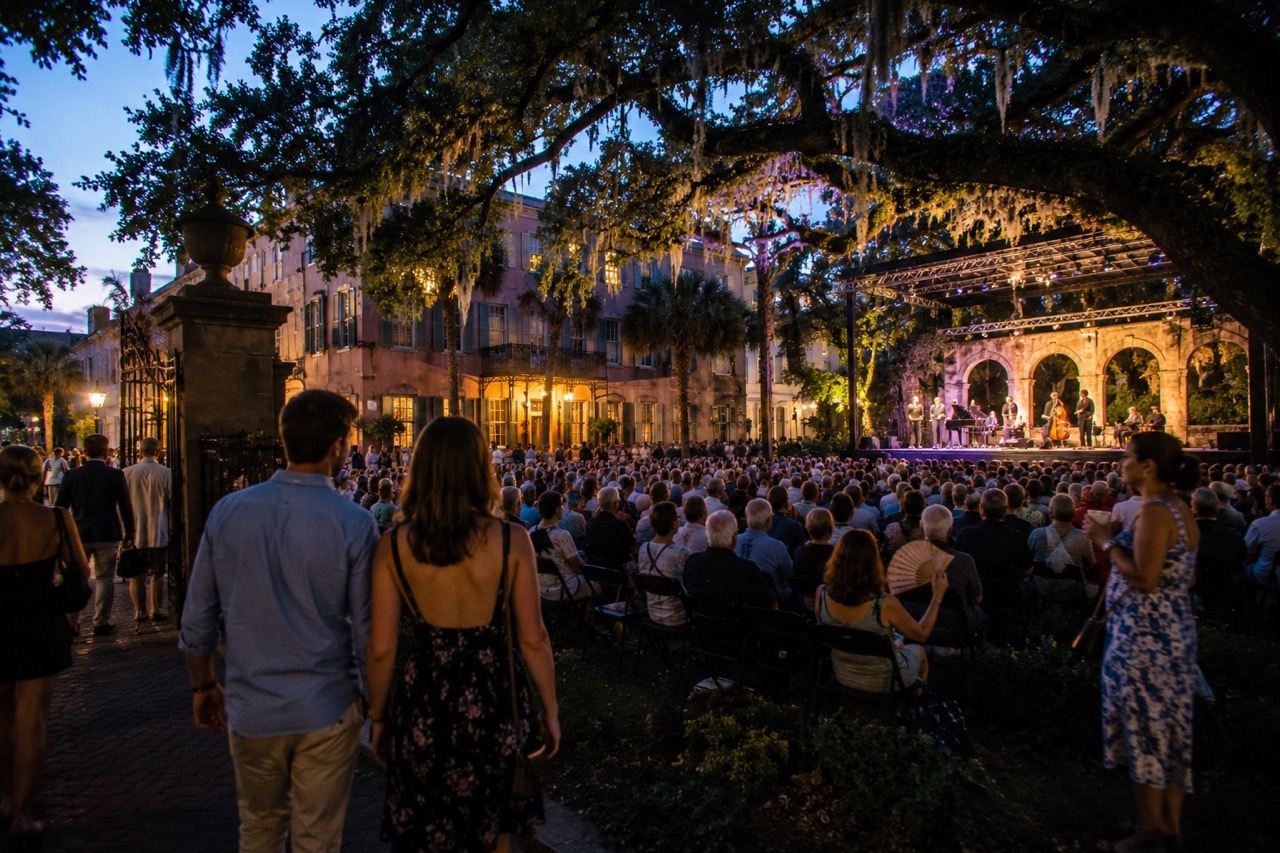
  • Outdoor concerts at the Cistern Yard place performers beneath live oaks and open sky, where weather, evening light and the historic campus enter the experience.
  • Do not select every highlight by scale.
  • Spoleto’s smallest room may create the performance that follows you farthest.

Getting There & Around

Where It Happens

The festival does not have one center.

The Charleston Gaillard Center accommodates large opera, dance, orchestral and featured productions with the infrastructure of a modern performance hall.

Dock Street Theatre offers intimacy within a building whose present form carries layers of theatrical and architectural reconstruction. Audiences enter through Charleston history before a performer speaks.

College of Charleston venues connect the festival to an active urban campus. The Cistern Yard becomes especially memorable after sunset, when live oaks, brick buildings and open air gather around the stage.

Festival Hall provides flexible space for work that may demand different relationships between audience and performer.

Churches across the peninsula offer acoustics and atmosphere shaped by worship. Their beauty should be encountered alongside their congregational histories, including the racial and denominational boundaries that influenced Charleston’s religious geography.

Mother Emanuel AME Church carries particular national and local significance through its history as a center of Black religious life, resistance and community, as well as the racist mass killing committed there. Any public programme held within it requires a level of attention beyond venue appreciation.

The streets connect these rooms.

Walking from one performance to another is where Charleston becomes more than a backdrop.

Getting Around

Most central venues can be connected on foot.

That does not make every schedule practical.

Charleston blocks may be short, but heat, humidity, uneven pavements, crowds and sudden rain alter travel time. Add space for leaving one venue, using restrooms, collecting tickets and entering the next.

Historic surfaces can create mobility challenges. Review each venue’s accessible entrance, seating, restroom and drop-off arrangements before purchasing a tightly connected series of performances.

Public transit and free downtown circulator services may help with longer movements across the peninsula. Routes and operating hours should be confirmed for the festival period.

Rideshares become less efficient immediately after major performances. Walk a block or two away from the main exit when safe and appropriate before requesting pickup.

Driving between venues is usually the weakest plan. Parking availability changes, garages may require a long exit and street spaces rarely align with performance timing.

Bicycles can be useful for experienced urban riders, though heat, formal clothing and nighttime visibility require consideration.

Let walking become part of the festival.

A performance should have time to follow the audience outside before another one begins.

Visitor Guide

Festival Food & Drink

Charleston’s meals carry histories longer than the interval between performances.

Rice once generated enormous Lowcountry wealth through the agricultural knowledge and forced labor of enslaved Africans and their descendants. Gullah Geechee foodways sustained connections among West African techniques, coastal ingredients and communities formed across the Sea Islands and surrounding region.

Okra thickens. Benne adds nuttiness. Field peas, greens, crab, oysters and shrimp enter dishes shaped by season, water and inherited judgment.

The city’s contemporary restaurants approach those traditions in different ways. Some preserve family practices. Others reinterpret Lowcountry ingredients through modern kitchens. The most expensive dining room does not automatically provide the deepest encounter.

Structure meals around attention.

A light breakfast belongs before chamber music. Lunch should leave enough time to discuss what the morning unsettled. Before an evening production, choose food that will not force a hurried walk to the venue. After the final curtain, allow conversation to become part of dinner.

Do not reduce Gullah Geechee cuisine to a fashionable influence on Charleston food. Seek restaurants, cooks and cultural institutions that name the people responsible for carrying those practices.

### Must Try

• **Shrimp and grits:** Coastal shrimp served over ground corn, with preparations ranging from restrained to richly sauced.

• **Hoppin’ John:** Field peas and rice seasoned into a dish with deep Lowcountry and West African connections.

• **Red rice:** Rice cooked with tomato and seasoning, associated particularly with Gullah Geechee foodways.

• **Okra soup:** Okra simmered with tomato, meat or seafood in a dish carrying strong West African lineage.

• **She-crab soup:** Rich crab soup traditionally finished with sherry, closely associated with Charleston dining.

• **Frogmore stew:** Shrimp, sausage, corn and potatoes boiled together; despite the name, it is not a conventional stew.

• **Oysters:** Served roasted, fried or raw according to season and preparation.

• **Benne wafers:** Thin sesame cookies whose principal ingredient reflects crops brought through the African diaspora.

• **Deviled crab:** Seasoned crab mixture baked inside a shell or dish.

• **Carolina Gold rice:** A historic rice variety revived through agricultural and culinary preservation.

Charleston often presents its food as hospitality.

The ingredients remember who made that hospitality possible.

Budget & Costs

Spoleto can become expensive through accumulation.

Each performance generally requires its own ticket. Major productions and premium seating cost more, while smaller events, selected programmes and some public activities may provide more accessible entry points.

Choose one premium experience rather than purchasing the highest seating category everywhere. Intimacy, acoustics and artistic quality do not always increase with price.

Accommodation on the peninsula becomes another major expense. Staying within walking distance can justify a higher room rate by reducing transport, parking and lost time between performances.

Meals vary from informal counters to nationally recognized dining rooms requiring advance reservations. Balance one planned dinner with flexible lunches and neighborhood restaurants.

Piccolo Spoleto and community programmes can broaden the itinerary at lower cost, but their separate tickets still require budgeting.

Museum admission, local transport and service charges should be included before the performance schedule grows.

A moderate trip might combine two festival tickets, one recurring music programme, a Piccolo event, walking and informal meals across several days. A premium itinerary can include opera, major dance, donor events, central accommodation and formal dining.

The purpose is not to see enough performances to justify the journey.

It is to give each chosen work enough space to matter.

Tips for First-Time Visitors

Choose one essential production first.

Build the remaining programme around it by adding a different discipline, a smaller venue and at least one work selected through curiosity rather than recognition.

Check every running time. “Evening performance” does not reveal whether dinner is possible afterward or whether another curtain can be reached safely.

Avoid booking more than three substantial events in one day. Two performances with a meal, museum visit or long walk between them may create a fuller experience.

Do not judge value by production scale. An intimate concert can demand as much attention as opera.

Read enough background to enter unfamiliar work without fear, but do not search for an interpretation that tells you what the performance is supposed to mean.

Dress for the weather and the room. Charleston audiences range from casual to elegant depending upon the production, but breathable clothing and comfortable walking shoes remain practical. Carry a light layer for strongly cooled interiors.

Arrive early at historic venues. Entrances, lobbies and seating layouts may be less forgiving than those of a purpose-built contemporary hall.

Keep Spoleto Festival USA and Piccolo Spoleto tickets organized separately. Their box offices, policies and programmes are distinct.

Leave one opening in the itinerary.

The work that was not part of the original plan may become the reason the festival remains.

Safety

Heat and humidity are the most consistent physical concerns.

Walk slowly, hydrate throughout the day and use shaded routes when possible. Historic Charleston encourages long periods outside without always making exertion obvious.

Thunderstorms can develop quickly. Outdoor performances may delay, relocate or cancel according to weather conditions. Read the specific policy before attending and follow staff instructions around lightning.

Uneven sidewalks, steps and historic entrances require attention, especially after dark or during rain. Visitors with mobility needs should confirm accessible routes directly with the venue.

Protect hearing during amplified performances and carry essential medication rather than leaving it at accommodation between events.

Crowds are generally dispersed across the city, but major productions release many people onto narrow pavements simultaneously. Step away from entrances before stopping to arrange transport or discuss the performance.

Charleston’s waterfront climate can also bring mosquitoes. Repellent is useful for outdoor evening programmes.

Cultural safety requires awareness at churches, memorial spaces and sites connected to slavery or racial violence. Do not treat them as atmospheric settings for personal photographs.

Some rooms hold more than the performance scheduled inside them.

Cultural Significance

Spoleto changed Charleston.

It helped establish the city as an international arts destination, supported the restoration and development of performance venues and created a spring season in which ambitious artistic work could occupy the historic peninsula at exceptional density.

Charleston also changed Spoleto.

The city’s scale made movement between disciplines unusually intimate. Its architecture provided atmosphere and acoustics unavailable on a conventional festival campus. Its history placed international work inside an American city whose beauty and violence cannot be separated honestly.

That relationship continues to carry questions.

Who is represented onstage? Who can afford repeated tickets? Which local communities encounter the festival as participants rather than workers or surrounding residents? When Charleston’s history appears in a production, who retains authority over its telling?

Works connected to Gullah Geechee life, African American history or Charleston subjects require more than local imagery. They enter fields of authorship, memory and representation shaped by people whose culture was often used without equal control.

Spoleto’s significance lies partly in its ability to hold these questions without requiring every production to answer them.

A performing arts festival should not turn a historic city into a motionless museum.

It should make the rooms available to voices the architecture could not have anticipated.

Plan Your Journey

When to Go

The festival traditionally begins in late spring and continues for more than two weeks, extending across several weekends.

Opening weekend brings premieres, ceremonial energy and audiences arriving with the entire season ahead. It suits travelers who enjoy beginnings and are willing to encounter work before broader reactions have formed.

The middle of the festival can offer the most balanced experience. Productions are established, the city has settled into its performance rhythm and several disciplines may be combined without the emotional pressure of opening or closing.

The final weekend carries culmination. Closing performances and returning audiences create a stronger sense that the temporary artistic city is about to disappear.

Weekday visits may provide greater accommodation availability and slightly easier restaurant access, although popular performances can sell strongly on any night.

Allow at least three days. One should include a major production, one an intimate musical experience and one a performance selected because it lies outside familiar taste.

Late-spring Charleston is warm, humid and vulnerable to sudden rain. Outdoor programmes require flexible clothing and attention to weather policies.

Arrive before the first performance rather than on the same afternoon.

The city should be entered before art begins rearranging it.

Where to Stay

Charleston’s historic peninsula provides the most useful base.

Staying downtown allows many venues to be reached on foot and gives performances room to remain in conversation with the streets between them.

The French Quarter places visitors near historic theaters, churches, galleries and the city’s most visited architecture. It offers exceptional convenience but commands premium prices and can feel heavily shaped by tourism.

The area around Marion Square provides access to hotels, restaurants and several routes across the peninsula. It is practical for travelers attending venues in different directions.

Cannonborough-Elliotborough offers neighborhood restaurants and a less formal atmosphere northwest of the historic core. Walking distances grow, but the route can reveal a Charleston beyond the most polished façades.

Staying across the rivers in Mount Pleasant or West Ashley may reduce accommodation costs while making every performance dependent upon bridges, traffic and parking. It works better for travelers attending one event per day than for those moving among several venues.

Choose the room from the programme map.

A beautiful hotel becomes inconvenient when the final performance ends far across the peninsula and rain has closed the distance emotionally, if not geographically.

Bottom Line & Key Days

Bottom Line

Applause fills a room that stood before anyone imagined the work performed inside it.

The artists return once. Lights rise. Programs fold. The audience moves through the doors and into Charleston’s warm night.

Outside, the building appears unchanged.

Its columns retain their order. Church towers hold the skyline. Brick walls return the day’s stored heat. Carriages pass streets whose beauty can make history look settled.

But the performance has entered the walk.

A line spoken onstage follows the harbor. A dancer’s movement changes the scale of a courtyard. Music heard beneath an old ceiling remains present when the audience passes buildings raised through wealth that other people were forced to create.

Tomorrow, another company will enter another room.

Charleston will offer its beauty, acoustics and history. The artists will bring voices the original walls could not have anticipated. Neither will leave the other entirely untouched.

The buildings preserve the city’s appearance.

What enters them keeps changing how it is seen.

Key Days

Opening day introduces the festival through public ceremony and the first major performances. It provides the clearest sense of Charleston entering an altered cultural season.

Opening weekend brings premieres, high demand and the energy of work being encountered before consensus forms.

Weekdays support a more measured rhythm. Chamber music, theater, exhibitions and evening performances can be connected without the density of a peak weekend.

The middle weekend often provides the widest sense of continuity. Artists and audiences have settled into the city while substantial parts of the programme remain ahead.

Closing weekend carries final performances, returning artists and the recognition that the temporary occupation of Charleston’s stages is ending.

Individual productions follow their own schedules. Some appear once. Others repeat throughout the festival. Outdoor concerts and special events may require separate weather planning.

Piccolo Spoleto unfolds alongside the principal festival under its own calendar. Use it to widen the experience rather than fill every remaining hour.

A complete visit does not require opening or closing night.

It requires enough silence after one performance for the next choice to remain voluntary.

Book Your Festival Trip

You've explored what makes this festival special. Now it's time to plan your trip. Compare flights, book your hotel, arrange transportation, and take care of your travel essentials—all in one place.

Tickets

Check current ticket availability and prices.

Check Tickets →

✈ Find Flights

Loading booking widget...

Booking is completed on Expedia in a new tab.

🏨 Find Hotels

Search places to stay

Powered by Booking.com

Booking is completed on Booking.com in a new tab.

Rail & Bus Travel

Compare train and coach routes for the journey.

Compare Routes

Things to Do

Discover tours and attractions before or after the festival.

Explore Experiences

eSIM Mobile Data

Stay connected abroad without traditional roaming charges.

Get an Airalo eSIM

Travel bookings are provided by our trusted partners. We may earn a commission when you book through these links, at no additional cost to you.

Independent Editorial Standards

Every Follow the Festivals guide is independently researched and regularly reviewed using official festival information, destination resources, and trusted travel references. We also welcome verified updates from festival organizers, destination marketing organizations, tourism partners, and local experts to help keep our guides accurate, current, and useful for travelers.

Represent this festival or have a verified update to share? We'd love to hear from you through our contact page.

Photo Credits