Follow the Festivals

Jaipur Literature Festival

Jaipur Literature Festival

Jaipur, India

2027-01-14 - 2027-01-18

The Story

Festival Overview

A speaker stops in the middle of a sentence.

The audience waits.

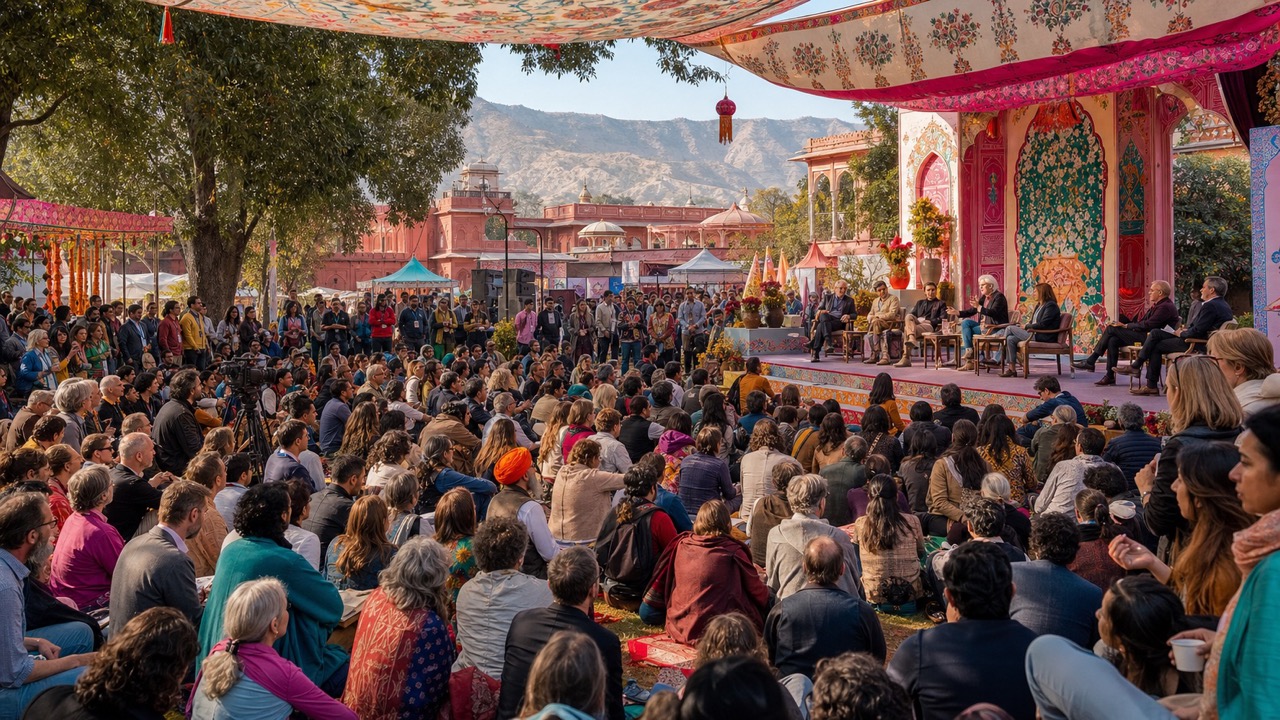
Beyond the festival grounds, Jaipur is fully awake. Traffic moves along Jawahar Lal Nehru Marg, auto-rickshaws press into gaps and market streets grow louder beneath pink façades. Inside the session, thousands of people remain quiet enough to hear the pause.

Then the sentence continues.

The Jaipur Literature Festival brings writers, poets, historians, journalists, translators, scientists and public thinkers together across several stages. Conversations move from fiction to politics, language, biography, art, music and the histories carried between them.

Readers arrive with marked programmes and books already waiting to be signed. Students sit wherever space remains. Friends separate after discovering that two essential sessions have been scheduled at the same time.

Some follow the largest names. Others enter a smaller session because the title catches their attention, then leave carrying a book they had never intended to buy.

Why This Festival Is Special

Books are usually encountered in private. A reader turns the pages alone, hears the voice internally and decides what to believe without an audience watching.

In Jaipur, that exchange becomes public.

Writers read their work aloud. Translators explain the choices hidden inside a finished sentence. Historians disagree over the past, novelists discuss people who never existed and journalists defend the words they used to describe real events.

India’s linguistic range gives these conversations particular depth. Hindi, English and other Indian languages share the programme with voices from abroad. A poem may be heard first for its sound and then through translation, revealing what travels easily and what refuses to move without explanation.

The setting adds its own texture. Bright canopies, textiles, books and winter flowers bring Rajasthan’s colour into grounds devoted mainly to listening. Folk musicians and oral performers remind audiences that literature did not begin on the printed page.

A question from the floor can alter the final minutes of a session. Afterward, the answer continues through notebooks, tea queues and books opened before their readers have left the shop.

Festival Experience

What to Expect

Morning begins with music before conversations take over the stages. Jaipur’s winter light reaches the lawns slowly, and jackets worn at entry are often folded over chairs by midday.

Several sessions run at the same time. Large venues fill early when a celebrated writer, political figure or public personality appears, while smaller stages offer closer discussions and more room for audience questions.

General admission has traditionally required advance registration even when entry is free. Check the current entry process and identification requirements, then save the pass offline before reaching the grounds.

By late morning, pathways, food areas and book stalls are busy. A session ending sends hundreds of people toward the next stage, and seats can disappear while the previous audience is still leaving.

The bookshop experiences its own rush after popular appearances. Readers search for the title they have just heard discussed, while signing queues form around authors moving from stage to table.

Festival days are long. Outdoor seating, winter sun, repeated walks and sustained attention can be more tiring than the programme suggests.

Festival Highlights

  • Morning music settles the grounds before the speaking programme begins. Arriving for the first performance provides a quieter introduction than entering after the major stages have filled.
  • Author conversations form the centre of the festival. The best sessions move beyond plot and promotion into research, language, memory and the practical work of writing.
  • Poetry readings change the pace. Hearing a poem in its original language before or after a translation allows rhythm and meaning to arrive separately.
  • Panels on politics, history, environment, science, art and current affairs draw audiences beyond conventional literary interests. These sessions often produce the strongest disagreements and the longest questions.
  • The bookshop turns listening into reading. Browse before the afternoon rush, note which authors are signing and leave space in the bag for discoveries.
  • Visual art, craft, food and evening music extend the programme beyond the stages. Access to concerts or special events may differ from general admission and should be checked separately.

Getting There & Around

Where It Happens

When held at Hotel Clarks Amer, the festival uses outdoor and covered stages, lawns, food areas, book stalls and activity spaces near Jaipur International Airport.

The current address and site map should always be checked. Stage names and layouts can change, and knowing the route between two priority venues may determine whether a seat remains available.

South Jaipur feels different from the historic centre. The broad roads and airport corridor around the festival do not provide the palaces, bazaars and dense streets visitors may imagine when planning a trip to the Pink City.

Hawa Mahal, City Palace, Jantar Mantar and the shops around Johari and Bapu bazaars require a separate journey north. Dedicated time there allows the old city to become more than scenery glimpsed through a taxi window.

Jaipur International Airport is close to the south-city venue area. The railway station lies farther northwest, which makes hotel location more important for visitors arriving by train.

Getting Around

Taxis and auto-rickshaws provide the simplest journeys between most Jaipur neighbourhoods and the festival grounds. App-based services are widely used, although demand rises sharply when the programme ends.

Hotels near Tonk Road, Malviya Nagar and the airport may offer short transfers to a south-city venue. C-Scheme, M.I. Road, Bani Park and the old city require more time, particularly during morning and evening traffic.

Jaipur Metro serves selected parts of the city but may not connect directly with the festival entrance. It is more useful for particular city journeys than as the sole transport plan.

Arrange a fixed pickup point outside the busiest exit before the final session. Drivers may be unable to reach the main gate once crowds and vehicles gather.

Inside the grounds, walking is unavoidable. Stages that appear close on the map take longer to reach when a large audience enters the same path.

Amer Fort, Nahargarh and Jaigarh need dedicated excursions. Each requires travel beyond central Jaipur and should not be placed inside a short festival gap.

Visitor Guide

Festival Food & Drink

Jaipur’s winter mornings begin well with kachori and chai.

A crisp pyaz kachori filled with spiced onion or a hing kachori carrying the warmth of asafoetida provides a substantial breakfast before hours of outdoor sessions. Tea follows, hot enough to make the first wait for a stage more comfortable.

Inside the grounds, the food area serves the programme. Lunch before the busiest afternoon period means shorter queues and more available seating. Waiting until several large sessions finish together can leave little time before the next stage fills.

The city should provide the meals beyond the festival. Dal baati churma deserves an evening without another panel approaching. Baati is broken and covered with ghee before dal is added, while sweet churma completes the plate.

Gatte ki sabzi, ker sangri and papad ki sabzi reveal how Rajasthani kitchens build flavour from gram flour, dried ingredients, yoghurt and spices suited to the region’s climate. Mirchi vada brings heat and crunch to a quick snack, while Jaipur’s sweet shops add ghewar, rabri and laddus.

Tea keeps returning through the day: before the first session, between two stages and after a debate that nobody has finished discussing.

Must Try

• Pyaz kachori: A crisp pastry filled with spiced onion, particularly satisfying before the first morning session.
• Hing kachori: Fried pastry flavoured with asafoetida and spices, commonly served with chutney or potato curry.
• Dal baati churma: Baked wheat baati served with lentils, ghee and sweet crumbled churma.
• Gatte ki sabzi: Gram-flour dumplings cooked in a spiced yoghurt gravy.
• Ker sangri: A preparation of desert berries and beans seasoned with spices.
• Mirchi vada: A large chilli filled with spiced potato, coated in gram-flour batter and fried.
• Ghewar: A latticed Rajasthani sweet soaked in syrup and sometimes topped with rabri.
• Masala chai: Sweet, spiced tea suited to Jaipur’s cool mornings and the pauses between sessions.

Dinner may begin with the session everyone attended and end with the one they wish they had chosen.

Budget & Costs

General registration has traditionally been free, but accommodation, transport, food and books still require a realistic budget.

Hotels close to the venue reduce daily travel costs and protect the morning programme. Heritage properties in central or historic Jaipur may cost more once repeated festival transfers are included.

Food and drinks inside the grounds can be more expensive than comparable meals elsewhere in the city. Breakfast before arrival and dinner after leaving reduce both cost and time spent in queues.

Books create the least predictable expense. A reader planning to buy one title may leave with several discovered through sessions.

Premium access, evening music and special events may require separate payment. Check what each ticket includes rather than assuming every part of the programme falls under general registration.

Shared auto-rickshaws and taxis can keep transport manageable. Leave a separate amount for the final ride, when demand is highest.

Tips for First-Time Visitors

Register before arriving and keep the entry pass available offline. Download the programme, then select a few priority sessions for each day.

Reach major stages early. A seat near the back is more useful than standing outside after the venue has reached capacity.

Stay until the final question when a discussion is holding your attention. Session endings often contain the sharpest exchange because speakers have moved beyond their prepared introductions.

Carry a notebook, water, sunscreen and a light layer for the morning. A portable charger helps when the registration pass and programme are stored on the same phone.

Browse the bookshop early. Popular titles and signing queues become harder to manage after major appearances.

Choose one meeting point for friends attending different stages. Mobile service and crowded paths can make repeated coordination frustrating.

Audience questions should be brief and clear. A question gives the speaker something to answer; a speech gives everyone else less time.

Safety

Crowd pressure is the main festival-specific concern.

Popular sessions fill early, and entrances become congested as one audience leaves while another tries to enter. Follow volunteer instructions, keep exits clear and avoid pushing toward a stage that has reached capacity.

Choose a meeting point before friends separate. Mobile service may slow, and crowded paths make vague descriptions difficult.

Keep phones, wallets and book purchases in a closed bag. Open totes are useful for programmes but less secure in dense queues.

Jaipur’s winter sun can feel mild while still causing dehydration during hours outdoors. Drink water regularly and use sunscreen. Morning layers should be easy to carry once the temperature rises.

Locate medical points and emergency exits on the site map. Anyone feeling faint or overwhelmed should move away from the busiest paths and ask a volunteer for assistance.

After the final sessions, wait inside the managed grounds until the group and return vehicle are confirmed.

Cultural Significance

The Jaipur Literature Festival helped establish the large public literary gathering as a major part of India’s cultural calendar.

Its programme reflects a country where literature does not belong to one language or form. Novels, poetry, oral traditions, translation, journalism, history and public debate share stages, allowing audiences to move between subjects that publishing and academic institutions often keep separate.

Free general access has been central to the festival’s public identity, although registration and premium categories now shape the experience. Students, established writers, casual readers and visitors drawn by a single public figure occupy the same grounds.

The crowds create tension as well as access. Celebrity appearances can overwhelm smaller conversations. Book promotion, sponsorship and intellectual debate share space. A festival intended to open literature to the public must continually manage what happens when the public arrives in extraordinary numbers.

Translation remains one of its most important contributions. India’s many literary languages are not variations of one tradition, and bringing them together requires more than replacing one set of words with another.

Jaipur adds Rajasthan’s oral poetry, folk music, court histories and storytelling traditions to that wider exchange.

Plan Your Journey

When to Go

Reach Jaipur before the first full festival day. The extra time allows the venue, registration and transport route to be understood before the programme begins.

A multi-day stay reveals the festival’s range. One day may lean toward fiction and poetry, another toward history, politics, science or biography. The published programme changes with every edition and should guide the final length of the visit.

Opening days usually provide more room to learn the grounds. Peak attendance brings greater energy, longer queues and more competition for popular sessions.

Keep separate time for Jaipur. The old city, bazaars and forts cannot be fitted comfortably between two panels, and rushing back to the venue weakens both experiences.

Winter mornings can be cold by Rajasthan standards, particularly in outdoor seating areas. Afternoons become warmer in direct sun before the temperature falls again after dark.

Official dates, registration details and the venue should be confirmed before non-refundable bookings are made.

Where to Stay

The festival venue can change, so confirm the official address before choosing accommodation. If it is held at Hotel Clarks Amer, hotels around Tonk Road, Malviya Nagar and the airport shorten the morning journey.

C-Scheme and areas around M.I. Road provide a useful compromise. Restaurants, shops and central Jaipur remain nearby, while the venue can be reached by taxi or auto-rickshaw.

Bani Park offers guesthouses, heritage-style hotels and convenient access to the railway station. It suits travelers continuing elsewhere in Rajasthan, although the daily festival transfer is longer.

A room near the old city places Hawa Mahal, City Palace, Jantar Mantar and the bazaars close at hand. This creates richer mornings and evenings but requires more time in traffic.

The decision depends on which hours matter most. Staying south protects the programme. Staying centrally keeps Jaipur present after the final session.

Confirm the venue before reserving a non-refundable room, since a change of site can alter the usefulness of every neighbourhood.

Bottom Line & Key Days

Bottom Line

The Jaipur Literature Festival turns reading, usually a private act, into several days of public conversation. Writers, translators, historians, journalists and thinkers speak across languages and disciplines while readers carry questions from one stage into the next.

Experiencing it well requires selection rather than endurance. Register early, stay close enough for the morning programme and choose a few conversations worth hearing in full. Give Jaipur separate time beyond the venue, allowing its bazaars, architecture, winter food and Rajasthani traditions to remain part of the journey.

The famous speakers may determine which sessions fill first. The lasting memory often comes from somewhere less expected: a sentence copied into a notebook, a disagreement continued over chai or a book opened before its reader has left the shop.

A speaker pauses.

Key Days

Arrival

Reach Jaipur before the programme begins, confirm the venue and complete any remaining registration. Use the first evening for a quiet meal and an early night.

First Sessions

Enter before the opening programme, learn the stage layout and attend morning music. Browse the bookshop before the largest crowds arrive.

Full Festival Day

Build the day around a few priority conversations, eat before the main lunch rush and leave space for one unfamiliar subject.

Jaipur Day

Give the old city, City Palace, Jantar Mantar, Hawa Mahal or the forts dedicated time rather than fitting them between sessions.

Final Morning

Attend one last complete conversation, collect any remaining books and avoid placing onward travel too close to the closing programme.

Ready to Experience Jaipur Literature Festival?

You've explored what makes this festival special. Now it's time to plan your trip. Compare flights, book your hotel, arrange transportation, and take care of your travel essentials—all in one place.

✈ Find Flights

Loading booking widget...

Booking is completed on Expedia in a new tab.

🏨 Find Hotels

Search places to stay

Powered by Booking.com

Booking is completed on Booking.com in a new tab.

Rail & Bus Travel

Compare train and coach routes for the journey.

Compare Routes

Things to Do

Discover tours and attractions before or after the festival.

Explore Experiences

eSIM Mobile Data

Stay connected abroad without traditional roaming charges.

Get an Airalo eSIM

Travel bookings are provided by our trusted partners. We may earn a commission when you book through these links, at no additional cost to you.

Independent Editorial Standards

Every Follow the Festivals guide is independently researched and regularly reviewed using official festival information, destination resources, and trusted travel references. We also welcome verified updates from festival organizers, destination marketing organizations, tourism partners, and local experts to help keep our guides accurate, current, and useful for travelers.

Represent this festival or have a verified update to share? We'd love to hear from you through our contact page.

Photo Credits